

Requires the superintendent of state police to develop, maintain and disseminate to all members of the division of state police a critical incident leave policy requiring critical incident paid leave for any members directly involved in a critical incident; prohibits such superintendent from taking any punitive administrative action against any member of the division of state police granted critical incident leave solely on the basis of the provision of such leave.
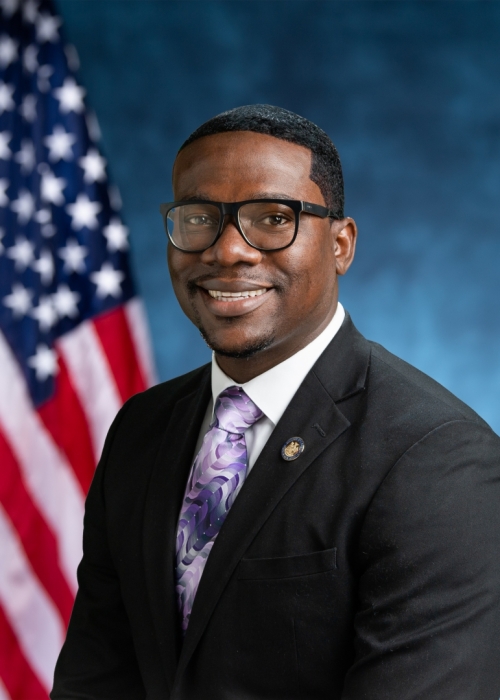
Asm. Demond Meeks
Sponsored bills
Directs the commissioner of education to conduct a survey of recess held in public and charter schools serving students in kindergarten through grade six and to provide any information collected to the governor and the legislature.
Provides for the inclusion of a faculty or staff member on the board of trustees of community colleges elected by and from among the faculty and staff of the college.
Relates to rechargeable battery recycling; adds a battery used as the principal electric power source for an electric scooter or bicycle with electric assist to the definition of "rechargeable battery"; provides that a battery manufacturer may not sell, offer for sale, or distribute rechargeable batteries in the state unless the battery manufacturer is implementing or participating under an approved plan; allows a city with a population of one million or more to enforce through its own agencies.
Enacts the "public renewables transparency act"; relates to the New York power authority's conferral process; requires the conferral report be posted on the authority's website; provides that the authority shall provide an option for stakeholders to submit comments remotely as well, and incorporate feedback from such sessions and written comments into the final draft of the strategic plan; makes related provisions.
Maddy summaryThis bill, the "Responsible AI Safety and Education Act" (RAISE Act), regulates large artificial intelligence (AI) developers who train or use "frontier models" - defined as models requiring over $100 million in computing costs or 10^26 computational operations. It directly affects commercial AI companies (excluding academic researchers) by requiring them to implement safety protocols, conduct risk testing, and report incidents like unauthorized model access or misuse. Key provisions mandate documented safety measures to prevent "critical harm" (defined as serious injury to 100+ people or $1 billion+ in property damage), with remedies for violations. The law also creates specific definitions for terms like "frontier model," "safety incident," and "knowledge distillation" (modified AI models), ensuring clarity for compliance.
Maddy summaryThis bill clarifies the types of damages that can be recovered in wrongful death lawsuits in New York. It specifically allows survivors to seek compensation for funeral expenses, medical costs related to the injury causing death, grief, loss of financial support/services, and loss of nurture/education. The bill also defines who qualifies as "beneficiaries" (including spouses, domestic partners, and those acting as parents) and specifies how damages must be distributed based on each person's financial losses. These changes update existing law to provide clearer standards for compensation without creating new legal rights.
Protects individuals who provide or receive legally protected health activity, including reproductive health care and gender-affirming care, from criminal or civil liability or professional sanctions imposed by jurisdictions outside the state.
Maddy summaryThis bill prohibits food stores and retail establishments from refusing cash payments for in-person transactions, with limited exceptions for cash payments over $20 or remote purchases (phone/mail/internet). It bans charging higher prices for cash payments compared to digital payments and imposes civil penalties of up to $1,000 for first violations, increasing to $1,500 for subsequent violations. Retailers must provide fee-free cash-to-prepaid card conversion devices with receipts, and if these devices malfunction, they must accept cash and display clear signage. The law applies to most retail businesses but excludes banks and trust companies.
Establishes the youth justice innovation fund to make funds available to community-based organizations for services and programs with the purpose of youth development and preventing youth arrest and incarceration.