

Maddy summaryThis bill requires utility companies to submit annual reports listing all utility poles they own in public areas, specifically identifying which ones are currently in use and which are abandoned. It mandates that companies create a plan to remove any unused poles within one year of being identified and authorizes regulators to impose fines of up to $10,000 per pole for each year a company fails to comply. The reports must be shared with state officials and legislative leaders by December 1st each year to improve transparency and clear clutter from public rights-of-way.
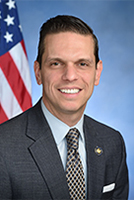
Asm. Angelo Santabarbara
Sponsored bills
Provides for availability of ambulance services and advanced life support first response service to store and distribute blood and initiate and administer blood transfusions, by expanding current provisions for air transport to apply additionally to motor vehicle based ambulance services.
Enacts the "dialogue and decorum act" which establishes the crime of disruption or disturbance of a lawful assembly; makes such crime an unclassified misdemeanor.
Maddy summaryThis bill requires motor vehicle dealerships to receive full and fair payment from their franchisors for all warranty-related work, including repairs, diagnostics, and parts. It mandates that payments for approved claims be made within thirty days and sets a specific method for calculating compensation based on the rates dealers charge their own customers for similar non-warranty services. The law also establishes a process for dealers to declare their reimbursement rates and limits exclusions to items like wholesale parts, tires, and routine maintenance. By defining "reasonable compensation" and outlining dispute resolution steps, the bill aims to ensure dealers are not underpaid for services performed under manufacturer warranties.
Requires an agency responding to a request for public employee disciplinary records to develop a policy to notify the public employee whose personal information is subject to the request.
Requires that applicants not be prohibited from taking competitive civil service exams if they will meet the minimum age requirement or attain the minimum education requirement within twelve months.
Provides that the state civil service department shall review and update the questions contained within the examination, as deemed appropriate by the department, no less than every five years.
Maddy summaryThis bill amends state law to rename the Young Farmer Advisory Board on Agriculture to the Beginning Farmer Advisory Board on Agriculture, thereby broadening its scope to include a wider range of early-career agricultural operators. The legislation expands the board's membership from twenty to twenty-five members and adjusts appointment processes to ensure representation from diverse sectors, including urban farming, veterans, underrepresented groups, and various service providers. Key provisions require the board to meet twice a year, produce biennial reports on policy issues affecting beginning farmers, and offer advice to state agencies on programs related to land access, capital, and economic development. The board members serve without salary but receive travel expense reimbursements, and the act takes effect immediately upon signing.
Maddy summaryThis bill expands state funding for public library construction projects located in economically disadvantaged communities. It increases the maximum state contribution from fifty percent to ninety percent of total project costs for these specific libraries, provided they demonstrate a need to serve areas with high poverty rates or limited fiscal capacity. The legislation also extends the deadline for completing certain projects that were delayed by the state's COVID-19 emergency declaration. Ultimately, the bill aims to help libraries in struggling areas build, renovate, or upgrade their facilities with greater financial support from the state.
Maddy summaryThis bill amends New York's Public Officers Law to allow assistant district attorneys in Schenectady County to live in Schenectady County or any adjoining county within New York State, rather than requiring them to reside specifically within the county. The change applies only to assistant district attorneys and explicitly excludes the chief assistant district attorney, who must continue to meet existing residency rules. Effective immediately upon signing, the legislation removes the previous restriction that limited these legal officials to living within the political subdivision where they serve.