

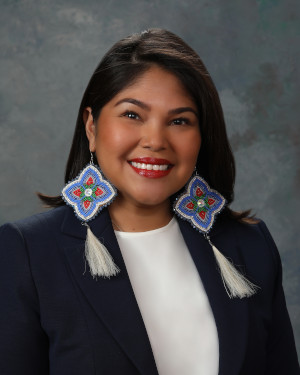
Maddy summarySB 441 requires judges and court personnel in New Mexico to complete annual, evidence-based training on domestic abuse starting in 2026. It updates custody standards to mandate courts consider evidence of child or domestic abuse when deciding custody, including protection orders or arrests. The bill also bars courts from ordering reunification programs or psychological evaluations in contested custody cases where abuse evidence exists - unless the evaluator meets specific qualifications. This directly affects family court proceedings, judges, court staff, and families navigating custody disputes involving abuse allegations.
Sponsored bills
Maddy summarySB 468 proposes appropriating $33 million from the state general fund to create tribal liaison programs in every New Mexico county. The bill directs these programs to provide nonpartisan voter education, translation services, and voter registration drives specifically to improve access to the voting process for Native American communities. Each county would receive funding to support these services, aiming to ensure equal participation in elections. The funding is limited to fiscal year 2026, with any unused funds reverting to the general fund.
Maddy summaryHB 504 amends New Mexico tax law to exclude gross receipts from prime contractors operating specific facilities from certain manufacturing-related tax deductions. It directly affects national laboratories designated by Congress and state-owned research facilities in New Mexico, preventing them from claiming deductions normally available to manufacturers. The bill adds a new exception to existing tax deduction rules (Sections 7-9-46 and 7-9-46.1), specifying that receipts from these facilities cannot be deducted as they would be for other manufacturers. This change aims to align tax treatment for federal and state research entities with standard manufacturing deduction rules. The bill was referred to committees but was postponed indefinitely in June 2025.
Maddy summarySB 306 appropriates $1 million from the state general fund to support new police departments in Valencia County communities with populations under 5,000. The funds cover start-up costs like officer salaries, training, and equipment for these small-town departments during fiscal year 2026. Any unspent funds at year-end must return to the state general fund. This bill directly affects Valencia County communities meeting the population threshold by providing dedicated state funding for local law enforcement infrastructure.
Maddy summaryThis bill clarifies that foster children are not considered residents of foster homes for homeowners insurance purposes. It directly affects foster children, foster families, and insurance providers by preventing insurers from denying coverage based solely on a child's foster placement status. The key provision adds to New Mexico's insurance code to state that minors in foster care cannot be disqualified from premises liability coverage due to their foster status. This creates a specific policy change to ensure consistent insurance coverage for foster children without requiring additional legal or administrative steps.
Maddy summaryThis Senate Joint Memorial (SJM 3) requests the New Mexico Higher Education Department to develop a joint bachelor's degree in elementary bilingual multicultural education across four public universities (UNM, Western NM, NM Highlands, NM State). It also proposes scholarships for students and educators pursuing advanced degrees in bilingual education, increased faculty positions for bilingual programs, and college credit recognition for students with New Mexico’s "state seal of bilingualism-biliteracy." The memorial aims to address a shortage of bilingual teachers, aligning with state and federal mandates like the Martinez/Yazzie court ruling and the Bilingual Multicultural Education Act. It is a non-binding request to state agencies, not a law.
Maddy summarySB 193 requires health insurers in New Mexico to cover at least one injectable weight loss drug (specifically a glucagon-like peptide-1 receptor agonist) for adults with obesity who need long-term weight management. It applies to all group health plans, individual insurance policies, HMOs, and nonprofit health care plans delivered or renewed after January 1, 2026. The law directly affects insured adults with obesity by mandating coverage for these medications and insurers who must add this coverage to their plans. It does not specify which drug must be covered, only that at least one such injectable option must be included in prescription drug coverage.
Maddy summarySB 13 establishes a legal framework for New Mexico to create state-tribal education compact schools operated by tribal nations. It authorizes the Public Education Department to enter into agreements with tribes to establish schools focused on language and cultural preservation, requiring tribes to submit a resolution and application detailing grade levels and compliance. The bill exempts these schools from certain state laws and rules while allowing them to access state and federal funding, and it mandates a five-year compact term with provisions for compliance, dispute resolution, and reporting. This directly affects tribal nations in New Mexico seeking to operate culturally rooted schools within the public education system.
Maddy summarySB 41 creates a "Turquoise Alert System" to rapidly share information about missing enrolled members or eligible members of federally recognized American Indian tribes, pueblos, or nations in New Mexico. The bill requires the Department of Public Safety to develop a plan for issuing these alerts, including notifying law enforcement, media, and cellular providers through existing emergency alert systems. It mandates specific record-keeping for each alert, tracking details like the person's age, gender, and recovery date. This system directly affects tribal communities and law enforcement agencies responsible for implementing the alerts, while distinguishing this category from existing "Silver" (elderly/dementia) or "Brittany" (developmental disability) alerts.
Maddy summarySB 163 prohibits New Mexico public and charter schools from banning students enrolled in or eligible to enroll at federally recognized tribes, pueblos, or nations from wearing tribal regalia at graduation ceremonies and other school events. The bill amends existing school discipline policies to explicitly state that schools cannot restrict "tribal regalia" - defined as traditional dress, symbols, jewelry, beading, or feathers - along with graduation attire or as part of cultural expression. It directly affects Native American students in New Mexico public schools by protecting their right to display cultural items during formal school activities. The law clarifies that such protections are part of broader anti-discrimination policies already in place for students' cultural and religious expression.