

Maddy summaryThis New Jersey bill (S 1067) requires the state's Department of Human Services to conduct a landscape analysis of mental health services accessible to deaf and hard of hearing residents. It mandates that mental health services be provided in a client's primary communication method (like sign language or speech), delivered by professionals certified in that method and trained in culturally appropriate care for the deaf community. The bill also requires the creation of a resource guide listing providers meeting these standards and defines key terms like "culturally affirmative mental health services." It directly affects deaf and hard of hearing individuals seeking mental health care across New Jersey.
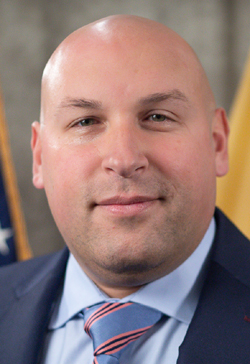
Asm. Mike Venezia
Sponsored bills
Maddy summaryNew Jersey's S 3041 prohibits cooperatives from receiving public works contracts if any member contractor or subcontractor within the cooperative has failed to pay prevailing wages. The bill extends a three-year ban (currently applied to individual contractors) to cover entire cooperatives, meaning a cooperative cannot win contracts if one of its members violates wage laws. It defines a "cooperative" as a business with collective ownership and long-term member control, and includes a process for affected cooperatives to request a hearing if they believe the ban is wrongly applied. The prohibition applies to all cooperative entities with a member on the prevailing wage violation list, lasting three years from the date of listing.
Maddy summaryAJR 122 designates the last weekend in October each year as "Honor Your Hometown Weekend" in New Jersey. It requests the Governor to issue an annual proclamation encouraging public officials and residents to celebrate their hometowns through community events. The resolution also asks the Governor to urge Congress and the President to create a similar national observance. This is a ceremonial resolution with no new laws, funding, or binding requirements - it simply recognizes hometowns as unifying community assets. It affects all New Jersey residents by formally designating a time for local community appreciation.
Maddy summaryThis bill limits certification requirements for career and technical education (CTE) teachers seeking a "Certificate of Eligibility" through the alternate route program. It prohibits the State Board of Education from requiring these teachers to complete educator preparation programs exceeding 200 hours or one academic year (currently 350 hours). The bill also removes the requirement to pass basic skills tests like the Praxis Core if candidates demonstrate proficiency through approved alternatives (e.g., occupational licenses, portfolios). These changes aim to streamline certification for CTE teachers, addressing concerns about program length and cost that have impacted recruitment.
Maddy summaryThis bill requires all public school staff in New Jersey to complete training on caring for students with epilepsy or seizure disorders every two years. It directly affects school staff (including teachers, coaches, and support personnel) and students with these conditions. The training, provided through Department of Health-approved courses by nonprofit organizations, covers recognizing seizures, emergency response, and daily care. This update builds on existing law (P.L.2019, c.290) that already requires schools to develop individualized health plans for affected students but adds the mandatory biennial staff training requirement. The law applies to all school-sponsored activities, including those outside regular school hours.
Maddy summaryThis bill requires New Jersey cosmetology schools to include training on working with textured hair in their curricula for students preparing for licensure as cosmetologists, hairstylists, beauticians, barbers, and hair braiders. Textured hair is defined as hair that is coiled, curly, or wavy, and the training must cover working with various coil, curl, and wave patterns, hair strand thickness, and hair volume. The bill also mandates that the state's licensure examinations include textured hair as part of both written and practical testing components. These requirements will apply to all schools licensed under New Jersey's cosmetology regulations. The bill aims to ensure professionals receive appropriate training for serving clients with textured hair without expanding current training hour requirements.
Maddy summarySJR 100 designates every July as "Cleft and Craniofacial Awareness and Prevention Month" in New Jersey to raise public awareness about cleft lip and palate birth defects. The resolution requests the Governor to issue an annual proclamation encouraging community organizations, medical institutions, and advocacy groups to collaborate on educational programs and research about these conditions. This symbolic measure does not create new laws or funding but aims to foster understanding and support for individuals and families affected by cleft lip and palate.
Maddy summaryThis bill directs New Jersey's Attorney General to establish a program enabling anonymous reporting of potential threats to school safety. The program would provide accessible methods - including a telephone tip line staffed during reasonable hours and a mobile app - for students, parents, school staff, and community members to report unsafe or threatening activities without revealing their identity. Reports would be promptly forwarded to law enforcement or school officials, and the program must include training for schools and law enforcement on handling such reports. The Attorney General would also annually report on the program's usage, including the number of reports, times of reporting, and outcomes.
Maddy summaryThis bill requires New Jersey law enforcement officers to reveal their facial identity during public interactions (e.g., stops, patrols) and present clear identification before detaining or arresting someone. Officers must show one of four acceptable forms of ID: a uniform with agency insignia, a photo ID card, a numbered badge, or verbally state their name and agency. Exceptions apply for undercover work, medical masks with physician approval, smoke protection during emergencies, or situations where revealing ID could compromise investigations, safety, or stealth operations. The law applies to all officers (federal, state, local) and directly affects members of the public during police encounters, aiming to increase transparency during interactions.
Maddy summaryThis bill increases penalties for retailers who sell tobacco or vapor products to people under 21. First violations now carry $500 fines (up from $250), second violations $1,000 (up from $500), and third or subsequent violations $2,000 (up from $1,000). Small businesses with clear compliance policies pay only $100 for the first violation. Five percent of collected fines will fund public education on vapor product dangers and illegal sales. Retailers must also post new signs at points of sale and vending machines warning that selling to minors is prohibited.