

Maddy summaryThis bill (A6286) creates a new crime called "political violence" for acts targeting individuals due to their political affiliation or expression, such as assault, kidnapping, or homicide committed to interfere with or retaliate against political views. It increases penalties for these acts (e.g., upgrading murder to first-degree if politically motivated) and establishes a permissive inference that targeting based on politics implies criminal intent. An independent "Political Violence Review Board" will collect and analyze data on such cases, tracking arrests, charges, trial outcomes, and disparities based on race, gender, or political affiliation. The board aims to identify systemic biases in how law enforcement and prosecutors handle these incidents.
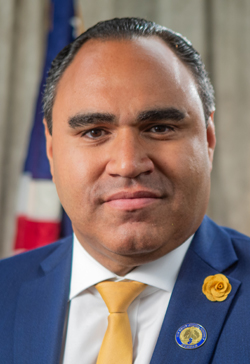
Asm. Gabe Rodriguez
Sponsored bills
Maddy summaryThis bill (A1941) requires the New Jersey Commission on Human Trafficking to expand public awareness signage about human trafficking to 12 new types of establishments, including gas stations, staffing agencies, law enforcement offices, nail salons, and Motor Vehicle Commission offices. The signage must display the national 24-hour human trafficking hotline number and meet specific size (8.5" x 11") and language (English/Spanish) requirements. Businesses failing to comply face civil penalties of $300 for a first offense and $1,000 for subsequent violations. The bill directly affects all covered establishments by mandating visible signage to educate the public on trafficking resources.
Maddy summaryThis bill prohibits public utilities in New Jersey from disconnecting residential electric, gas, water, or sewer service due to non-payment during the coronavirus 2019 state of emergency (declared March 9, 2020) and for 180 days after its expiration. It requires utilities to offer residential customers deferred payment plans with at least 48 months for overdue bills, during which disconnections are banned if customers comply. The policy directly affects residential utility customers facing financial hardship and utilities serving these households. Key mechanisms include mandatory payment agreements and a ban on disconnections for payment delinquency during the specified period.
Maddy summaryThis bill requires New Jersey law enforcement officers to reveal their facial identity during public interactions (e.g., stops, patrols) and present clear identification before detaining or arresting someone. Officers must show one of four acceptable forms of ID: a uniform with agency insignia, a photo ID card, a numbered badge, or verbally state their name and agency. Exceptions apply for undercover work, medical masks with physician approval, smoke protection during emergencies, or situations where revealing ID could compromise investigations, safety, or stealth operations. The law applies to all officers (federal, state, local) and directly affects members of the public during police encounters, aiming to increase transparency during interactions.
Maddy summaryThis bill establishes a $200 million mortgage assistance program administered by New Jersey's Housing and Mortgage Finance Agency. It provides four types of forgivable, zero-interest loans to low- and moderate-income homeowners (defined as those earning ≤50% or 50-80% of local median household income) facing imminent homelessness due to qualifying economic hardships like job loss or medical issues. Assistance includes "deep" subsidies covering all mortgage arrears plus six months' payments for severe delinquency, "moderate" subsidies for any delinquency, "shallow" for imminent risk, and "single" for near-term payment risks. Recipients must commit to living in the home as their primary residence for three years to have the loan forgiven.
Maddy summaryThis bill requires electric utilities to notify pole attachment owners (like cable or phone companies) when a "double utility pole" exists - a damaged or outdated pole still holding attachments after a replacement was installed. Attachment owners must remove their equipment within 10 business days of notification, then confirm removal to the pole owner. The pole owner must then remove the pole itself within 5 business days of receiving confirmation. It directly affects utilities and attachment companies, streamlining the removal process to eliminate outdated infrastructure.
Maddy summaryThis bill allows New Jersey municipalities and other local governments to purchase unused sick leave from their public employees (including elected officials) under specific rules. It limits purchases to 60% of the sick leave's value (based on the employee's annual pension base), caps yearly purchases at 120 hours per employee, and requires employees to retain at least 800 hours of unused sick leave after any purchase. The bill also prohibits using special emergency funds to finance these purchases. It applies to employees covered under New Jersey's Title 11A retirement system.
Maddy summaryThis bill (A6217) requires individuals circulating recall petitions to take an oath by affidavit before an officer authorized to administer oaths in New Jersey. The circulator must verify under oath that they witnessed each signature, confirmed signers are legal residents, and collected signatures in good faith. This applies to all completed petition pages filed with election officials, adding a verification step similar to requirements for nomination petitions. The change aims to strengthen procedural safeguards against petition fraud by requiring in-person oath administration.
Maddy summaryThis bill requires New Jersey's Department of Agriculture to consult with the U.S. Department of Agriculture to identify nonlethal geese control methods and, when lethal methods are needed, prioritize humane options excluding gassing. It mandates state agencies to create public fact sheets detailing these methods and establish agreements with federal partners for implementation. The bill also directs the Division of Fish and Wildlife to develop, within 180 days, best management practices for land management that discourages geese habitats by minimizing natural turf and promoting native plants. These provisions directly affect state agencies managing wildlife and public lands, focusing on coordinated, science-based geese population control.
Maddy summaryThis bill establishes standardized credit transfer rules for New Jersey public colleges and universities, replacing previous "collective agreements" with requirements set by the Secretary of Higher Education. It creates a New Jersey Transfer Ombudsman within the Secretary's office to resolve disputes between students and institutions about credit transfers, conduct compliance reviews every three years, and publish annual reports on transfer outcomes. Public institutions must now provide transfer students with data on program completion rates and ensure associate degrees earned at community colleges are fully transferable toward bachelor's degrees. The changes directly affect students transferring between NJ public colleges and universities, as well as the institutions themselves, by standardizing credit recognition and adding oversight.