

Maddy summaryThis bill requires New Jersey Medicaid managed care organizations to allow any pharmacy in the state to dispense covered medications, directly affecting Medicaid enrollees and community pharmacies. It mandates that MCOs permit all pharmacies to participate without restrictions based on medication cost or other criteria, while ensuring pharmacies cannot be forced to dispense below their acquisition cost. The bill also guarantees enrollees can choose any qualified pharmacy without extra fees and prohibits MCOs from denying pharmacy participation under different terms than other participating pharmacies. These changes aim to expand access to medication options for Medicaid beneficiaries.
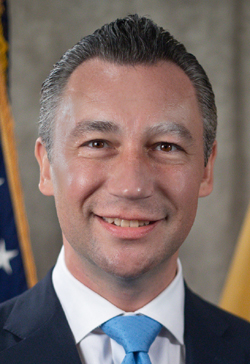
Asm. John Allen
Sponsored bills
Maddy summaryAJR 70 designates December 12 of each year as "Frank Sinatra Day" in New Jersey to commemorate the singer's birthday and his contributions to music, film, and humanitarian work. The bill requests the governor issue an annual proclamation encouraging public officials and citizens to observe the day with appropriate activities. It recognizes Sinatra's New Jersey ties, including his birth in Hoboken, his first recording contract in Camden, and his humanitarian efforts. This is a symbolic, non-binding commemorative resolution with no new laws or funding.
Maddy summaryThis bill (A2501) removes a prohibition that previously prevented restaurants without liquor licenses from advertising that patrons may bring and consume their own alcohol (BYOB) on premises. It allows these restaurants to charge corkage or service fees for patrons bringing wine, beer, cider, or mead, and explicitly includes cider and mead as permitted beverages. The policy change directly affects restaurants operating without on-premises alcohol licenses, which previously faced fines or jail time for advertising BYOB options. The bill responds to a court ruling that found the prior advertising ban unconstitutional under free speech protections.
Maddy summaryThis bill (A2496) clarifies that New Jersey state entities issuing professional or occupational licenses (such as for nurses, contractors, or cosmetologists) cannot require applicants to prove lawful presence in the U.S. or New Jersey to obtain a license. It amends existing law (P.L.2020, c.75) to explicitly state that lawful presence is not a requirement for licensure, while maintaining all other standard eligibility criteria. The law applies to all state departments, agencies, and entities regulating professions or occupations. It takes effect immediately upon passage.
Maddy summaryThis bill designates Vaisakhi (typically falling on April 13-14) and Bandi Chhor Divas (typically in autumn) as official public holidays in New Jersey. It amends state law to add these days to the list of paid holidays for state government employees and to the calendar of public holidays affecting business operations and financial transactions. The bill directly affects state government operations, requiring offices to close on these days, and ensures financial instruments like checks are treated as payable on the next business day if issued on these holidays. It does not change existing holiday provisions or create new obligations beyond the designated holidays.
Maddy summaryThis bill changes New Jersey's process for reappointing administrative law judges. Judges nominated for reappointment after the bill's effective date will receive lifetime tenure, serving until mandatory retirement at age 70. The Senate must provide advice and consent for these reappointments, and the Senate Judiciary Committee will receive judicial evaluations to inform their decision. The bill also makes technical updates to streamline references to the director position in related statutes.
Maddy summaryThis bill (A2499) amends New Jersey law to explicitly permit voters to photograph their own voted ballots in polling booths and share those photos on internet-based social media platforms. It directly affects voters participating in New Jersey elections by adding a specific exception to existing ballot secrecy rules. The key provision clarifies that current prohibitions against showing or inspecting voted ballots do not apply when a voter voluntarily takes and shares a photo of their own ballot. This does not change other voting rules, such as restrictions on others requesting to see ballots or inspecting ballots in polling places.
Maddy summaryNew Jersey Assembly Bill A2498 requires state parks, counties, and municipalities to annually inspect public park water bodies for duckweed (a small aquatic plant that appears as a thick, solid mat on water). If duckweed is found, they must post clear warning signs stating it poses a danger because it can't support weight. The bill also mandates the Department of Environmental Protection to create educational materials about identifying duckweed and provide standardized warning signs to all counties and municipalities. This applies to all public parks in the state and aims to prevent accidents from people stepping on duckweed.
Maddy summaryMarcAnthony's Law criminalizes using defaced or stolen firearms to injure police officers, with different penalties based on the severity of injury. Using such a firearm to cause serious bodily injury is a first-degree crime, while causing bodily injury is a second-degree crime. The law defines a firearm as not defaced if it's merely refinished, rusted, or damaged from ordinary wear and tear without having been used in a crime. It also enhances penalties for defacing firearms (upgraded from third to second degree) and possessing defaced firearms (upgraded from fourth to third degree), with increased prison terms and fines.
Maddy summaryThis bill prohibits sewerage authorities, municipal authorities, and local government units in New Jersey from charging interest on unpaid sewer fees and charges owed by the State, local governments, or their agencies (including housing authorities). It amends existing laws to clarify that interest cannot be charged on these specific unpaid amounts, while allowing interest to be charged on fees owed by private entities. The bill specifically targets sewerage service charges and aims to prevent financial penalties on government properties and entities. This change affects how government entities manage their sewer fees, reducing financial burdens on public entities that might otherwise face interest charges.