

Maddy summaryThe K-9 Hero Act of 2026 establishes a grant program to help cover medical costs for retired federal working dogs, directly affecting nonprofit organizations that provide care or financial aid to their owners. Starting in fiscal year 2027, the Secretaries of Defense and Homeland Security will jointly award grants to eligible nonprofits, with a maximum of $1 million per organization per year, to pay for veterinary treatment, surgeries, and necessary health supplies. To ensure accountability, recipients must submit annual reports on how the funds are used, and any unspent money will reduce the grant amount for the following year. The legislation authorizes $5 million annually for four years and requires the agencies to track health outcomes and report their findings to Congress every year until 2031.
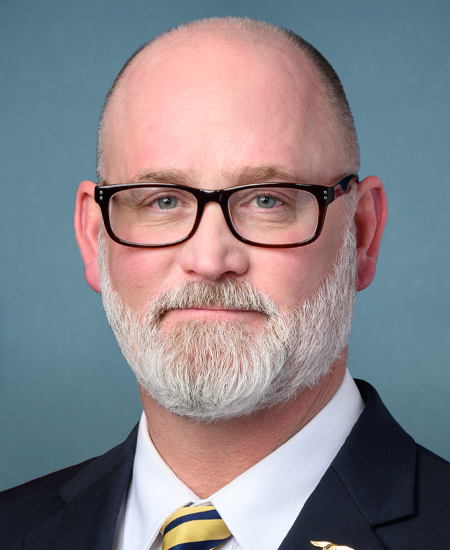
Rep. Derrick Van Orden
Sponsored bills
Maddy summaryThis resolution expresses support for designating July 10th as Journeyman Lineworkers Recognition Day to honor the workers who maintain the nation's electrical grid. The bill specifically recognizes the dangerous conditions these employees face, such as working at heights near live power lines and responding to disasters like hurricanes and wildfires. It also commemorates Henry Miller, the first president of the International Brotherhood of Electrical Workers, who died on July 10, 1896, while performing his duties. Ultimately, the measure encourages the public to observe this day with reflection on the contributions of lineworkers.
Maddy summaryThe Sunshine for Our Kids Act of 2026 makes standard time permanent across the United States by repealing the requirement to observe daylight saving time. It allows individual states to choose whether to adopt standard time year-round or to continue observing daylight saving time, provided the entire state observes the same time. This change would eliminate the biannual clock shifts that currently occur in spring and fall.
Maddy summaryThe Birthright Citizenship Clarification Act of 2026 would amend federal law to change how citizenship at birth is determined for children born in the United States. Under this proposal, a child born in the U.S. to parents who are present temporarily or unlawfully would not automatically receive citizenship, while also preserving historical exceptions for children of foreign diplomats and those born on foreign ships. The bill specifically defines temporary presence to include holders of student, work, tourist, and other nonimmigrant visas, as well as participants in the Visa Waiver Program. These changes would apply only to individuals born after the law takes effect, leaving the citizenship status of those born before that date unchanged.
Maddy summaryThis bill, known as the Hmong Congressional Gold Medal Act, authorizes the U.S. Congress to present a gold medal to the Hmong people in recognition of their distinguished service during the Vietnam War. The legislation directs the Speaker of the House and the President pro tempore of the Senate to arrange for this presentation, while the Secretary of the Treasury is tasked with creating the medal and selling duplicate bronze versions to cover production costs. Following the award ceremony, the original gold medal will be given to the Smithsonian Institution for display and research, with a recommendation that it also be made available at locations significant to Hmong history. The act applies to the over 327,000 Hmong currently living in the United States, acknowledging their heavy casualties and displacement after the war.
Maddy summaryThe Jewish American Security Act aims to combat antisemitism by strengthening protections for Jewish students, securing Jewish communities, and increasing transparency regarding online hate speech. For educational institutions receiving federal funds, the bill mandates the creation of specific coordinators to handle discrimination complaints, requires annual training on handling antisemitism, and establishes a new federal clearinghouse to share best practices for campus safety. To support physical security, the legislation expands grant funding for nonprofit organizations and directs the Attorney General to provide resources for law enforcement agencies protecting houses of worship. Additionally, the act requires major online platforms with over 50 million monthly users to submit detailed reports to the Federal Trade Commission on how they detect, remove, and moderate antisemitic content.
Maddy summaryThe Declaration of Independence Reaffirmation Act of 2026 directs Congress to formally reaffirm the Declaration of Independence as an organic law of the United States. This legislative measure is intended to commemorate the 250th anniversary of American independence by restating the document's principles regarding natural rights, equal citizenship, and government by consent. The bill includes the full text of the Declaration of Independence as part of its provisions. It does not create new legal obligations or alter existing laws but serves as a symbolic recognition of the document's foundational role in American political order.
Maddy summaryThe Securing Agriculture's Workforce Act of 2026 modernizes the H-2A visa program by transferring administrative authority to the Department of Homeland Security and introducing a unified online platform to streamline applications for employers and workers. Key provisions include establishing new housing standards with mandatory inspections, creating a system for staggered worker entry and exit, and allowing workers to transfer between employers without losing their status. The bill also defines specific job classifications for wage calculations, expands the scope of covered agricultural activities, and provides legal protections for employers who document the employment of workers seeking visa status. Additionally, it requires agencies to develop a heat illness prevention plan and allows for contract termination due to natural disasters.
Maddy summaryThe Veterans STAND Act requires the Department of Veterans Affairs to provide annual preventative health assessments to veterans with spinal cord injuries or disorders. These assessments cover risks for health complications, chronic pain management, dietary needs, prosthetic equipment, and access to assistive technologies like spinal cord neuromodulation devices. The VA must consult with medical specialists and device manufacturers when creating guidelines and submit yearly reports to Congress on veterans' use of these services and devices. This policy directly affects veterans with spinal cord injuries by ensuring regular, tailored health evaluations to improve long-term management and independence.
Maddy summaryHR 4398, the Veteran Burial Timeliness and Death Certificate Accountability Act, requires Veterans Affairs (VA) physicians or nurse practitioners to certify the death of a veteran who dies of natural causes within 48 hours of learning of the death. This directly affects veterans' families, who previously faced delays of up to eight weeks in burial and access to survivor benefits due to slow death certifications. The bill mandates annual reports to Congress on VA compliance with the 48-hour rule, including statistics on delays and their causes. The key change is establishing a strict timeline for death certification to prevent unnecessary delays in honoring veterans' final arrangements.