

Maddy summaryThis bill authorizes the U.S. Mint to produce commemorative $5 gold and $1 silver coins marking the 25th anniversary of the September 11, 2001, terrorist attacks. The coins must feature designs honoring victims and first responders (including the inscription "Never Forget") and will be sold only during 2027-2028. All surcharges ($35 per gold coin, $10 per silver coin) collected from sales will fund the National September 11 Memorial and Museum at the World Trade Center, with no net cost to the federal government. The coins are legal tender but primarily intended for collectors, not circulation.
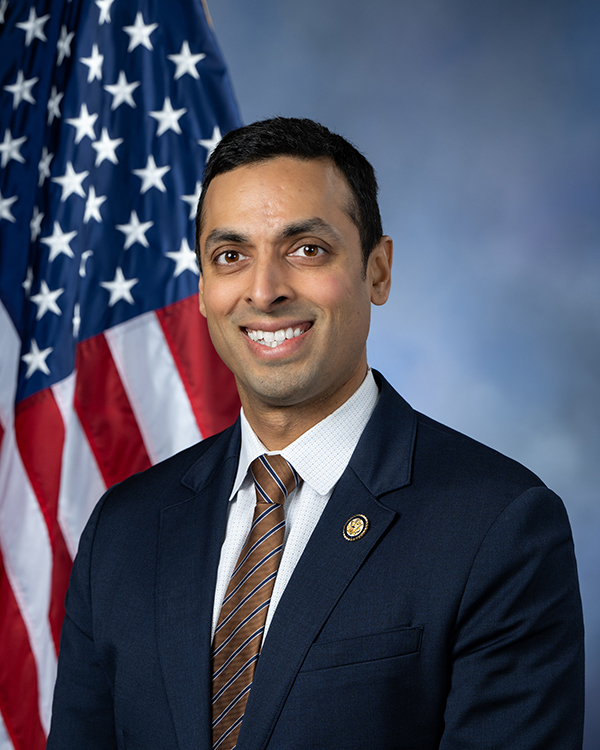
Rep. Suhas Subramanyam
Sponsored bills
Maddy summaryThe No Taxpayer-Funded Settlement Slush Funds Act of 2026 prohibits the use of federal money to pay specific settlements involving high-ranking government officials and their close associates. It bars payments to the President, Vice President, their immediate families, cabinet members, senior executive staff, political appointees, and individuals connected to these roles, as well as any entity owned by the President or Vice President. Additionally, the bill restricts settlements related to claims about the January 6 Capitol attack, foreign election interference, or previously dismissed lawsuits, while requiring Treasury reports for large settlements and allowing the government to seek repayment if rules are broken.
Maddy summaryHR 1352 designates the General George C. Marshall House in Leesburg, Virginia, as an "affiliated area" of the National Park System. The George C. Marshall International Center will manage the site, with the National Park Service providing technical assistance but not acquiring property or managing operations. The bill clarifies that this designation does not affect adjacent private property rights, create buffer zones, or regulate activities outside the house. It is a procedural measure to formally recognize the historic site within the National Park System framework.
Maddy summaryThis bill creates a new federal tax on money received by former U.S. presidents, their immediate family members, or their controlled businesses from civil lawsuits against the government. Under the law, any settlement or verdict awarded to these individuals would be subject to a 100 percent tax, and the payments would not be counted as taxable income for other purposes. To enforce this, the bill requires trustees and administrators to file public reports detailing these payments and imposes a $10,000 penalty for failing to do so. These rules would apply to any funds received on or after May 20, 2026.
Maddy summaryThe Protecting Our Democracy Act is a comprehensive legislative bill designed to prevent abuses of presidential power, restore checks and balances, and defend elections against foreign interference. Key provisions include prohibiting the President from granting self-pardons, requiring congressional oversight for pardons involving the President or their family, and banning the President from accepting payments from individuals who have received clemency. The bill also strengthens enforcement of the Hatch Act and ethics rules for political appointees, mandates greater transparency in presidential tax returns and campaign finances, and restricts the use of federal property for political conventions. Additionally, it expands reporting requirements for foreign contacts in federal campaigns and imposes stricter penalties for violations of election laws.
Maddy summaryThis bill requires companies that list securities in the United States to disclose whether their supply chains involve goods produced using forced labor in China's Xinjiang region. To comply, issuers must obtain independent audits from third-party auditors and publicly report detailed information about their sourcing, including specific facility names, revenue generated from affected products, and steps taken to avoid human rights abuses. The legislation defines forced labor broadly to include work under state-sponsored programs targeting specific ethnic groups in Xinjiang and mandates that these disclosure rules remain in effect for eight years unless the President certifies that such abuses have ended.
Maddy summaryThe BEACON Act of 2026 establishes two grant programs to improve treatment for veterans with chronic mild traumatic brain injury (mTBI). It authorizes $30 million over three years for grants to nonprofits, academic institutions, and health providers to develop and test non-drug neurorehabilitation approaches, focusing on mental health outcomes, suicide risk reduction, and long-term recovery. The bill requires grantees to prioritize patient-centered care, conduct clinical studies, and partner with VA facilities, with each grant capped at $5 million annually. A separate $10 million annual program funds independent research on TBI treatments, requiring third-party analysis and annual reports to Congress. The pilot programs expire after three years, with evaluations to determine future expansion.
Maddy summaryThis bill establishes a compensation fund to provide financial support to law enforcement officers who actively defended the U.S. Capitol on January 6, 2021, and suffered injuries, emotional distress, or death as a result. The program is administered by a Special Master appointed by the Attorney General, who will review individual claims for economic and non-economic losses while ignoring any questions of negligence. Eligible officers can receive specific payments for their injuries or the death of a colleague, with a guaranteed minimum of $4.975 million for death claims, plus an additional equal distribution to all qualifying officers regardless of injury status. The legislation also includes provisions to reduce payouts by any other compensation the claimant has already received and grants the federal government the right to recover funds if they are later paid out in related legal settlements.
Maddy summaryHRES 64 is a non-binding House resolution affirming the U.S.-South Korea alliance. It highlights historical ties (dating to 1882), economic partnerships (including 2023 trade data), and security cooperation (like the 1953 Mutual Defense Treaty), while celebrating Korean American contributions to U.S. society. The resolution formally supports strengthening security, economic, and cultural ties between the two nations and notes the 2025 anniversary of Korean liberation. It does not create new laws or funding, but serves as a symbolic statement of congressional support for the alliance.
Maddy summaryThe Data Infrastructure Risk Reduction Act directs the Department of Homeland Security to identify data centers that should be classified as critical infrastructure within 180 days of enactment. This directive requires the agency to evaluate the security of power and water supplies connected to these facilities and assess the potential impact of their locations near residential communities. Following this assessment, the Department must submit a strategy to Congress outlining how to defend these sites from breaches and protect nearby neighborhoods. The law applies to federal agencies responsible for cybersecurity and infrastructure security, specifically focusing on data centers as defined by existing energy legislation.