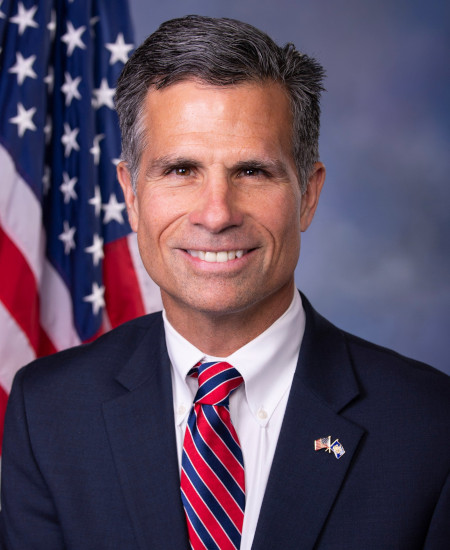
This resolution recognizes law enforcement agencies and officers for their tireless work to protect us and make our communities safer. It also condemns calls to defund, disband, dismantle, or abolish the police.
Rep. Daniel Meuser
Sponsored bills
Fifth Amendment Integrity Restoration Act of 2021 or the FAIR Act This bill revises federal laws governing civil asset forfeiture. Specifically, the bill makes various changes to the general rules governing civil forfeiture proceedings. Among the changes, the bill requires counsel for an indigent property owner regardless of whether the owner requests counsel, raises the evidentiary standard from preponderance of the evidence to clear and convincing evidence, and sets forth factors courts must consider in determining whether a forfeiture of facilitating property is excessive. Additionally, the bill eliminates statutory authority for equitable sharing and directs forfeiture proceeds to be deposited into the general fund of the Treasury instead of the Department of Justice Assets Forfeiture Fund. Finally, the bill makes changes with respect to the civil forfeiture of money involved in structuring offenses (i.e., structuring currency transactions to evade currency reporting requirements). Among the changes, the bill specifies an evidentiary standard of knowingly for structuring offenses, and requires a prompt probable cause hearing following the seizure of money involved in a structuring offense.
Lower Costs, More Cures Act of 2021 This bill establishes and modifies several programs and requirements to address prescription drug prices. The bill modifies provisions under Medicare and Medicaid relating to prescription drug coverage and price transparency. Among other changes, the bill requires the Centers for Medicare & Medicaid Services to publish certain information, as reported by pharmacy benefit managers (PBMs), relating to generic dispensing rates, drug discounts and rebates, and payments between PBMs, health plans, and pharmacies; caps annual out-of-pocket spending under the Medicare prescription drug benefit; allows prescription drug plan sponsors under the Medicare prescription drug benefit to offer additional plans in a region; requires pass-through pricing models, and prohibits spread-pricing, for payment arrangements with PBMs under Medicaid; and allows states to include in the Medicaid Drug Rebate Program covered outpatient drugs that are provided as part of physician or outpatient hospital services. The bill also generally modifies other provisions relating to the regulation and costs of generic and brand-name drugs. Among other changes, the bill prohibits the manufacturer of a brand-name, generic, or biosimilar drug from entering into certain agreements to resolve or settle a patent infringement claim in connection with the sale of a drug or biological product; permanently allows high deductible health plans to waive deductibles for insulin and associated products; and establishes the position of Chief Pharmaceutical Negotiator in the Office of the U.S. Trade Representative.

Maximum Pressure Act This bill expands sanctions and economic penalties on Iran. It also restricts the President from unilaterally lifting or waiving the sanctions or penalties and increases congressional oversight of them. Specifically, the bill requires the President to impose visa- and asset-blocking sanctions. Additionally, it modifies existing sanctions, including by (1) providing statutory authority for executive orders imposing sanctions; (2) applying sanctions to additional sectors of Iran's economy; and (3) broadening sanctionable conduct to cover, for example, assisting Iran with the acquisition of ballistic missiles and the complicity of Iranian officials in human rights violations in specified countries. The bill also requires reporting on licenses that authorize activities subject to sanctions. The bill prohibits U.S. representatives at the International Monetary Fund from voting to allow Iran's access to special drawing rights (a currency support tool) and places restrictions on financial transactions with Iran. The restrictions include requiring domestic financial institutions to implement special measures with respect to foreign financial institutions that conduct significant transactions connected to the Instrument in Support of Trade Exchanges (a European mechanism that bypasses U.S. sanctions when carrying out trade with Iran). The Department of State must maintain the Islamic Revolutionary Guard Corps' designation as a terrorist organization and must designate Ansharallah (or Houthis), which operates in Syria, as a foreign terrorist organization. The bill also requires reports on U.S. sanctions concerning Iran, the status of Iran's nuclear weapons program, and other matters.
Asylum Abuse Reduction Act This bill places restrictions on aliens seeking asylum and contains provisions related to immigration enforcement. Under this bill, an asylum seeker who arrives at a U.S. land port of entry without entry documents may not be admitted unless an asylum officer at a U.S. embassy or consulate has interviewed the alien and has concluded that the alien (1) has been persecuted in the alien's country of nationality due to their race, religion, or other characteristics; (2) has a credible fear of persecution if they returned to that country; or (3) would be tortured by the government upon return to that country. (Currently, an alien arriving at a port of entry may apply for asylum and an immigration officer there typically will give the alien a credible fear interview.) Furthermore, an alien who traveled through a third country to enter the United States through the southern border shall be ineligible for asylum unless (1) the alien has applied for and been denied asylum or protection in that third country, (2) the alien was a victim of severe human trafficking, or (3) the third country is not party to certain international agreements relating to refugees. Each federal judicial district shall appoint at least one judge to issue arrest warrants for individuals violating orders to depart, upon a showing of probable cause. Under this bill, the Flores agreement (a lawsuit settlement which imposes various requirements relating to the treatment of alien minors detained for immigration-related purposes) shall not apply.
Prohibiting IRS Financial Surveillance Act This bill prohibits the Department of the Treasury from requiring a financial institution to report the transfers into and out of a financial account. This prohibition does not apply to laws or regulations in effect on October 1, 2021.
Choose Home Care Act of 2021 This bill provides for coverage of home-based extended care services under Medicare. Specifically, the bill provides for coverage of services that are furnished to Medicare beneficiaries in their homes by home health agencies, including nursing care, meals and nutritional support, home medical supplies, nonemergency medical transportation, and care coordination. Coverage includes 30 days of post-hospital care and other periods of extended illness, as determined by the Centers for Medicare & Medicaid Services (CMS). Home health agencies that provide such services may receive additional payments in accordance with a specified methodology. The CMS may make payments for covered services furnished before 2022 during any period in which there is a public health emergency.
This resolution requests the President and directs the Department of State to transmit to the House of Representatives, not later than 14 days after the adoption of this resolution, copies of both classified and unclassified documents that refer or relate to certain information on the withdrawal of the United States from Afghanistan, including reactions, concerns, or objections expressed by certain allies and partners; any agreement reached with the Taliban related to the evacuation of specified individuals; and numbers of specified individuals in contact with the State Department to request evacuation assistance from Afghanistan, from July 30, 2021, to the present.
Protecting Financial Privacy Act of 2021 This bill prohibits a federal agency from creating, implementing, or administering a program that requires financial institutions or individuals to report on the balances of, transactions involving, or transfers into and out of financial accounts. This prohibition does not apply to laws or regulations in effect on September 1, 2021, or to the Bank Secrecy Act (laws that require financial institutions and other entities to report on certain financial transactions to prevent money laundering, the financing of terrorism, and other criminal activity). This prohibition does apply, however, to regulations issued under the Bank Secrecy Act after September 1, 2021.
Israel Relations Normalization Act of 2021 This bill requires the Department of State to take certain actions promoting the normalization of relations between Israel, Arab states, and other relevant countries and regions. Specifically, the State Department must develop a strategy on expanding and strengthening the Abraham Accords (the term used to refer collectively to agreements between Israel and the United Arab Emirates and between Israel and Bahrain marking the public normalization of relations between the two Arab countries and Israel). The strategy must include a description of how the U.S. government will encourage further normalization of relations with Israel. In addition, the State Department must report on options for U.S. international efforts to promote the strengthening of ties between Israel, Arab states, and other relevant countries and regions. The State Department must also report on the status of the normalization of relations with Israel, including information on (1) laws that punish individuals for people-to-people relations with Israelis (i.e., anti-normalization laws), and (2) evidence of steps taken by Arab governments toward permitting or encouraging normalized relations between their citizens or residents and Israeli citizens.