

Maddy summarySRES 585 is a commemorative resolution honoring Ben Nighthorse Campbell, a former U.S. Senator from Colorado and the first Native American to chair the Senate Committee on Indian Affairs. It recognizes his military service, Olympic judo career, legislative work (including authoring the National Museum of the American Indian Act), and advocacy for tribal communities. The resolution has no policy impact - it formally expresses the Senate’s respect for his legacy, requests transmission to his family, and directs a moment of silence. It directly affects Campbell’s legacy and family, not any current policy or population. (Note: This is a procedural resolution, not a bill with legislative provisions.)
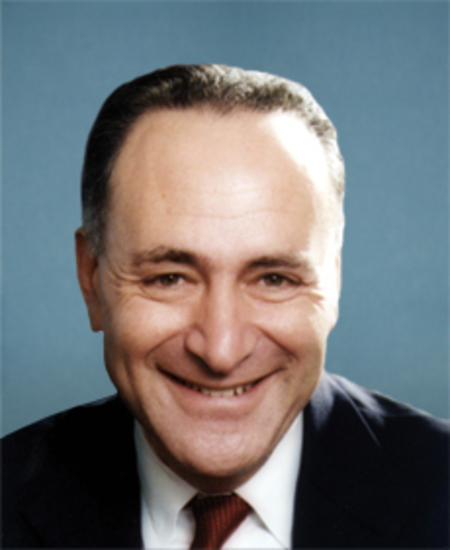
Sen. Charles E. Schumer
Sponsored bills
Maddy summaryThis bill reauthorizes funding for the West Valley Demonstration Project, a nuclear waste cleanup initiative in New York. It increases annual funding from $75 million (2020-2026) to $150 million for fiscal years 2027 through 2037. The key provision directly affects the project's operations by doubling its annual budget for the next decade. This change ensures continued cleanup efforts at the West Valley site without altering the project's core purpose or scope.
This joint resolution directs the President to terminate the use of U.S. Armed Forces for hostilities within or against Venezuela unless a declaration of war or authorization to use military force for such purpose has been enacted. The joint resolution specifies that it shall not be construed to prevent the United States from defending itself from an armed attack or threat of an imminent armed attack.
Maddy summaryThe "No Political Enemies Act" (S 3646) prohibits federal officials from taking enforcement actions against individuals or groups that are substantially motivated by their constitutionally protected speech, such as criticism of government policies. It creates legal defenses for those targeted, requiring courts to dismiss enforcement actions if proven to be politically motivated, and establishes new remedies including the ability to seek injunctions and sue for damages. The bill also requires the Justice Department to report quarterly to Congress on sensitive investigations and prohibits using government funds for politically motivated enforcement actions. This legislation directly affects federal enforcement agencies, officials, and anyone engaging in protected speech who might face government action.
Maddy summarySJRES 84 is a joint resolution seeking to block a rule issued by the Centers for Medicare & Medicaid Services (CMS) under the Affordable Care Act. The rule, published in the Federal Register on June 25, 2025, aimed to improve affordability and integrity in health insurance marketplaces. If approved, this resolution would invalidate the rule under a federal disapproval process, preventing its implementation. This directly affects how health insurance plans are structured and priced for consumers using ACA marketplaces.
Maddy summaryS 3622, the SERVE Act, prohibits naming or renaming any federal building, land, or asset after a sitting president. It directly affects all federal property currently named for a sitting president and prevents future naming during a president's term. The bill bans using federal funds for such naming and requires reverting any existing presidential-named property to its prior official designation. This applies to all federal assets covered by existing law, without exception.
Maddy summaryThe DEFIANCE Act of 2025 creates civil legal remedies for individuals harmed by non-consensual digital forgeries depicting them in sexually intimate situations without their consent. It defines "intimate digital forgery" as fabricated images or videos that appear authentic to a reasonable person, even with disclaimers, and allows victims to sue those who create, possess, or disclose such content. Key provisions include fixed damages of $150,000 (or $250,000 for severe cases like sexual assault-related forgeries), court-ordered privacy protections (like pseudonyms and redacted filings), and a 10-year statute of limitations. The law applies to interstate or online disclosures and explicitly preserves existing state laws, ensuring it does not override stronger state protections.
Maddy summarySRES 288 is a Senate resolution condemning recent ideologically motivated attacks on Jewish individuals, including a violent assault in Boulder, Colorado, on June 1, 2025, and other incidents like the attack on Israeli Embassy staff in Washington, D.C., and fires at the Pennsylvania Governor’s Residence. The resolution formally expresses the Senate’s condemnation of these acts as part of a growing pattern of antisemitism and politically motivated violence. It reaffirms the Senate’s commitment to protecting peaceful assembly and religious practice, while urging federal, state, and local law enforcement to thoroughly investigate such incidents and calling on community leaders to publicly oppose antisemitism. This resolution has no legal effect but serves as a formal statement of the Senate’s position.
Maddy summaryThis resolution commemorates the fifth anniversary of the January 6, 2021, Capitol attack and honors the U.S. Capitol Police, Metropolitan Police Department, and Capitol staff (including custodial, janitorial, and maintenance personnel) who protected the building during the assault. It recognizes their bravery in defending Congress during the attack, which injured over 100 officers and contributed to five officer deaths, and acknowledges their ongoing essential work in maintaining Capitol operations. The resolution expresses Senate gratitude for their service and reaffirms commitment to protecting democratic processes. As a commemorative resolution, it does not create new laws or funding.
Maddy summarySJRES 82 is a joint resolution seeking to block a rule issued by the Department of Health and Human Services (HHS) regarding how the agency should follow the text of the Administrative Procedure Act (APA), a federal law governing how agencies create regulations. The rule, published in March 2025, was identified by the Government Accountability Office as a "rule" subject to the Congressional Review Act. If enacted, this resolution would void the HHS policy, preventing it from taking effect and requiring HHS to disregard this specific internal guideline. The bill directly affects HHS's rulemaking procedures by invalidating the policy statement on APA adherence.