

Main Street Tax Certainty Act This bill makes permanent the tax deduction for qualified business income. (Under current law, the deduction expires after December 31, 2025.) Qualified business income is defined as the net amount of qualified items of income, gain, deduction and loss with respect to any trade or business, excluding capital gains or losses, dividends, interest income, or income earned outside the U.S.
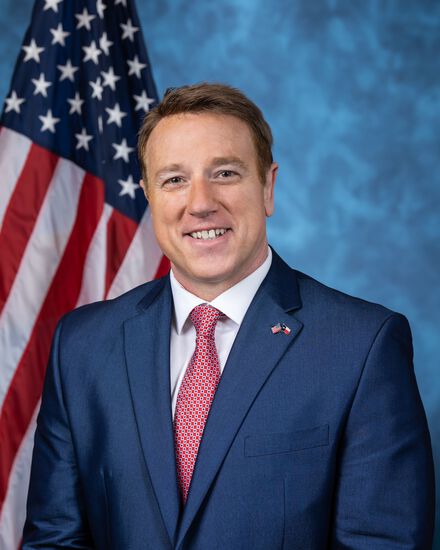
Rep. Pat Fallon
Sponsored bills
National Right-to-Work Act This bill repeals those provisions of the National Labor Relations Act and the Railway Labor Act that permit employers to make an agreement with a labor union to require employees to join such union as a condition of employment. Currently, at least 27 states have enacted laws prohibiting employers from compelling employees to become members of a union as a condition of employment.
Gold Star Altitude Act This bill authorizes the Department of Defense to offer, on a space-available basis, transportation on military aircraft to the children, surviving spouses, parents, and siblings of members of the Armed Forces who die during active service.
Saving America's Energy Future Act This bill prohibits the Department of Agriculture and the Department of the Interior from declaring a moratorium on issuing new oil and gas leases and drill permits on certain federal lands. In addition, the bill prohibits the departments from declaring a moratorium on renewals of such permits.
Constraining Human Rights Offenders in the Middle East Act or the CHROME Act This bill prohibits the President from taking any action relating to the reentry of the United States into the Joint Comprehensive Plan of Action (JCPOA) unless the President makes specified certifications. The JCPOA is an agreement, signed by Iran and several other world powers (including the United States), that places restrictions on Iran's nuclear program in exchange for certain sanctions relief. The United States withdrew from the JCPOA in 2018. The bill prohibits the President from taking action to rejoin the JCPOA unless the President certifies to Congress that no sanctions waived or suspended pursuant to that reentry will operate to the benefit of (1) a designated foreign terrorist organization or its members, or (2) any individual or entity of the Iranian government that has engaged in gross violations of human rights.
Taiwan Invasion Prevention Act This bill authorizes the President to use the Armed Forces to defend Taiwan against a direct attack by China's military, a taking of Taiwan's territory by China, or a threat that endangers the lives of civilians in Taiwan or members of Taiwan's military. The bill also directs the Department of Defense to convene an annual regional security dialogue with Taiwan and other partners to improve U.S. security relationships with countries in the Western Pacific. (China considers Taiwan a part of China.)
This bill makes certain full-time health care practitioners eligible for the Public Service Loan Forgiveness program. Specifically, the bill extends program eligibility to health care practitioners who work at a nonprofit or public hospital or facility but are prohibited under state law from being directly employed by the hospital or facility.
World Health Act This bill directs the United States to withhold all contributions to the World Health Organization (WHO) until (1) China's WHO membership is terminated, and (2) Taiwan is granted full membership. (China has opposed Taiwan's participation in the World Health Assembly, the governing body of the WHO.) The President shall direct the U.S. representative to the WHO to encourage other member states to take similar action.
Opposing Business with Chinese Military Companies Act This bill requires the President to exercise certain economic powers, such as investigating or prohibiting payments, with respect to an entity that is engaging in economic activities in the United States and is (1) affiliated with China's government or military, or (2) owned or controlled by an entity affiliated with China's defense industrial base. (The President currently has such powers but is not required to exercise them.) The bill extends to December 31, 2026, a provision requiring the Department to Defense to annually report to Congress an updated list of such entities.
Safeguarding Coal Leasing Act of 2021 This bill requires the President and the Department of the Interior to obtain the approval of Congress before implementing a moratorium on coal leasing.