

Maddy summaryHR 6172, the Ending Forced Arbitration of Race Discrimination Act of 2025, prevents companies from requiring employees or consumers to use private arbitration to resolve race discrimination claims. It makes any pre-dispute arbitration agreement unenforceable for disputes involving alleged race, color, or national origin discrimination under federal, tribal, state, or local law. The bill ensures courts - not arbitrators - determine if this law applies to a case, giving people the choice to pursue claims in court instead of forced arbitration. It directly affects individuals alleging race discrimination who would otherwise be barred from court by such agreements. The law applies to claims arising on or after its enactment date.
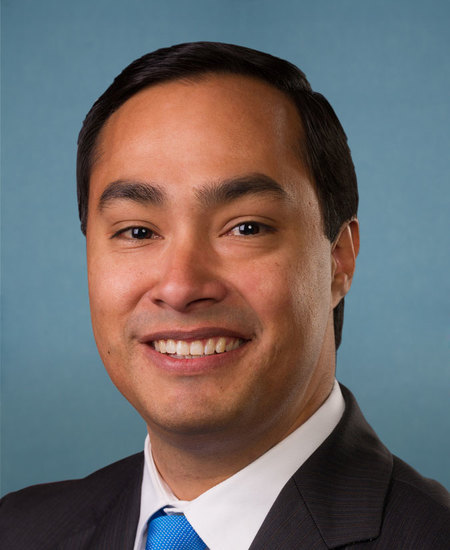
Rep. Joaquin Castro
Sponsored bills
Maddy summaryThis bill allows Inspector General (IG) offices to continue operating during government funding gaps. It permits IGs to spend funds at the previous year's funding rate to cover basic operations and oversee programs that remain active when Congress hasn't passed new appropriations. The law directly affects federal IGs and the agencies they monitor, ensuring oversight continues without interruption during shutdowns. It amends existing law to provide this authority without requiring new appropriations.
Maddy summaryHR 6126 authorizes the minting of commemorative coins to mark the 100th anniversary of the U.S. Foreign Service (established in 1924). It specifies three coin types: up to 50,000 $5 gold coins (90% gold), 400,000 $1 silver coins (90% silver), and 750,000 half-dollar coins, all to be sold during 2029. A surcharge of $35 per gold coin, $10 per silver coin, and $5 per half-dollar is added to the sale price, with all surcharge funds directed to the Association for Diplomatic Studies and Training to support its diplomatic history preservation work. The coins must include standard inscriptions (e.g., "Liberty," "United States of America") and will be legal tender, but the bill does not create new policy or affect government operations.
Maddy summaryThe Global Respect Act (HR 6151) requires the U.S. President to publicly list foreign officials responsible for severe human rights violations against LGBTQI individuals, including torture, prolonged detention, or violence based on sexual orientation or gender identity. It mandates denying visas and entry to listed individuals and requires annual reports on the list's updates and impacts. The bill also directs the State Department to track global violence against LGBTQI people and update annual human rights reports to include discrimination based on sexual orientation or gender identity. These provisions directly affect foreign government officials and entities implicated in such abuses, aiming to increase accountability through U.S. visa restrictions.
Maddy summaryThis bill amends Section 1983 of federal law (42 U.S.C. 1983) to explicitly allow lawsuits against federal officials who violate constitutional rights while acting under federal authority. It directly affects individuals whose constitutional rights were allegedly infringed by federal employees, such as law enforcement or agency staff. The key provision inserts "of the United States" before "of any State" in the statute, expanding the existing legal remedy for state officials to cover federal officials as well. This creates a clear, standalone legal path for citizens to seek redress for federal constitutional violations without relying on precedent.
Maddy summaryHR 6056, the International Human Rights Defense Act of 2025, establishes a permanent Special Envoy at the State Department to lead U.S. foreign policy efforts addressing discrimination and violence against LGBTQI+ people globally. The bill requires the U.S. government to develop and update a biannual global strategy to prevent criminalization and violence against LGBTQI+ individuals, mandate detailed reporting on such abuses in annual country reports, and ensure all U.S. foreign assistance programs include inclusive nondiscrimination policies. This legislation directly affects U.S. foreign policy implementation, federal agencies receiving funding, and LGBTQI+ communities facing persecution worldwide. The bill aims to coordinate U.S. government efforts across departments and with international partners to advance LGBTQI+ rights globally through concrete policy mechanisms.
Maddy summaryThis bill requires all new passenger vehicles manufactured for sale in the U.S. to include AM radio as standard equipment (not an optional add-on) by 2027-2028, depending on manufacturer size. It mandates that AM radio receivers must be easily accessible to drivers and allows compliance through digital AM broadcast technology. During a transition period, manufacturers must clearly label vehicles without AM radio but cannot charge extra for this feature. The bill also mandates a GAO study on AM radio's role in emergency alerts and includes a 10-year sunset provision for the rule. It preempts state laws regarding AM radio access in vehicles.
Maddy summaryHRES 863 is a symbolic House resolution honoring veterans from Texas, recognizing the state's status as home to nearly 1.6 million veterans - the highest in the U.S. - including over 203,000 women veterans and 11 House members who are veterans. The resolution does not create new laws or alter policies but expresses the House's commitment to supporting veterans through existing VA programs, particularly addressing challenges like mental health care, homelessness, and job transitions. It emphasizes Texas's significant military legacy, including over 22,000 Texan lives lost in World War II and 102 Medal of Honor recipients. As a commemorative resolution, it has no binding effect but serves as a formal acknowledgment of Texas veterans' service.
Maddy summaryThis bill prohibits the Department of Veterans Affairs (VA) from requiring veterans to pay copayments for hospital care or medical services under specific circumstances. It bans copayments for all veterans receiving care, prevents retroactive billing for care received within two years if the VA failed to process claims on time, and caps copayments at $2,000 for errors caused by VA staff or systems. Veterans affected by VA processing errors or billing mistakes would no longer face these charges. The bill also grants the VA authority to waive copayments without requiring veterans to submit a formal request.
Maddy summaryThis bill prevents states from redrawing congressional district maps more than once per decade. It prohibits states from changing district boundaries after their initial post-2020 census redistricting until the next census, unless a court orders it or state law specifically requires it. The law directly affects all states responsible for creating congressional maps, aiming to limit frequent redistricting cycles. It applies to all redistricting occurring after the 2020 census. The bill does not alter how states conduct elections for state or local offices.