

Maddy summaryThis bill modifies the legal definition of "administrative action" specifically for the Public Utilities Commission (PUC) under Minnesota law. It explicitly clarifies that the PUC's application of rules - including rate setting, power plant/siting decisions, and certificate of need approvals - counts as an "administrative action," which was previously excluded. The change ensures these routine regulatory activities are treated consistently under the statute. This is a procedural adjustment to the definition, not a new policy.
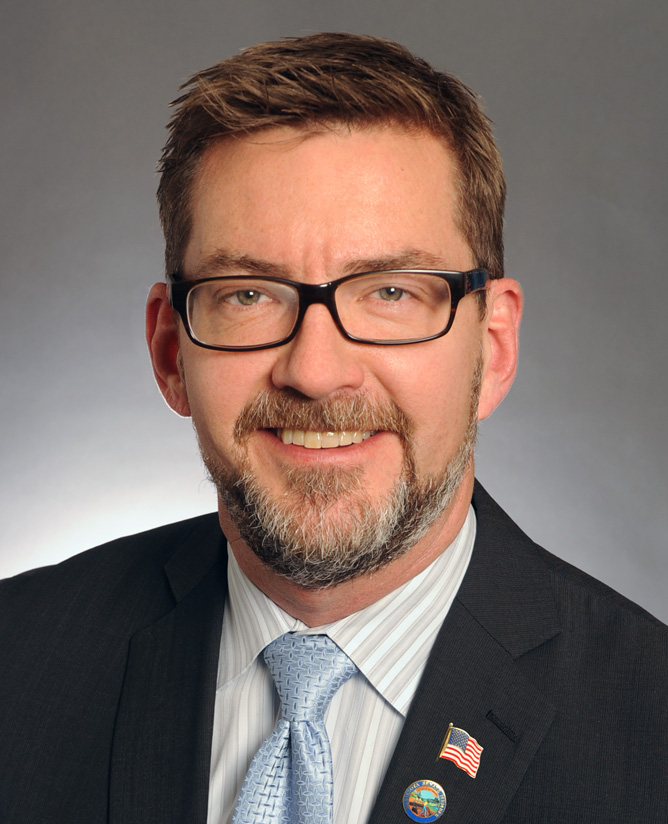
Sen. Scott Dibble
Sponsored bills
Maddy summarySF 1171 increases Minnesota's state rail safety inspector workforce from six to ten positions. It amends Minnesota Statutes 2024, section 219.015, to adjust how railroad companies are assessed for funding: the assessment now covers costs for up to ten inspectors (including salaries, training, and equipment), rather than the previous six. This change directly affects railroad companies classified as Class I or II carriers operating in Minnesota, requiring them to pay higher annual assessments to support the expanded program. The bill updates the funding mechanism to reflect the increased staffing level without altering the core inspection authority outlined in section 218.041.
Maddy summaryMinnesota's Senate Resolution SF 569 is a symbolic request to Congress, not a binding law. It asks Congress to propose a constitutional amendment clarifying that constitutional rights apply only to natural persons (people), not corporations or other artificial entities. The resolution specifically requests that Congress amend the Constitution to: (1) limit constitutional rights to people, (2) allow government to regulate campaign spending as non-speech, and (3) require public disclosure of political contributions. The bill directly affects Minnesota's relationship with Congress, urging federal action to overturn the *Citizens United* Supreme Court decision.
Maddy summarySF 289 authorizes Minnesota to issue up to $400 million in state bonds to fund local infrastructure. It appropriates $250 million for county road projects, prioritizing statewide/regional roads and rural safety improvements on county state-aid highways. An additional $150 million is allocated for bridge repairs, including matching federal funds to replace or rehabilitate deficient bridges, covering design, construction, and land acquisition costs. The funds directly support counties and local communities by improving road safety and bridge infrastructure. The bill enables these investments through bond financing rather than direct state budget spending.
Maddy summaryThis bill increases fines for driving without a valid license in Minnesota. It sets minimum fines at $300 for first offenses, $550 for offenses within 10 years of a prior violation, and $850 for two or more prior violations within that timeframe. The changes apply to drivers operating vehicles while their license is revoked, canceled, or disqualified (e.g., for commercial vehicles), with an exception for licenses expired less than three months. The new penalties take effect August 1, 2025, and directly affect individuals convicted of these driving violations.
Maddy summarySF 1279 authorizes the state to issue $5 million in bonds to fund transportation infrastructure projects. It appropriates these bond proceeds to the commissioner of transportation for grants under Minnesota Statutes §116J.436, directly supporting local transportation improvements like roads, bridges, or transit systems. The bill creates a dedicated funding stream for economic development infrastructure by borrowing money through state bonds, following standard bond procedures under Minnesota law. This measure affects communities and local governments eligible to receive these transportation grants.
Maddy summarySF 1384 modifies Minnesota's rules for permitting small wireless facilities (like 5G cell equipment) in public rights-of-way. It requires local governments to process permit applications without asking for redundant information, to provide clear 300-foot notice to nearby property owners before installation (including "NOTICE OF 5G TOWER CONSTRUCTION" in bold), and to allow consolidated applications for up to 15 facilities within a two-mile radius. The bill prohibits local fees for routine maintenance or minor replacements of existing facilities and mandates nondiscriminatory review. This directly affects telecom companies installing small wireless infrastructure and local governments managing public rights-of-way.
Maddy summaryThis bill exempts certain health-related purchases from state sales tax. It creates two new tax exemptions: (1) for "health care materials" like single-use medical supplies prescribed by a physician (e.g., bandages, syringes), and (2) for other items purchased through private health plans that aren't already covered by existing exemptions. The exemption applies to sales and purchases made after June 30, 2025, directly affecting health plans (both public and private) and businesses selling these medical supplies. This change simplifies tax treatment for essential health products without altering coverage or costs for consumers.
Maddy summaryThis bill provides a refundable sales tax exemption for construction materials used in renovating Minneapolis-St. Paul International Airport. Contractors and subcontractors purchasing eligible materials between July 1, 2023, and January 1, 2028, will pay the standard sales tax upfront but receive a refund from the state. The exemption applies retroactively to purchases made after June 30, 2023, with refunds unavailable before July 1, 2025. The state will fund these refunds using general fund appropriations.
Maddy summaryThis bill amends Minnesota's motor vehicle sales tax exemptions to add 12 new categories of exempt purchases. It specifically exempts vehicles used by veterans with total service-connected disabilities (section 16), mobile medical units operated by federally qualified health centers (section 15), vehicles in job opportunity building zones (section 13), lease-to-own purchases from 501(c)(3) charities (section 14), and certain nonprofit educational vehicles (section 6). These changes directly affect veterans, healthcare providers, businesses in designated zones, and charitable organizations. The bill modifies existing law without removing current exemptions, focusing solely on expanding who qualifies for tax relief on vehicle purchases.