

Maddy summaryHF 1793 modifies how Minnesota's medical assistance program reimburses birth centers for maternity services. Currently, birth centers receive payment at 70% of the hospital rate for facility services and nursery care, but the bill changes this to 100% of the hospital rate starting January 1, 2027 (or after federal approval). It also requires full reimbursement for comprehensive maternal care services within a birth center’s scope, regardless of location, and mandates the state to update payment practices based on consultation with licensed birth centers. These changes directly affect licensed birth centers, traditional midwives, and the state’s Medicaid program by adjusting payment rates and expanding covered services. The current 70% rate expires when the new 100% rate takes effect.
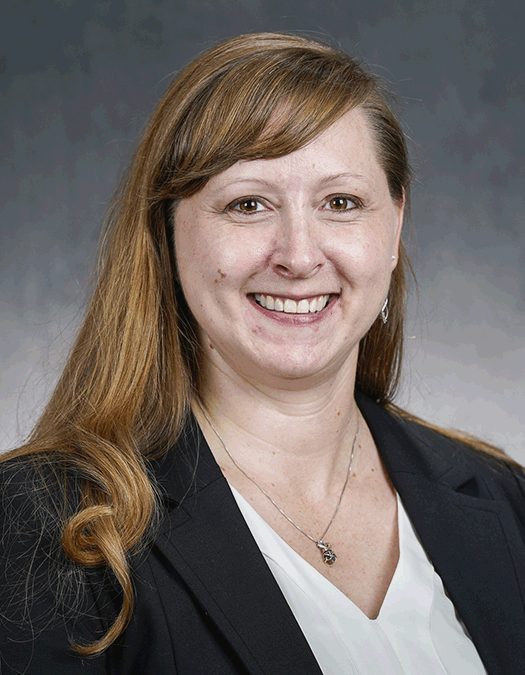
Sen. Amanda Hemmingsen-Jaeger
Sponsored bills
Maddy summaryHF 2289 requires Minnesota hospitals to maintain registered nurse staffing levels consistent with nationally accepted standards, ensuring adequate care for patients. Hospitals must create and implement staffing plans specifying maximum patient-to-nurse ratios for each unit, developed with input from direct-care registered nurses, and report these levels to the state. The bill prohibits retaliation against nurses who raise staffing concerns and imposes civil penalties for noncompliance. It directly affects all licensed Minnesota hospitals, their nursing staff, and patients by mandating safer staffing practices. The law appropriates funding to support implementation of these requirements.
Maddy summaryThis bill appropriates $342,000 from the general fund for each of fiscal years 2026 and 2027 to the Minnesota Rare Disease Advisory Council. It directly provides funding to support the council's operations under Minnesota Statutes section 256.4835. The funding mechanism is a straightforward annual appropriation for the council's existing statutory purpose, with no new program requirements or eligibility changes. The bill affects the council and the rare disease community it serves by ensuring ongoing financial support for its advisory work.
Maddy summaryHF 1502 establishes a new process to determine disability for Minnesota medical assistance (Medicaid) eligibility, creating a specific pathway for applicants under 65 who are blind or claim disability but haven’t been formally determined disabled by the Social Security Administration. The bill requires that such applicants be referred to the state medical review team for a disability determination if they don’t qualify under other eligibility categories. This change, effective July 1, 2025, directly affects Minnesotans applying for medical assistance who fall into this category. The bill amends Minnesota Statutes sections 256B.055 and 256B.056 to implement these provisions.
Maddy summaryHF 1913 creates a new limited medical license for graduates of foreign medical schools who meet specific criteria, including 60 months of practice outside the U.S. in the past decade, working in a collaborative agreement within a rural or underserved area, and providing evidence of a job offer. It requires employers of these limited license holders to carry medical malpractice insurance and pay at least the equivalent of a medical resident's salary, while prohibiting retaliation for reporting violations. Limited license holders must submit periodic certification to the medical board confirming their employment and good standing every six months. The bill also establishes a pathway to full licensure after two years of practice (1,692 hours annually), passing all USMLE/COMLEX-USA steps, and obtaining a recommendation letter.
Maddy summaryThis bill appropriates $20 million ($10 million for each of fiscal years 2026 and 2027) to create regional food bank grants. It directs the commissioner of Children, Youth, and Families to distribute funds to regional food banks and federally recognized Minnesota tribes to purchase, transport, and distribute food through federal programs, with optional use for hygiene products like diapers. Recipients must comply with federal food assistance guidelines and report spending to the commissioner. The program aims to increase food availability for individuals and families in need across Minnesota.
Maddy summaryHF 2228 establishes a 13-member task force to address insurance affordability issues affecting homeowners, renters in multifamily housing, common interest communities, cooperatives, and small businesses. The task force will review topics like risk mitigation, liability laws, reinsurance markets, and climate-related claim costs, then submit recommendations by February 2026. The bill appropriates $200,000 from the general fund to cover the task force’s operational costs through June 2026. It does not make immediate policy changes but requires a final report with findings and draft legislation to strengthen Minnesota’s property insurance system.
Maddy summaryHF 2761 updates Minnesota's pesticide regulations to include pesticides from treated seeds in the commissioner's management plans and monitoring. It requires new coordination between state agencies, local governments, and public health agencies for pesticide management, and adds monitoring for pesticides from treated seeds and their breakdown products in groundwater, surface water, and air. The bill establishes new labeling requirements for certain pesticide-treated seeds and defines "systemic pesticides" (like neonicotinoids) for a new regulatory program. These changes primarily affect farmers using treated seeds, state environmental agencies, and local communities managing water and air quality.
Maddy summaryHF 1644 creates a grant program to fund family permanent supportive housing in Minnesota. It appropriates $1.5 million for fiscal year 2026 to provide $15,000 per family served to nonprofit organizations or Tribal governments operating housing for families facing barriers like homelessness, mental health challenges, or child protection referrals. The program requires grantees to offer specific services - including child-centered education, job training, counseling referrals, and 24/7 on-site staffing - to help families maintain stable housing and support children's well-being. Funding must serve 60% of families in the metro area, 40% outside it, and at least 10% from Minnesota Tribal Nations.
Maddy summaryHF 2065 increases annual state funding for library online databases by $2.9 million for fiscal years 2026 and 2027. The bill appropriates these funds to the Department of Education to maintain statewide licenses for online research databases. These licenses directly benefit school media centers, public libraries, state government agency libraries, and college/university libraries across Minnesota. The funding ensures continued access to digital resources without requiring additional local spending.