

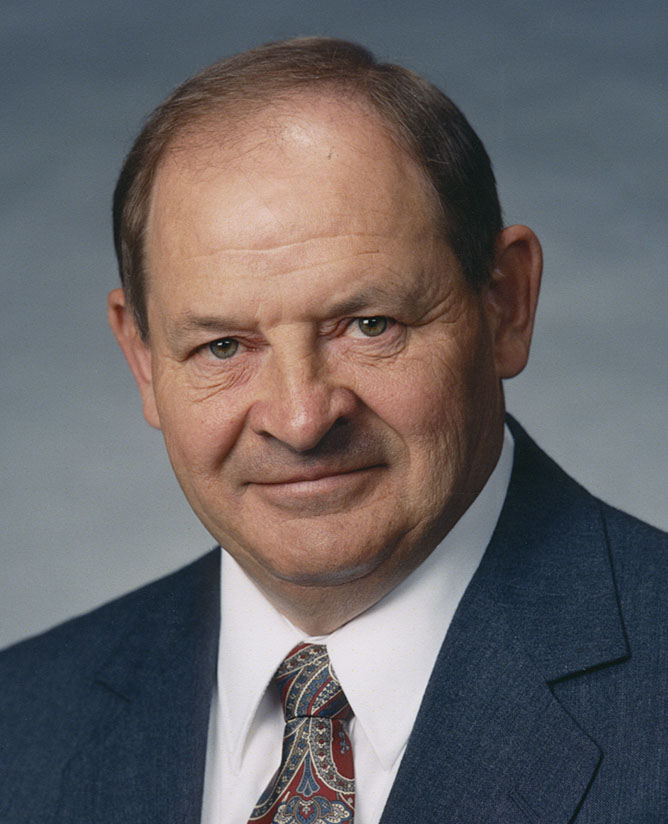
Photo of Gary Dahms
R Minnesota Senate · District 15

Sen. Gary Dahms

Compare
Total votes
24
all sessions
Attendance
92%
2 missed
Lower than 89% of chamber peers
With party
83%
of cast votes
Lower than 89% of chamber peers
Bipartisan score
8%
crosses aisle rarely
Higher than 86% of chamber peers
Sponsored
781
bills & resolutions
Lower than 97% of chamber peers
Committees
2
assignments
781 bills and resolutions

Sponsored bills

Total
781
Primary
316
Co-sponsor
465
This page
781
matching current filters
Co-sponsor SF 2487
In committee · Minnesota Senate · Co-sponsor
Cottonwood County land acquisition appropriation from the clean water water fund

Maddy summarySF 2487 appropriates $3.9 million from Minnesota's Clean Water Fund in fiscal year 2026 to the Red Rock Rural Water System for acquiring land containing a groundwater aquifer in Cottonwood County. This funding directly supports the water system's ability to maintain safe, high-quality water services for its community by protecting a critical groundwater source. The bill's key mechanism is a specific grant allocation to secure this land, ensuring long-term water supply reliability. It does not change water quality standards or regulations but provides targeted financial support for infrastructure protection.

In committee Mar 13, 2025 1 co-sponsor
Primary SF 2376
In committee · Minnesota Senate · Lead sponsor
Springfield issuance of and on-sale liquor license authorization

Maddy summarySF 2376 authorizes the city of Springfield to issue on-sale liquor licenses for its city-owned Springfield Area Community Center, overriding any conflicting local laws or ordinances. The bill allows the city to obtain standard on-sale, wine/strong beer, or Sunday sales licenses for this facility, treating it as a municipal liquor store under Minnesota Statutes sections 340A.603 and 340A.604. The license becomes effective only after Springfield City Council approval and compliance with state statute 645.021. This bill directly affects the Springfield Area Community Center's ability to serve alcoholic beverages.

In committee Mar 10, 2025 0 co-sponsors
Primary SF 2302
In committee · Minnesota Senate · Lead sponsor
Farmed Cervidae provisions modifications

Maddy summaryThis bill modifies Minnesota's requirements for farmed deer and elk (Cervidae) to strengthen chronic wasting disease (CWD) management. It requires annual vet verification of herds, 14-day reporting for animal movements, and mandatory CWD testing for all farmed Cervidae over six months old that die or are slaughtered. If CWD is detected, owners must depopulate within 30 days (after federal indemnification), maintain fencing for 10 years, post biohazard signs, and disclose the CWD history to future property buyers. The bill directly affects farmed Cervidae owners, property sellers, and buyers in affected areas. These changes aim to prevent CWD spread through stricter monitoring and post-outbreak protocols.

In committee Mar 10, 2025 0 co-sponsors
Co-sponsor SF 565
In committee · Minnesota Senate · Co-sponsor
Cost defrayal to health plan companies for additional benefits by the commissioner of commerce requirement

Maddy summaryThis bill requires Minnesota's commissioner of commerce to reimburse health plan companies for increased costs when state-mandated health benefits raise per-member monthly expenses. It applies specifically to companies offering coverage in individual, small group, and large group markets. The commissioner must pay affected companies within 60 days of receiving their cost statements, using funds from a designated state account. The law takes effect January 1, 2026, for all new mandated health benefit proposals enacted after that date.

In committee Mar 10, 2025 1 co-sponsor
Co-sponsor SF 2315
In committee · Minnesota Senate · Co-sponsor
Excess money in the grain indemnity account requirement to be transferred to the agricultural emergency account

Maddy summarySF 2315 requires Minnesota's Department of Agriculture to transfer excess funds from the grain indemnity account to the agricultural emergency account. Specifically, if the account balance exceeds $15 million on June 30 and no claims were paid in the previous 24 months, the commissioner must transfer the surplus. This applies to Minnesota's grain indemnity program, which collects premiums from agricultural producers. The transferred funds would then be available for agricultural emergency response efforts.

In committee Mar 10, 2025 1 co-sponsor
Co-sponsor SF 2187
In committee · Minnesota Senate · Co-sponsor
County feedlot program appropriation

Maddy summaryThis bill appropriates $2.95 million for fiscal year 2026 and $2.95 million for fiscal year 2027 to fund Minnesota's existing county feedlot program. The funds, coming from the general fund, will be distributed as grants to delegated counties through the Pollution Control Agency. This funding supports counties in administering feedlot regulations under Minnesota Statutes section 116.0711, specifically for managing manure and waste from livestock operations. Unused funds from 2026 can carry over to 2027. The bill does not create new regulations or alter program requirements.

In committee Mar 6, 2025 1 co-sponsor
Co-sponsor SF 386
In committee · Minnesota Senate · Co-sponsor
Public safety radio grants appropriation

Maddy summaryThis bill appropriates $300,000 per county (totaling $1.5 million) from the general fund for fiscal year 2026 to five specific Minnesota counties - Rock, Jackson, Lac qui Parle, Roseau, and Red Lake - to participate in the statewide ARMER public safety radio system. Each county must provide a 50% nonstate match ($150,000) to receive the grant, which must be used exclusively for purchasing or upgrading portable, mobile, or related radio equipment compatible with the ARMER system. The funding is a one-time appropriation, not renewable, and directly affects these counties’ emergency communication capabilities. It does not change existing law but provides targeted financial support for equipment upgrades.

In committee Mar 3, 2025 1 co-sponsor
Co-sponsor SF 1666
In committee · Minnesota Senate · Co-sponsor
Minnesota Strategic Industrial Development Enhancement tax credits establishment

Maddy summaryThis bill creates tax credits for businesses in Minnesota to support industrial development and infrastructure. It allows eligible businesses in qualifying locations (like rural counties, industrial parks, or near rail lines) to claim up to 10% of qualifying construction costs ($8 million max) or 50% of new rail infrastructure costs ($4 million max) against state taxes. Projects must apply for credit approval, and total annual credits are capped at $50 million. Unused credits can be carried forward for up to five years or transferred to other Minnesota taxpayers via written agreement.

In committee Mar 3, 2025 1 co-sponsor
Co-sponsor SF 2008
In committee · Minnesota Senate · Co-sponsor
Public water and sewer systems instillation of water and sewer pipelines in public road rights-of-way authorization provision

Maddy summaryThis bill amends Minnesota law to explicitly allow public water districts, sewer districts, and combined water/sewer districts to install pipelines in public road rights-of-way. It adds these entities to the existing list of utilities (like telephone and power companies) already permitted to use public roads for infrastructure under Minnesota Statutes 222.37. The key provision requires these districts to follow the same notice and permitting rules as other utilities - such as notifying local governments before major construction - and to avoid interfering with road safety. It directly affects public water/sewer districts and local governments managing road rights-of-way.

In committee Feb 27, 2025 1 co-sponsor
Co-sponsor SF 1975
In committee · Minnesota Senate · Co-sponsor
Various net metering governing provisions modifications

Maddy summaryThis bill modifies Minnesota's net metering rules for small-scale renewable energy systems. It directly affects residential and small business customers with solar panels or similar installations under 40 kilowatts (kW) capacity. Key changes include allowing these customers to choose compensation based on the utility's average retail energy rate (instead of avoided costs) for excess power sent back to the grid, and clarifying definitions like "aggregated meter" for multi-property systems. The bill ensures utilities can recover fixed costs through reasonable fees while maintaining non-discriminatory billing practices for small generators.

In committee Feb 27, 2025 1 co-sponsor
Showing 71 to 80 of 781 bills
Previous 1 7 8 9 79 Next