

Maddy summaryHF 1784 requires government entities (such as state agencies or local municipalities) to pay the legal costs - including attorney fees - of individuals or organizations they sue and lose in court. If a government entity initiates a civil lawsuit against a person and does not win, the bill mandates that the government cover all defense-related expenses incurred by the losing party. This applies to actions filed on or after August 1, 2025, and does not limit other legal remedies available to defendants. The bill aims to discourage government entities from filing meritless lawsuits by making them financially responsible for opposing legal costs.
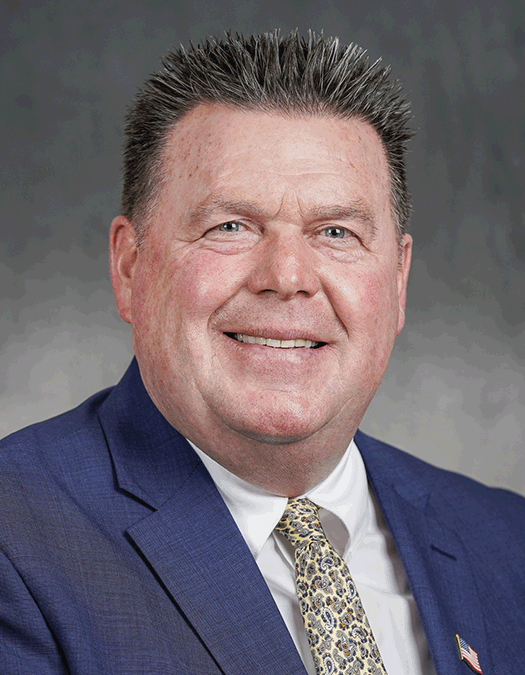
Rep. Tom Murphy
Sponsored bills
Maddy summaryThis House concurrent resolution sets the next meeting date for Minnesota's House of Representatives and Senate as Tuesday, February 17, 2026, at noon. It allows both legislative chambers to adjourn beyond the usual three-day limit by mutually consenting to this extended break. The resolution directly affects Minnesota's state legislators, establishing a specific date for the next session rather than allowing the chambers to reconvene at an earlier time. As a procedural measure, it does not change laws or policies but formalizes the schedule for the 2026 legislative session.
Maddy summaryHF 2201 increases local optional aid for Minnesota schools and limits state-paid free school lunches to families with incomes at or below 500 percent of the federal poverty level. The bill establishes a "free enhanced school meals program" requiring participating schools to provide two free meals per day (breakfast and lunch) to students from families earning between 185% and 500% of the federal poverty level. It amends school meal financing rules to adjust state aid payments and appropriates funds to support these changes, effective for fiscal year 2026. This directly affects schools, families with children in the specified income range, and the state's education budget.
Maddy summaryHF 47 modifies certification requirements for underground telecommunications installers in Minnesota. It mandates that workers performing installations near existing utilities or using directional drilling must be certified safety-qualified installers, requiring a 40-hour training course covering utility identification, incident response, and safety procedures. The law phases in requirements: certified installers must be used for new work in the seven-county metro area starting July 1, 2025, and statewide by January 1, 2026, with a 36-inch depth exemption for private property. Installers must pass an exam and complete refresher courses every three years to maintain certification. This directly affects telecommunications companies, installers, and construction projects involving underground utility work.
Maddy summaryHF 185 establishes a resilient pavement program for Minnesota's trunk highway projects, appropriating $150 million from the general fund for fiscal year 2027. The program provides supplemental funding to modify pavement designs on eligible projects to achieve a minimum 50-year lifespan, requiring a cost-effectiveness ratio of at least 2.0 (comparing baseline project costs to modified project costs). It directly affects trunk highway projects already in state transportation plans with a proposed design life of 20 years or less. Projects must meet specific criteria, including pavement cost analysis and approval by the commissioner of transportation, with funds covering up to 110% of the cost difference between baseline and modified designs.
Maddy summaryThis bill appropriates $342,000 from the general fund for each of fiscal years 2026 and 2027 to the Minnesota Rare Disease Advisory Council. It directly provides funding to support the council's operations under Minnesota Statutes section 256.4835. The funding mechanism is a straightforward annual appropriation for the council's existing statutory purpose, with no new program requirements or eligibility changes. The bill affects the council and the rare disease community it serves by ensuring ongoing financial support for its advisory work.
Maddy summaryHF 1502 establishes a new process to determine disability for Minnesota medical assistance (Medicaid) eligibility, creating a specific pathway for applicants under 65 who are blind or claim disability but haven’t been formally determined disabled by the Social Security Administration. The bill requires that such applicants be referred to the state medical review team for a disability determination if they don’t qualify under other eligibility categories. This change, effective July 1, 2025, directly affects Minnesotans applying for medical assistance who fall into this category. The bill amends Minnesota Statutes sections 256B.055 and 256B.056 to implement these provisions.
Maddy summaryHF 3151 prohibits health care providers in Minnesota from offering gender-affirming medical care (like hormone therapy or puberty blockers) or certain counseling to minors under 18. It directly affects minors seeking such care, their health care providers, and public health programs that could fund this care. Exceptions include treatment for precocious puberty or intersex conditions when medically necessary, and mental health counseling that doesn't affirm a gender identity differing from biological sex. Violations carry severe penalties, including $500,000 fines per violation, license revocation, up to 10 years in prison, and civil lawsuits by guardians. The bill takes effect July 1, 2025.
Maddy summaryHF 3205 appropriates $235,000 from Minnesota's arts and cultural heritage fund for the 2026 fiscal year to reinstall the Christopher Columbus statue on the State Capitol Mall. The funds are directed to the commissioner of administration, who must work with the Capitol Area Architectural and Planning Board to complete the reinstallation. This bill is procedural, allocating existing funds for a specific physical display without creating new laws or affecting citizens.
Maddy summaryHF 3189 imposes a 5-cent tax per kilowatt-hour on electricity used for charging electric vehicles at public charging stations in Minnesota, effective October 1, 2025. This tax applies to charging station operators who charge customers for public use (e.g., at businesses or public locations), but excludes home charging, small chargers under 50 kilowatts, and legacy stations (operating before October 2023) until 2032. Revenue from the tax is split equally: 50% goes to the highway user tax fund and 50% to the transportation advancement account. The bill also repeals a prior $75 annual surcharge on electric vehicle registrations.