

Maddy summaryHF 16 prohibits Minnesota cities, counties, or local governments from passing laws that block law enforcement from sharing immigration status information with federal authorities. It requires county attorneys to notify federal immigration agencies when someone without legal status is arrested for a violent crime. The bill overrides any local "noncooperation" policies that would restrict this information sharing or federal immigration enforcement. It applies to all local law enforcement and government entities in Minnesota, ensuring consistent cooperation with federal immigration enforcement on specific matters.
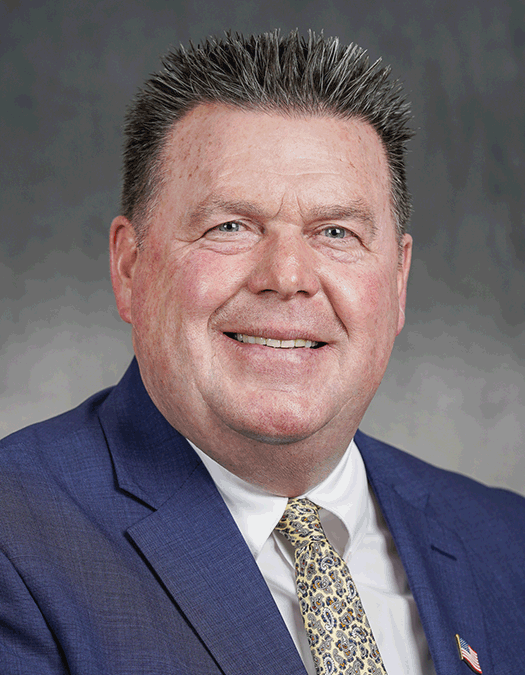
Rep. Tom Murphy
Sponsored bills
Maddy summaryHF 1593 allows counties and municipalities in Minnesota to delay compliance with certain state mandates until funding is provided. It specifically exempts local governments from mandates that affect daily operations, change resource allocation, or alter spending priorities - unless the required funding is minor relative to the local budget. Exceptions include mandates for financial audits, public safety, and health protections, which must still be followed. The law applies to state mandates effective after June 30, 2025, and modifies Minnesota Statutes sections 373.52 (for counties) and 471.343 (for municipalities).
Maddy summaryHF 13 would amend Minnesota Statutes section 609.06 to eliminate the requirement that individuals must attempt to retreat before using reasonable force in self-defense or defense of others. The bill specifically removes the "duty to retreat" provision, allowing people to use force without first trying to avoid confrontation if they reasonably believe it is necessary. This change would directly affect Minnesotans using force to defend themselves or others in situations where they perceive an immediate threat. The bill was introduced but not passed, as it was laid on the table during the 2025 legislative session.
Maddy summaryThis bill creates a new crime called disruption of worship services in Minnesota, targeting individuals who enter religious buildings with the intent to disrupt scheduled services by committing a crime. The law defines a religious establishment as a building used for worship that is clearly marked with a sign or other identifier. First-time offenders face gross misdemeanor charges, while repeat offenders could be charged with a felony punishable by up to five years in prison or a fine of $10,000 or both. The provisions take effect on August 1, 2026, and apply only to crimes committed on or after that date.
Maddy summaryThis bill modifies income and asset requirements for households receiving SNAP benefits in Minnesota. It requires SNAP households to demonstrate that their gross income does not exceed 200 percent of the federal poverty guidelines, while net income must still meet federal SNAP requirements. The legislation also changes how vehicles are counted toward asset limits, specifically requiring that vehicles with a trade-in value of $100,000 or more be included in personal property calculations rather than being excluded. These changes directly affect Minnesota residents applying for or receiving SNAP assistance by adjusting eligibility criteria for income and vehicle assets.
Maddy summaryThis bill repeals Minnesota's transportation greenhouse gas emissions impact assessment requirements and cancels $3 million in funding for related travel demand modeling. It directly affects the state Department of Transportation and metropolitan counties by removing the obligation to conduct emissions assessments for transportation projects. The legislation modifies how transportation funds are allocated, directing specific percentages toward active transportation, safety studies, infrastructure preservation, and transit services. Additionally, it updates the state highway investment plan to focus on performance targets for preservation, safety, and mobility over a 20-year period.
Maddy summaryThis bill updates Minnesota state law to define key terms related to autonomous vehicles, including automated driving systems, human drivers, and minimal risk conditions. It directly affects vehicle manufacturers, transportation companies, and law enforcement by establishing clear language for how these technologies operate and interact with public safety systems. The legislation creates specific definitions for dynamic driving tasks, first responder interaction plans, and on-demand autonomous vehicle networks to ensure consistent terminology across the state. By adding these definitions to existing transportation statutes, the bill provides a regulatory framework for future autonomous vehicle operations without changing current operational requirements.
Maddy summaryHF 3562 modifies Minnesota's motor vehicle registration tax for passenger cars and hearses. It reduces the tax rate from 1.54-1.575% to 1.25-1.285% of a vehicle's manufacturer's suggested retail price (MSRP), depending on whether the vehicle was first registered in Minnesota before or on/after November 16, 2020. The tax amount decreases each year based on the vehicle's age (e.g., 100% of MSRP in year one, dropping to 10% in year ten), then becomes a flat $20 annually after the 10th year. This bill directly affects Minnesota vehicle owners paying registration fees for passenger cars and hearses, effective for registrations starting January 1, 2027.
Maddy summaryThis bill strengthens penalties for misconduct by public officers and employees in Minnesota by increasing potential fines and prison sentences. It directly affects government officials and employees who fail to perform required duties, exceed their legal authority, harm others under false pretenses, or knowingly submit false official documents. Under the new provisions, first-time offenders could face up to one year in prison or a $5,000 fine, while repeat offenders could be sentenced to up to five years in prison or a $10,000 fine. The changes take effect on August 1, 2026, and apply to crimes committed on or after that date.
Maddy summaryHF 7 modifies multiple public safety laws in Minnesota. It requires law enforcement agencies to make bail/bond information public and mandates county attorneys to publicly report reasons for dismissing charges. The bill establishes mandatory minimum sentences for certain sex trafficking offenses and requires individuals subject to stays in sexual conduct cases to register as predatory offenders. It also increases penalties for assaulting police officers, obstructing highway/airport traffic, and expands law enforcement's use of tracking devices on fleeing vehicles. These changes apply directly to law enforcement agencies, prosecutors, and individuals involved in criminal cases.