

Maddy summaryHF 260 extends an exemption for small employers from Minnesota's Paid Leave Law until January 1, 2028. The bill amends Minnesota Statutes to exempt employers with 20 or fewer employees (as calculated under section 268B.14, subdivision 5b) from the law's requirements. This means small businesses in Minnesota will not need to provide paid leave to employees until 2028, while larger employers must comply earlier. The exemption expires on January 1, 2028, after which all employers must adhere to the full Paid Leave Law.
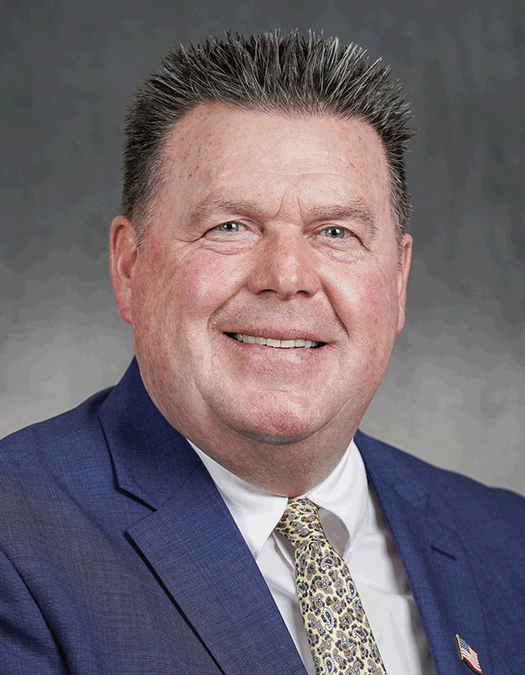
Rep. Tom Murphy
Sponsored bills
Maddy summaryHF 229 appropriates $1,050,000 in state bond funds to create a 12-unit youth transitional facility in Perham, Otter Tail County. The facility will provide transitional housing with comprehensive supportive services for young people transitioning from foster care or other systems. The bill authorizes the state to issue bonds to cover the cost, with funds directed to Otter Tail County for design, construction, and equipment. This directly affects youth in Perham needing housing support and Otter Tail County as the recipient of the grant.
Maddy summaryHF 636 removes the requirement for a permit to carry a firearm in public places for eligible Minnesotans, while creating an optional permit system. The bill amends Minnesota Statutes 624.714 to state that anyone not prohibited by state or federal law (and at least 21 years old) may carry a firearm without a permit in public places - defined as government-owned property or private property open to the public, excluding homes, businesses, gun shops, and hunting areas. An optional permit, which requires proof of pistol safety training and background checks for disqualifying offenses, remains available for those who choose it. This change directly affects eligible residents who currently need permits to carry firearms in public, eliminating that barrier while preserving the option for a permit.
Maddy summaryHF 378 creates a temporary two-year income tax exemption for certain emergency responders in Minnesota, effective for tax years 2025-2026. It applies to individuals who worked at least 1,000 hours (as paid or volunteer) in ambulance services or as emergency medical responders in Minnesota during the tax year, with adjusted gross income under $75,000 ($150,000 for joint filers). The exemption allows eligible individuals to avoid paying Minnesota individual income tax on their earnings during this period. This policy directly affects qualifying emergency medical personnel meeting these specific work and income criteria.
Maddy summaryThis bill modifies Minnesota's existing law restricting firearm discharge near livestock corrals. It clarifies that the 500-foot rule does not apply to hunters during established seasons on state or local government land (excluding road rights-of-way) or to landowners shooting on their own property or land owned by an immediate family member. The change specifically exempts normal hunting activities and personal land use from the restriction. This directly affects livestock owners, hunters, and landowners by adjusting when firearm use near corrals is permitted.
Maddy summaryHF 370 establishes a two-year income tax exemption in Minnesota for eligible direct support professionals working in specific care facilities. It exempts qualifying workers from state income tax for tax years 2025 and 2026, provided they worked at least 1,000 hours at an eligible facility (like nursing homes, assisted living, or developmental disability facilities) and earned under $75,000 individually ($150,000 for joint filers). The exemption applies to income tax under Minnesota Statutes, chapter 290, and does not affect existing refundable credit claims. This policy directly benefits lower-income care workers in defined long-term care settings.
Maddy summaryThis bill appropriates $250,000 from the general fund for the Minnesota Commissioner of Agriculture to develop a science-based assessment of mRNA treatments for livestock. The assessment must evaluate risks and benefits, including current commercial use and research trials, and be developed with input from the University of Minnesota Veterinary Medical Center and the Commissioner of Health. The Commissioner must submit a final report with policy recommendations to relevant legislative committees by January 15, 2026. The bill directly affects Minnesota's livestock industry by funding a review of emerging agricultural technologies, though it does not impose new regulations or requirements on farmers.
Maddy summaryHF 375 amends Minnesota law to specify how proceeds from gambling-related taxes are allocated. It directs a portion of these tax revenues - specifically, the combined net receipts tax from gambling - to three designated accounts: town roads, small cities assistance, and the general fund. Additionally, it allocates half a percent of the general fund revenue to two state programs: compulsive gambling treatment services and public awareness/education initiatives for problem gambling. The bill requires annual reporting to legislative committees and the National Council on Problem Gambling affiliate on how these funds are distributed.
Maddy summaryHF 366 appropriates $1.2 million from the general fund for a one-time resurfacing project on Trunk Highway 74 in Winona County. The funds cover work from north of Elba to County State-Aid Highway 30, including design, engineering, and construction using methods like Otta seal. This bill directly affects Winona County residents and travelers using this highway segment by improving road conditions. The appropriation is available until June 30, 2028, and is limited to the specified highway section.
Maddy summaryHF 379 creates a two-year income tax exemption for eligible Minnesota police officers. It applies to taxable years 2025-2026 for officers who worked at least 1,000 hours as a peace officer in Minnesota during the year and had adjusted gross income under $75,000 (or $150,000 for joint filers). The exemption allows qualifying officers to file tax returns without owing state income tax for those years. This policy directly affects lower-to-moderate income sworn police officers meeting the specified hours and income thresholds.