

Maddy summaryHF 1566 requires landlords in Minnesota to make reasonable safety modifications for tenants with children who have autism, specifically when hazards like lakes, rivers, or other water bodies are near rental properties. Tenants must request these accommodations, and landlords can ask for documentation unless the child's condition is obvious. Landlords cannot retaliate against tenants making such requests and must adjust policies or property features to protect the child, unless the change would fundamentally alter the property. This bill directly affects tenants with autistic children and their landlords in rental housing.
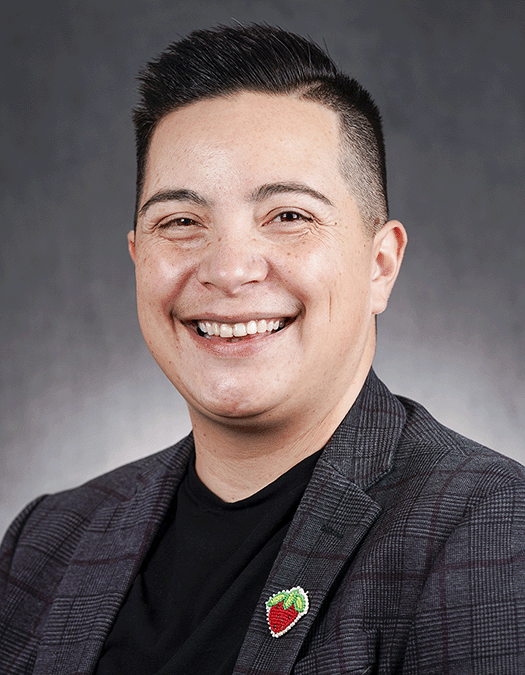
Rep. Liish Kozlowski
Sponsored bills
Maddy summaryHF 1535 allocates $1.7 million from Minnesota's general fund for a one-time grant to the Duluth Children's Museum, a nonprofit organization. The funding is specifically for designing, constructing, furnishing, and equipping capital improvements to expand the museum's building in Duluth. This appropriation is available until the project is completed or abandoned, as outlined in Minnesota Statutes section 16A.642. The bill directly affects the Duluth Children's Museum by providing resources for physical infrastructure upgrades.
Maddy summaryHF 1389 transfers specific state-owned land at the Cloquet Forestry Center in Carlton County to the University of Minnesota Board of Regents. It appropriates $1.3 million from the general fund to pay off existing state bonds financing improvements on this property, removing it from "state bond-financed property" status under Minnesota law. This debt payment enables the University of Minnesota to eventually return the land to the Fond du Lac Band of Lake Superior Chippewa, as stated in the bill's purpose. The bill directly affects the state, the University of Minnesota, and the Fond du Lac Band by facilitating a land transfer.
Maddy summaryHF 1385 appropriates funds from the general fund for a statewide tenant education and hotline service in Minnesota. The bill allocates unspecified amounts for fiscal years 2026 and 2027 to provide all Minnesota renters with free, confidential legal advice through a hotline and educational resources. The service will be administered by the Housing Finance Agency. This funding directly supports renters seeking assistance with housing rights and legal questions.
Maddy summaryHF 1537 appropriates $44 million from state bond proceeds to fund Minnesota's Port Development Assistance Program under Chapter 457A of state law. The funds must be used for publicly owned port infrastructure improvements, such as docks or equipment. The commissioner of management and budget will issue up to $44 million in state bonds to provide this funding, following established bond procedures. This bill directly affects Minnesota ports seeking capital improvements for public use.
Maddy summaryHF 1602 appropriates $2 million for fiscal year 2026 and $2 million for fiscal year 2027 from Minnesota's workforce development fund to the Latino Economic Development Center (LEDC). The bill directly provides funding to LEDC to support microentrepreneurs and prospective business owners, particularly in Minnesota's Latino community. Key provisions include using the funds for business training, workshops, one-on-one consultations, and assistance with startup processes - covering areas like green jobs, technology, STEM careers, and manufacturing. The grant aims to build business capacity and connect entrepreneurs to key resources, with no new laws or regulations created.
Maddy summaryThis bill appropriates $2.5 million for fiscal year 2026 and $2.5 million for fiscal year 2027 from the general fund to support the Greater Minnesota business development public infrastructure grant program. The funds will be administered by the commissioner of employment and economic development under Minnesota Statutes § 116J.431. The program directly assists businesses located outside Minneapolis (referred to as "Greater Minnesota") by providing grants for public infrastructure improvements. This is a funding allocation, not a new policy, with no changes to program eligibility or requirements.
Maddy summaryHF 1281 appropriates $750,000 from Minnesota's arts and cultural heritage fund for fiscal year 2026 to fund a lake sturgeon project at the Great Lakes Aquarium. The funds will support rearing and stocking lake sturgeon, along with public education about their historical, cultural, and biological significance in the St. Louis River. This project is implemented in partnership with the Minnesota Department of Natural Resources, the Fond du Lac Band of Lake Superior Chippewa, and the U.S. Fish and Wildlife Service. The bill directly affects these organizations by providing dedicated funding for conservation and educational activities focused on lake sturgeon recovery.
Maddy summaryHF 115 appropriates $650,000 from the arts and cultural heritage fund for the Minnesota Children's Museum in fiscal years 2026 and 2027. The funding is intended to support new hands-on learning opportunities and expanded community outreach programs across Minnesota. This bill directly provides financial resources to the museum for specific educational initiatives. It is a straightforward funding measure with no additional policy provisions or requirements beyond the specified appropriation.
Maddy summaryHF 1041 imposes an additional tax on Minnesota corporations with high executive-to-median-worker pay ratios, ranging from 0.2% to 1.5% based on the ratio tier (e.g., 0.2% for 50:1 to 100:1 ratios). It directly affects corporations meeting specific pay ratio thresholds, using the federal disclosure standard (17 CFR § 229.402(u)(1)(iii)) to calculate the ratio. The bill also disqualifies these corporations from receiving state grants or subsidies, as specified in amended Minnesota Statutes sections 16B.981 and 290.06. The tax applies to taxable years beginning after December 31, 2025, with disqualification effective January 1, 2026.