

Maddy summaryHF 2810 appropriates $250,000 for fiscal year 2026 and $250,000 for fiscal year 2027 from the general fund to fund horse-assisted therapy for eligible first responders in Minnesota. It directs these funds to 7 Stars Ranch to provide mental health therapy to first responders suffering from job-related trauma or PTSD, including police officers, firefighters (full-time and volunteer), ambulance personnel, 911 dispatchers, and correctional officers. The bill requires 7 Stars Ranch to submit two reports detailing program costs, participants served, and benefits received - initially by January 2026 and finally by January 2028. This is a one-time funding appropriation with no ongoing program mandate beyond the specified reporting.
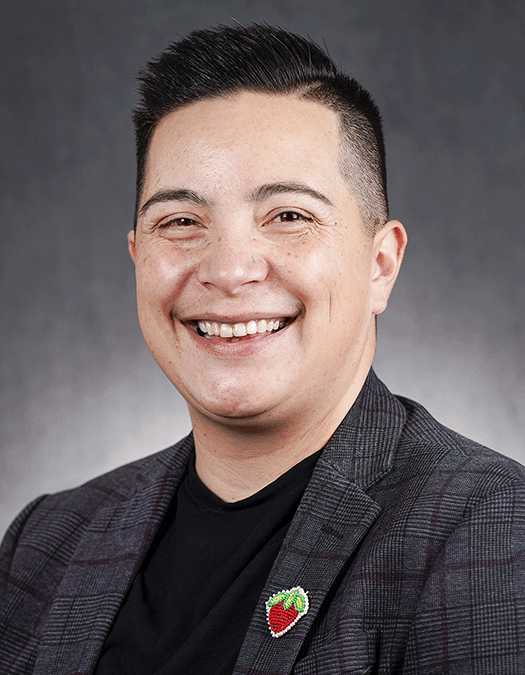
Rep. Liish Kozlowski
Sponsored bills
Maddy summaryHF 2148 establishes a locally controlled housing fund within Minnesota's housing development fund to finance affordable housing projects. The fund provides loans to eligible recipients - including cities, counties, tribes, community land trusts, and housing authorities - to acquire, rehabilitate, or build housing where local entities maintain at least 75% ownership control. Projects must include 30% of units for households earning ≤50% of area median income (AMI) and 30% for households earning 50-100% of AMI, with all housing meeting accessibility standards and avoiding income-based segregation. Repayments to the fund are reinvested to support additional affordable housing production in the recipient’s jurisdiction.
Maddy summaryHF 1489 appropriates $100 million from state bond proceeds to rehabilitate public housing for low-income residents in Minnesota. The funds, administered by the Minnesota Housing Finance Agency, will cover costs for preserving publicly owned, federally financed housing units. Key provisions require prioritizing health, safety, and energy improvements in rehabilitation projects while maximizing federal or local funding. The state will issue up to $100 million in bonds to finance this appropriation, effective upon enactment. This directly supports public housing providers and residents in maintaining safe, affordable housing.
Maddy summaryHF 2707 appropriates $11.125 million for each of fiscal years 2026 and 2027 from the general fund to support sexually exploited youth or youth at risk of sexual exploitation under Minnesota Statutes §256K.47. At least $9 million annually must fund street outreach, emergency shelter, regional navigators, and housing services for these youth. The bill directly affects vulnerable youth in Minnesota by providing dedicated funding for critical safe harbor resources and housing support. It establishes concrete funding mechanisms without altering existing statutes or creating new requirements.
Maddy summaryHF 1412 appropriates $202,600 from the general fund to the Minnesota Department of Health for a one-time grant to the Division of Indian Work. The bill directs this funding to develop and pilot culturally specific suicide prevention curriculum for Native American youth in Minnesota. The curriculum must cover mental health, emotional intelligence, depression, and suicide, providing practical tools for students to support themselves and others. It specifically targets Native American youth and is not intended for general school use.
Maddy summaryHF 186 requires Minnesota's transportation department to conduct cumulative impacts analyses and alternative design studies for highway projects, incorporating community input through a new policy advisory committee. It creates a dedicated environmental justice ombudsperson position to address equity concerns and restricts highway funds from covering non-transportation uses like tourist kiosks, parades, or electric vehicle infrastructure. The bill directly affects highway planning decisions, funding allocations for the Minnesota Department of Transportation, and communities near proposed projects. Key provisions include mandating community input for project designs and clarifying eligible uses of highway funds under Minnesota Statutes.
Maddy summaryHF 2727 appropriates $2.3 million from the general fund for fiscal year 2026 to stabilize a shoreline near Scandia Cemetery in St. Louis County. The funds will be used by St. Louis County to construct a retaining wall and a related access road. This bill directly affects residents and property near the Scandia Cemetery area by addressing shoreline erosion. It provides specific funding for a defined infrastructure project without altering broader environmental regulations.
Maddy summaryHF 573 appropriates $6 million from state bonds to fund a new integrated solid waste management campus in St. Louis County. The grant will help the county acquire land, design, and build the campus to manage waste from closed landfills and prevent hazardous chemicals like PFAS from contaminating Lake Superior. The bill authorizes the state to issue up to $6 million in bonds to cover these costs, following standard state bond procedures. This directly affects St. Louis County residents and the environmental protection of Lake Superior. The project aims to address waste management from existing landfills while safeguarding water quality.
Maddy summaryHF 2635 appropriates $5.5 million from Minnesota's workforce development fund to build a regional career technical education center in Northeastern Minnesota. The funds will support Independent School District No. 704 in Proctor, in partnership with Hermantown and Esko school districts, to construct a facility for workforce training. The center must address regional industry needs and can use the funds for property, construction, remodeling, and equipment. This bill directly affects students and job seekers in the Northeastern Minnesota region by creating a dedicated training hub.
Maddy summaryHF 107 modifies Minnesota's unemployment insurance rules for workers involved in labor disputes. It specifies that workers participating in or directly affected by a labor dispute can receive benefits until the end of the week the dispute was active, while those not involved are eligible until the dispute began. The bill clarifies that certain situations - like employer safety violations, lockouts, or being fired before a dispute starts - do not make applicants ineligible. This directly affects workers who stop working due to labor conflicts, ensuring they maintain eligibility under defined conditions. The changes amend Minnesota Statutes section 268.085, subdivision 13b.