

Maddy summaryHF 2171 is a symbolic resolution, not a law. It asks Congress to recognize Minnesota's historical ratification of the Child Labor Amendment (ratified by Minnesota in 1933), which would authorize federal regulation of child labor for those under 18. The resolution has no legal effect, as the amendment remains unratified nationally (requiring 38 states, but only 27 have ratified) and federal child labor laws are already in place following the 1941 Supreme Court case *United States v. Darby Lumber Co.*
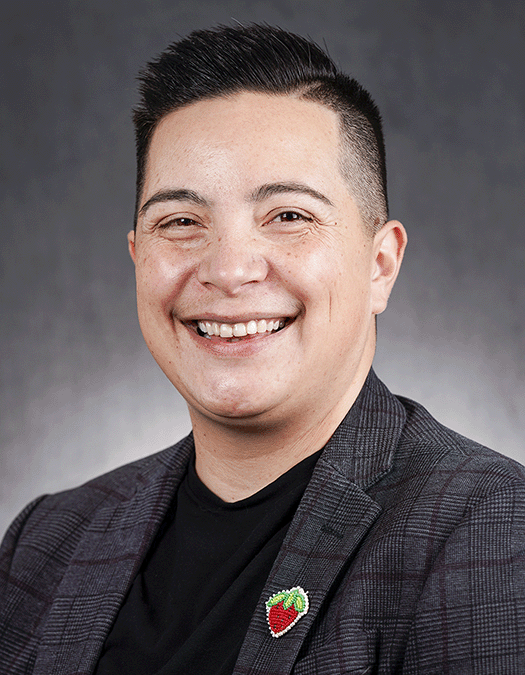
Rep. Liish Kozlowski
Sponsored bills
Maddy summaryHF 3125 appropriates $8,856,000 from state bond proceeds to fund a community engagement center in Duluth specifically for people experiencing homelessness. The bill authorizes the sale of state bonds to cover this cost and directs funds toward predesign, construction, and equipment for facilities including a commercial kitchen, warming center, health services, classrooms, and hygiene spaces. The Housing and Redevelopment Authority of Duluth will receive the grant to develop and operate the center, with potential lease or management agreements for program operations. This funding is effective upon final enactment.
Maddy summaryThis bill modifies Minnesota's definition of a "debt buyer" to clarify that businesses purchasing charged-off medical debts for collection purposes are considered debt buyers, while excluding nonprofits buying for charitable reasons. It appropriates $5 million from the general fund for a one-time grant to the nonprofit Undue Medical Debt to relieve medical debt for eligible residents who couldn't pay after hospitals completed reasonable collection efforts. The grant must be used by June 30, 2028, and Undue Medical Debt must report recipient demographics to state agencies. The bill directly affects low-income Minnesotans with unpaid medical bills and hospitals that previously pursued collections.
Maddy summaryHF 2018 requires Minnesota municipalities to permit multifamily residential developments (buildings with 13+ units or mixed-use buildings with ≥50% residential space) in zoning districts that allow commercial uses, effective until December 31, 2029. It limits local governments' ability to block such projects through comprehensive plan amendments or zoning changes, mandating approval under defined conditions. Municipalities must still enforce standards for public health, safety, infrastructure, and existing environmental protections (e.g., floodplains). The bill directly affects local zoning decisions, developers seeking to build apartment complexes, and residents in communities with commercial zoning. It does not override state/federal prohibitions or require affordable housing in all projects.
Maddy summaryThis bill appropriates $22.9 million for fiscal year 2026 and $12.9 million for fiscal year 2027 from the general fund to Minnesota's Housing Finance Agency. The funds will support the Economic Development and Housing Challenge Program and low/moderate-income housing initiatives under state law. It specifically reserves $1.2 million annually for housing projects serving American Indian communities, with unspent funds available for other eligible housing activities. The bill directly affects housing developers, communities, and residents seeking affordable housing in Minnesota.
Maddy summaryHF 3158 proposes a constitutional amendment requiring a two-thirds vote in both the Minnesota House and Senate to authorize public funding for the design, construction, or renovation of a professional sports facility. Currently, a simple majority vote suffices for such funding. The amendment must be submitted to voters in the 2026 general election, where they will decide whether to adopt the two-thirds requirement. If approved by voters, this change would become part of the Minnesota Constitution, affecting future legislative decisions on sports facility funding.
Maddy summaryHF 1914 appropriates state funds for three key human services programs in Minnesota. It provides emergency services grants for immediate crisis support, county grants to address homelessness gaps (prioritizing Tribal Nation partnerships and interventions like 24/7 shelters), and funding for provider capacity-building collaboratives. The capacity-building program helps service providers access stable funding streams, including Medicaid waivers and housing support programs. These funds are allocated for fiscal years 2026 and 2027, with unspent first-year money rolling over to the second year. The bill directly affects counties, service providers, and people experiencing homelessness by expanding access to crisis support and housing-focused services.
Maddy summaryHF 1309 prohibits Minnesota local governments (cities and counties) from requiring minimum parking spaces for new residential, commercial, or industrial buildings. The bill directly affects developers and property owners by removing a common zoning requirement that previously mandated a set number of parking spots. Key provisions state that political subdivisions cannot impose these minimums, though they may still require ADA-compliant disability parking or make non-binding parking space recommendations. This change aims to increase flexibility for development projects, potentially allowing more housing or commercial space without dedicated parking.
Maddy summaryHF 3075 allows individuals to change, remove, or add the sex indicator on their birth records in Minnesota. It directly affects people whose birth records include a sex designation, including minors (with parental/guardian consent) and adults 18+ or emancipated minors. To request a change, applicants must provide acceptable documentation like a medical provider's statement, court order, or sworn statement confirming the request is in good faith and, for minors, in their best interest. If documentation meets requirements, the state must approve the change. After approval, the original birth record becomes confidential and can only be accessed with a court order.
Maddy summaryHF 3074 creates legal rights for transportation network company (TNC) drivers in Minnesota to form and join labor organizations for collective bargaining. It directly affects "active drivers" who completed at least the median number of rides in the most recent two quarters, as defined by the bill. The law establishes a certification process where drivers can designate an exclusive representative (like a union) through the Bureau of Mediation Services, while prohibiting TNCs from controlling or dominating driver representation groups ("company unions"). Drivers gain the right to negotiate terms and conditions of work, including grievance procedures, with TNCs, and the bill defines "lockout" to prevent TNCs from restricting driver access to the platform during disputes.