

Maddy summaryThis bill modifies retirement vesting rules for Minnesota firefighters relief associations, making it easier for members to earn full pension benefits over a shorter period. It establishes a phased schedule where firefighters will reach 100% vesting in 20 years by 2027, 15 years by 2029, and 10 years by 2030, with corresponding increases in how quickly they earn their pension rights each year. The changes apply to both defined contribution plans, where members build accounts, and defined benefit plans, where members earn pension amounts based on service. Firefighters covered by these retirement systems will see faster vesting timelines, meaning they can claim their full pension benefits after fewer years of service than previously required.
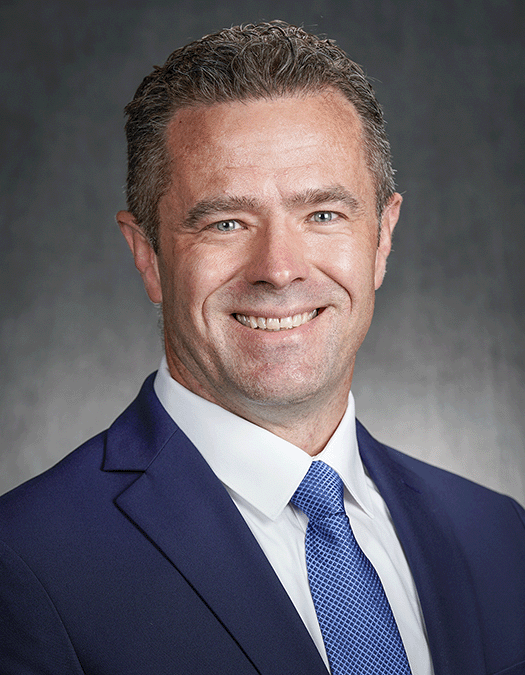
Rep. Pete Johnson
Sponsored bills
Maddy summaryHF 3356 requires sellers to remove all emergency vehicle identifying features - like sirens, lights, emblems, and antennas - from public safety vehicles (such as police or fire vehicles) before selling them to the public. This applies to private sales but excludes transfers to government entities, licensed ambulance services, or collector vehicles registered under specific statutes. Sellers must provide a certificate confirming the removal, and violations carry a $2,500 civil penalty, with funds directed to Minnesota’s victims of crime account. The bill aims to prevent misleading sales that could allow misuse of emergency vehicle markings.
Maddy summaryHF 3691 adds "emergency managers" to the statutory definition of "essential employees" in Minnesota law. This means emergency managers - professionals who coordinate responses to crises like natural disasters or public safety incidents - will now be officially classified as essential employees, alongside firefighters, police dispatchers, and correctional guards. The bill amends Minnesota Statutes § 179A.03, specifically adding "emergency managers" to the list of roles considered essential during emergencies. This change ensures emergency managers receive the same legal protections and operational status as other designated essential workers during critical events.
Maddy summaryHF 3695 establishes a task force to create a standardized identification system for Minnesota emergency responders (including police, firefighters, and EMTs). The task force, composed of state agency leaders and representative organizations, must design an ID card including a photo, name, role (e.g., peace officer or EMT), physical description, and certification details. It will also develop a plan for mandatory use of this ID by responders and their employers, and recommend whether the state or local governments should issue it. The bill appropriates funds for the task force’s work and requires a final report to the legislature by 2028. This is a procedural proposal to develop standards, not an immediate law.
Maddy summaryHF 3687 modifies Minnesota's medical assistance and MinnesotaCare coverage for chiropractic services. The bill removes the previous age restriction (limiting coverage to those under 21) and establishes new rules: chiropractic care for spinal pain, chronic conditions, and related services is covered for all ages, but limited to 24 visits per year without prior authorization. It also restricts x-ray coverage to specific spine examinations necessary for diagnosing subluxation. This affects all MinnesotaCare and medical assistance recipients seeking chiropractic care, changing coverage from age-limited to broadly applicable with visit and x-ray restrictions. The changes take effect January 1, 2027, or after federal approval.
Maddy summaryHF 3704 prohibits the sale or distribution of certain crop seeds (like corn, soybeans, and wheat) coated with systemic insecticides after January 1, 2029, unless a commissioner-issued waiver is provided. It also bans applying neonicotinoid insecticides (e.g., imidacloprid) to ornamental outdoor plants and turf, except in specific environmental emergencies approved by the commissioner. Farmers seeking seed waivers must complete integrated pest management training and submit third-party pest risk assessments. The bill requires annual training for applicators and allows limited emergency use if less harmful alternatives are ineffective. It directly affects farmers, gardeners, seed sellers, and pesticide applicators in Minnesota.
Maddy summaryHF 3643 establishes Melissa and Mark Hortman Memorial State Park in Ramsey County, specifically within St. Paul, as a new public park. The bill designates precise boundaries for the park using 18 directional points in St. Paul and requires that no park permit or entry fee be charged. It directs the commissioner of natural resources to manage the park under standard state park rules, while specifying that the commissioner of administration and Minnesota Historical Society retain authority over existing buildings and monuments within the park. The legislation also appropriates funds for the park’s establishment, directly affecting public access to this newly designated green space in the city.
Maddy summaryHF 2136 appropriates $250,000 for fiscal year 2026 and $250,000 for fiscal year 2027 from the general fund to provide grants for forensic interview training scholarships. The funds will support nationally recognized organizations that offer scholarships to law enforcement, child protection workers, prosecutors, health professionals treating child maltreatment cases, and forensic interviewers at children's advocacy centers. These scholarships cover basic, advanced, and specialized forensic interview training. The bill directly affects Minnesota professionals working with child abuse cases by expanding access to specialized training through state-funded scholarships.
Maddy summaryThis bill authorizes the sale and issuance of up to $10 million in state bonds to fund the Greater Minnesota Business Development Public Infrastructure Grant Program. The funds will be distributed by the commissioner of employment and economic development to provide grants for public infrastructure projects in Greater Minnesota. The legislation enables the state to raise capital through bond sales to support economic development initiatives in rural areas, with the money coming from the bond proceeds fund. The bill becomes effective the day after it is passed by the legislature.
Maddy summaryHF 3435 limits access to Minnesota school sites by federal immigration officials. It requires U.S. Immigration and Customs Enforcement (ICE), Customs and Border Protection (CBP), and other DHS agents to show valid identification, provide a written statement of purpose, and obtain a judicial warrant before entering schools. School officials must also approve entry and restrict such agents to areas without students present, even if all requirements are met. The bill applies directly to federal immigration enforcement personnel and school districts operating under Minnesota law.