

Maddy summaryThis bill increases funding for student support personnel in Minnesota schools by raising the per-pupil allowance amounts and establishing minimum funding floors for districts and charter schools. It directly affects independent school districts, special districts, charter schools, and cooperative units by adjusting how much money they receive for staff like counselors, nurses, and social workers. The law sets specific dollar amounts for the per-student allowance in 2025, 2026, 2027, and beyond, while also requiring districts to reserve funds in their balances and limiting cooperative aid to actual expenditures. Additionally, the bill appropriates state money to cover these increased funding levels for fiscal years 2026 and 2027.
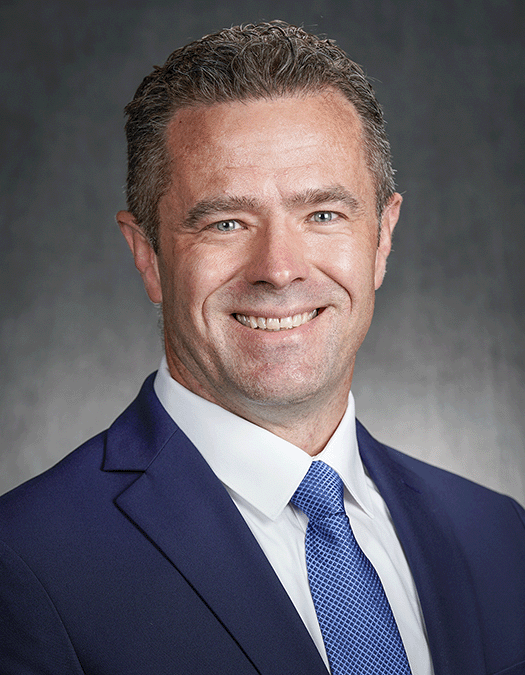
Rep. Pete Johnson
Sponsored bills
Maddy summaryThis bill establishes a new state wealth tax in Minnesota that would apply to individuals and trusts with taxable wealth exceeding $10 million. The tax would be calculated as one percent of the amount above that threshold, based on the total value of all property owned within Minnesota minus any debts owed by the taxpayer. Property values would be determined using the same valuation methods used for federal estate taxes, and the tax would apply to both residents and nonresidents who own property in the state. The legislation would take effect for taxable years beginning after December 31, 2025, and would be collected in addition to existing state taxes.
Maddy summaryHF 3403 allocates $44 million for counties and $6 million for Tribal governments in fiscal year 2026 to provide emergency rental assistance. It requires counties and Tribal governments to use these funds solely for rental assistance to eligible households meeting three criteria: income at or below 200% of the federal poverty level, Minnesota residency, and homelessness or imminent housing crisis. Funds must be distributed within 15 days of the bill's effective date and spent within 180 days, with unspent money returned to the state general fund. This one-time appropriation directly supports low-income renters facing housing instability across Minnesota.
Maddy summaryThis bill creates a new Greenhouse Gas Pollution Superfund in Minnesota to address climate change impacts. It establishes a program that requires fossil fuel companies responsible for over one billion metric tons of emissions between 1995 and 2026 to pay into a dedicated account. The collected funds will be used to finance climate change adaptation projects for state, local, and Tribal governments, as well as for disadvantaged communities. The bill defines specific terms like "responsible party" and "covered greenhouse gas emissions" to determine which companies must contribute and what types of projects can receive funding.
Maddy summaryThis bill repeals a previous requirement that reduced special education funding by $250 million starting in the 2027-2028 school year. The legislation directly affects the state's education finance system and the Department of Education by removing the mandate to cut special education aid appropriations. Under this bill, the commissioner of management and budget will no longer be required to assume the $250 million reduction when preparing state revenue forecasts, and the commissioner of education will not need to adjust the special education cross subsidy aid factor to make up any shortfall. The change takes effect on July 1, 2026, restoring the previous funding structure for special education aid.
Maddy summaryThis bill prohibits Minnesota municipalities from signing nondisclosure agreements that prevent them from sharing information about projects funded with public money. It directly affects local governments, including cities, counties, school districts, and other political subdivisions that manage public funds. The law makes any such restrictive contracts automatically unenforceable and requires municipalities to publicly disclose any agreements that violate this rule. The provision specifically covers projects involving land development, economic initiatives, tax revenues, bonds, and other debt obligations.
Maddy summaryHF 1338 creates an independent Office of the Inspector General in Minnesota to oversee state agencies and programs. The office will conduct audits and investigations into fraud, waste, and abuse of public funds, report findings publicly, and recommend improvements. It directly affects all state executive branch agencies and programs receiving taxpayer funding, requiring them to comply with oversight. Key provisions include establishing strict qualifications for the Inspector General, granting subpoena power, and mandating annual public reports. The bill also appropriates funding for the office's operations and staff.
Maddy summaryThis bill requires health insurance plans in Minnesota to cover cancer screenings for breast, colorectal, prostate, cervical, and lung cancers in accordance with current American Cancer Society guidelines. The law mandates that these plans provide coverage for all recommended examinations and follow-up tests without imposing any cost-sharing requirements, such as co-pays, deductibles, or coinsurance. Effective January 1, 2027, the provisions will apply to any health plan that is offered, issued, or renewed on or after that date.
Maddy summaryThis bill establishes the Minnesota Business Recovery Loan Program to provide financial assistance to businesses that have suffered revenue losses exceeding 30% due to staffing shortages or disruptions caused by increased immigration enforcement activities. The program allocates $100 million in one-time funding, with $18 million designated for zero-interest loans to businesses in greater Minnesota and $82 million for zero-interest loans to businesses in the seven-county metropolitan area through nonprofit lenders. To qualify, businesses must be Minnesota-based, in good standing, and demonstrate that their revenue decline stems from immigration-related events between the bill's enactment and December 1, 2025. Loan amounts vary by business size and location, ranging from $25,000 to $200,000, and funds must be used exclusively for business operations within Minnesota rather than debt repayment or real estate investment.
Maddy summaryHF 3624 appropriates $5,392,000 from the general fund for Minnesota's food shelf programs in fiscal year 2027. The funding, added to the base allocation, supports existing food shelf operations under Minnesota Statutes section 142F.14, administered by the state agency for children, youth, and families. This bill directly affects community food shelves that provide emergency food assistance to Minnesotans in need, without changing program eligibility or creating new requirements. The measure focuses solely on providing dedicated state funding for current food shelf services.