

Maddy summaryHF 1005 adjusts payment rates for healthcare providers under Minnesota's medical assistance program. It increases reimbursement rates for certain residential services, sets a new statewide rate for behavioral health home services, and adjusts physician professional service rates. These changes directly affect hospitals, clinics, and care providers receiving state medical assistance payments for these specific services. The bill amends existing statutes to implement these rate adjustments while requiring budget neutrality for hospital payments. It does not create new programs but modifies existing payment structures for covered services.
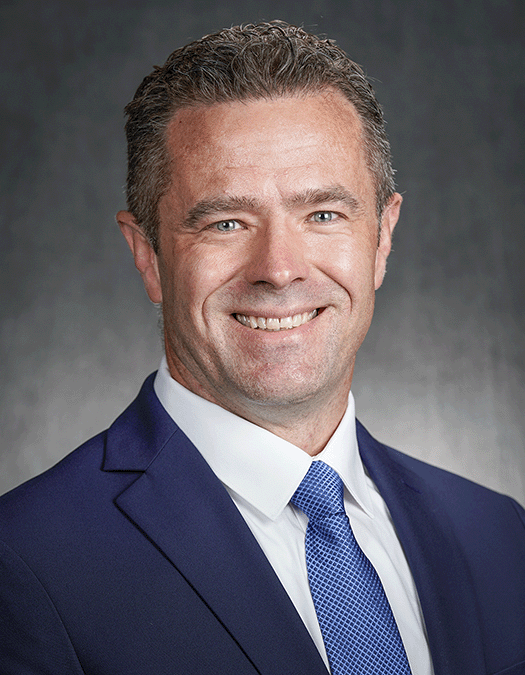
Rep. Pete Johnson
Sponsored bills
Maddy summaryHF 1295 amends Minnesota law to include children's advocacy centers as a program eligible to receive 70% of certain fines collected from offenders convicted of specific crimes, such as those involving child abuse or exploitation. The bill requires courts to collect a minimum fine of 30% of the maximum penalty for these crimes and forward 70% of that amount to a local victim assistance program, now explicitly including children's advocacy centers. If multiple programs serve the county, courts may choose which one receives funds based on the crime type and program needs; if no program is available, funds go to the state general fund. This ensures children's advocacy centers can directly access funding to provide services for child victims.
Maddy summaryHF 99 appropriates $4 million for fiscal year 2026 and $4.5 million for fiscal year 2027 from the general fund to support housing with services for Minnesotans with serious mental illness. The funds will be provided to the commissioner of human services to expand grants under Minnesota Statutes section 245.992, specifically increasing the availability of supported housing options. This funding is added to existing appropriations and directly affects individuals with serious mental illness who need housing combined with support services. The bill creates a concrete policy change by allocating new state funds to address housing needs for this population.
Maddy summaryHF 339 appropriates $1 million from the general fund for fiscal year 2026 to the Nursing Home Workforce Standards Board. This one-time funding is specifically for grants to certified worker organizations that support nursing home workers. The grants help these organizations carry out duties under Minnesota Statutes section 181.214, which relates to nursing home workforce standards. The funds are available until June 30, 2028.
Maddy summaryHF 2325 requires Minnesota employers to pay non-exempt employees at least 1.5 times their regular hourly rate for work performed on designated holidays. The bill directly affects hourly workers in Minnesota who are scheduled to work on holidays defined under Minnesota Statutes section 645.44, subdivision 5. It amends existing law (Minnesota Statutes 2024, section 177.25) to add a new provision mandating this overtime pay rate specifically for holiday work. This changes the current standard by explicitly requiring higher pay for holiday shifts, rather than allowing employers to use alternative compensation methods. The bill does not change the definition of "holiday" but specifies the required pay rate when work occurs on those days.
Maddy summaryHF 470 appropriates $96.565 million from the general fund for each of fiscal years 2026 and 2027 to fund Minnesota's early learning scholarships program under Minnesota Statutes section 142D.25. This funding directly supports families with young children by providing financial assistance for early learning services. The bill establishes a specific, dedicated funding stream for the program, adding it to the base budget. It does not change eligibility criteria or program rules, only providing the necessary state funding to operate the existing scholarship program.
Maddy summaryHF 1936 appropriates $1.25 million for fiscal year 2026 and $1.25 million for fiscal year 2027 from the workforce development fund to the Minnesota Alliance of Boys and Girls Clubs. The funds will support a statewide youth job skills and career development program focused on early access to education, work-based learning, STEM pathways, career exploration, and first job placement through community partnerships. The program must include career guidance and life skills components, and requires a 25% match from nonstate resources. This is a one-time funding appropriation for a specific youth workforce initiative.
Maddy summaryHF 1847 appropriates $1.2 million for fiscal year 2026 and $1.2 million for fiscal year 2027 from the general fund to the Minnesota STEM Ecosystem. The funds must support STEM learning opportunities and workforce development in science and technology fields across the state. The Minnesota STEM Ecosystem can award subgrants to programs that align with statewide STEM initiatives to ensure coordinated efforts. This bill directly affects STEM education programs and workforce development organizations receiving these grants.
Maddy summaryHF 1332 appropriates $18 million from state bonds to fund forest management on Minnesota's state forest lands. The funds cover reforestation activities (like planting native seeds and trees), site preparation, and forest stand improvement, including treatment for pests like emerald ash borer and spruce budworm. The state will issue bonds up to $18 million to finance these projects, administered by the commissioner of natural resources under Minnesota Statutes. This bill directly affects state forest management operations and the use of public funds for forestry capital projects.
Maddy summaryHF 2838 appropriates unspecified funds from the general fund to the commissioner of employment and economic development for Minnesota's vocational rehabilitation services program (under Minnesota Statutes, chapter 268A). The bill directly affects individuals with disabilities who rely on these state-funded services to gain employment skills and secure jobs. It provides dedicated funding for fiscal years 2026 and 2027, though the exact dollar amounts are not specified in the text. This is a straightforward funding measure without new policy provisions, solely allocating resources to an existing program.