

Maddy summaryHF 1003 appropriates $500,000 from the workforce development fund to Independent School District 294 in Houston for its Minnesota Virtual Academy career pathways program, in partnership with Operating Engineers Local 49. The program provides up to five semesters of courses leading to eligibility for the Operating Engineers apprenticeship program. It requires targeted outreach to students of color, Indigenous students, low-income students, and other underserved groups, and mandates an annual report to legislative committees detailing participant demographics, program spending, and recommendations for statewide improvements. This bill specifically supports one school district's program, not a statewide initiative.
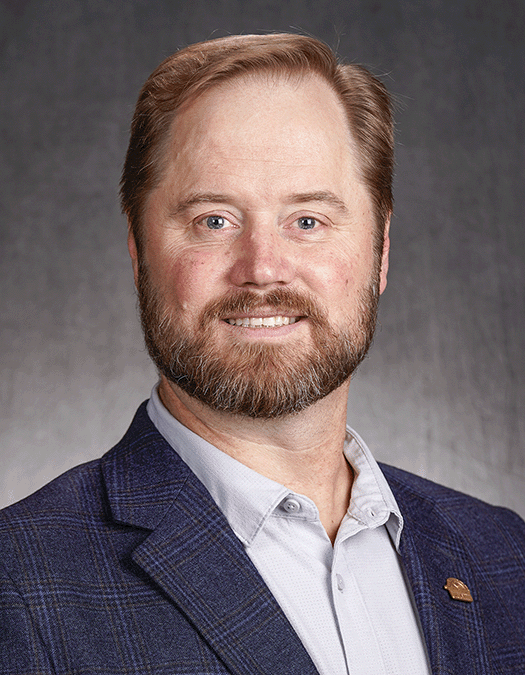
Rep. Cal Warwas
Sponsored bills
Maddy summaryHF 2384 establishes a grant program to help counties clean up blighted properties and address environmental contamination on tax-forfeited or tax-foreclosed properties they own or hold in trust. The bill appropriates funds for fiscal years 2026-2027, allowing counties to apply for grants to cover remediation costs, testing, monitoring, and fixing unsafe conditions. Counties must submit detailed applications proving property ownership, contamination evidence, blight documentation, and a remediation plan. The Pollution Control Agency will award grants, prioritizing counties' ability to fund projects without grants and ensuring statewide distribution.
Maddy summaryHF 961 appropriates $250,000 for each of the 2026 and 2027 fiscal years to fund the Hospitality Minnesota Education Foundation's ProStart program. This program provides high school students with culinary and hospitality management education, including curriculum, tools, skills training, professional development, and scholarships. The funds directly support addressing workforce shortages in Minnesota's hospitality industry by enhancing career pathways for students. This is a one-time appropriation specifically designated for these educational services in participating high schools.
Maddy summaryHF 783 changes Minnesota law to allow students enrolled in charter schools (who reside in the district) to fully participate in extracurricular activities like sports, clubs, and arts on the same terms as students in traditional public schools. The bill amends Minnesota Statutes to explicitly include charter school students under the definition of eligible participants for these activities, which are defined as non-credit, voluntary programs run outside regular school hours under adult guidance. This ensures charter school students have equal access to activities such as athletics, band, or student government without additional barriers. The change applies to all charter schools operating under Minnesota law and affects thousands of students across the state.
Maddy summaryHF 492 appropriates $250,000 for fiscal year 2026 and $250,000 for fiscal year 2027 from the general fund to fund mental health services and outdoor recreational activities for currently serving military personnel and veterans in Minnesota. The funds are directed to Hometown Hero Outdoors, a Stillwater-based nonprofit, to support programs promoting mental wellness, community interaction with professionals, and quality of life through outdoor engagement. This bill specifically provides dedicated funding for an existing nonprofit's established services rather than creating new state programs. It directly affects military members and veterans by expanding access to mental health support and outdoor activities through this designated organization. The appropriation is limited to these specific fiscal years and services as outlined in the bill.
Maddy summaryHF 2447 establishes a dedicated account for financial assurance funds collected from gas development permits. It requires the commissioner of natural resources to deposit these funds into an account managed by the State Board of Investment, with earnings credited back to the account. The funds can only be used for financial assurance purposes related to specific gas permits under chapters 93 and 103I of Minnesota Statutes. This bill directly affects gas development permit applicants and the commissioner's office, creating a new mechanism for handling and investing these required funds.
Maddy summaryHF 4 proposes a constitutional amendment requiring Minnesota to return budget surplus funds to taxpayers. If approved, it would create a "Minnesota tax relief account" funded by revenue exceeding 105% of projected spending, using those funds to refund or reduce property and income taxes. Taxpayers would receive direct refunds or tax reductions, but only up to the amount they owe in taxes, with the account funded annually from the state's general fund surplus. The amendment must be voted on by voters in the 2026 general election.
Maddy summaryHF 167 modifies Minnesota's individual income tax system by removing limits on subtracting Social Security benefits, allowing taxpayers to subtract all their Social Security income without phaseout thresholds or maximums. It also updates income tax brackets, raising the first tax bracket threshold to $47,620 for married couples filing jointly and $47,620 for single filers (from $38,770 and $26,520, respectively). The bill additionally modifies property tax refund rules, though specific changes aren't detailed in the provided text. These changes apply to taxable years beginning after December 31, 2024.
Maddy summaryHF 278 increases fees for all-terrain vehicle (ATV) registrations and nonresident trail passes in Minnesota. It adds a $45 surcharge to all ATV registration fees (raising public-use fees from $6 to $20 annually) and increases the nonresident trail pass fee from $30 to $45 per year. The surcharge and higher pass fees fund grant-in-aid programs under Minnesota Statutes 84.927, specifically for constructing and maintaining ATV trails and use areas in counties and municipalities. This directly affects ATV owners (residents and nonresidents) who must pay these updated fees to operate on state or grant-in-aid trails.
Maddy summaryHF 25 establishes a state grant program administered by Minnesota's Department of Health to fund nonprofit women's pregnancy centers and maternity homes. The program provides financial support for services like housing, medical care, parenting education, and mental health resources to help pregnant women and new mothers - particularly those facing homelessness or crisis - carry pregnancies to term and care for their children. Eligible organizations must be nonprofits offering free or low-cost services without promoting abortion, providing abortion care, or referring women to abortion providers. Grant funds cannot be used for abortion-related activities, and strict privacy rules require written consent before sharing personal information about clients. The bill appropriates state funds for this program while reducing other health-related appropriations.