

Maddy summaryThis bill appropriates $6 million for fiscal year 2024 and $8 million for fiscal year 2027 from the trunk highway fund to expand U.S. Highway 169 in Itasca County. The funding covers planning, design, environmental work, and engineering for converting a two-lane segment between Taconite and Pengilly into a four-lane divided highway. The $6 million appropriation, originally set to expire in 2027, is extended to June 30, 2029. This directly affects residents and travelers along this specific corridor by advancing infrastructure improvements for safety and capacity.
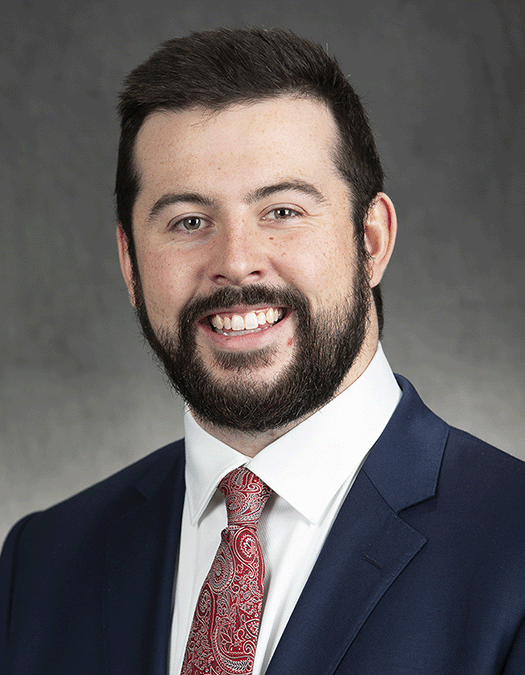
Rep. Spencer Igo
Sponsored bills
Maddy summaryHF 3598 requires larger Minnesota cities (home rule charter or statutory cities of the first, second, or third class) to accept electronic applications, certifications, and documentation for building projects covered by the State Building Code. The bill mandates that cities must use electronic methods like email, PDF files, and digital signatures instead of paper submissions for these projects. This modernizes documentation procedures without changing building safety standards or code requirements. The law takes effect on July 1, 2026, and directly affects city offices handling building permits and inspections.
Maddy summaryHF 3595 cancels $117 million previously allocated for the Minneapolis-Duluth Northern Lights Express passenger rail project and redirects that exact amount to fund the expansion of U.S. Highway 169. The bill appropriates $117 million from the general fund for the Minnesota Department of Transportation to expand a two-lane segment of Highway 169 between Taconite and Pengilly into a four-lane divided highway. This funding covers predesign, engineering, environmental work, property acquisition, and construction, and is available until June 30, 2029. The bill directly affects highway planning and construction for this specific corridor, replacing the canceled rail project with a highway infrastructure project.
Maddy summaryHF 3545 repeals a requirement for Minnesota to adopt new residential energy codes with specific efficiency targets. It removes Section 326B.106, subdivision 1(g), which would have mandated the commissioner to adopt updated residential energy codes starting in 2026, aiming for a 70% reduction in energy use by 2038. This repeal eliminates the obligation to implement these incremental code changes and the associated reporting requirements for residential construction. The bill directly affects residential builders, developers, and local building officials who would have been required to comply with future energy code standards. The repeal does not impact existing energy codes or commercial energy code requirements.
Maddy summaryHF 1161 creates a new funding mechanism for Minnesota school districts with significant seasonal property (like lakeshore areas). It establishes "seasonal tax base replacement aid" that adjusts a district's local tax levy based on the ratio of seasonal property value to total property value, with the adjustment capped between 50% and 100%. The bill appropriates funds to cover this aid, reducing districts' required tax levies without lowering them below zero, starting with taxes payable in 2026. This directly affects school districts that rely on seasonal property taxes for local funding.
Maddy summarySF 2298 is a comprehensive housing bill that combines new policy measures with funding to address homelessness and housing stability. It directly affects housing providers, local governments, and individuals experiencing or at risk of homelessness by expanding support programs and allocating state funds. Key provisions include increasing funding for emergency shelter beds, creating new rental assistance programs for vulnerable tenants, and establishing requirements for local housing plans. The bill, now law after gubernatorial approval on May 23, 2025, focuses on preventing homelessness through both financial resources and structural policy changes.
Maddy summaryHF 457 proposes a refundable tax credit of up to 30% of qualifying conversion costs for developers converting underutilized buildings in Minnesota. Eligible projects must convert buildings first placed in service at least 15 years ago, either by changing to a new commercial use (not previously intended for that purpose) or by restoring at least 50% of vacant space to income-producing use, while retaining 75% of external walls and internal structure. Applicants must apply for an allocation certificate before starting work and can choose a credit, a grant, or both. The credit is claimable in the year the project is completed, with annual reporting required to the state.
Maddy summaryHF 3229 requires the Prairie Island nuclear plant to move its spent nuclear fuel to a new storage site by January 1, 2028, and authorizes construction of additional storage at the Monticello nuclear plant for fuel transferred from Prairie Island. The bill allows the public utility owning Prairie Island to withdraw funds from the state's renewable development account to cover transportation costs, reducing annual payments to the account by $3.75 million. This directly affects the Prairie Island and Monticello nuclear plant operators and the renewable development fund. The law amends existing statutes to mandate the fuel transfer deadline, authorize new storage capacity at Monticello, and establish the funding mechanism for transport.
Maddy summaryHF 3245 repeals an exception that previously allowed Minnesota cities, counties, and towns to impose rent control on private residential properties through voter-approved ordinances. The bill removes the specific provision (Minnesota Statutes 2024, section 471.9996, subdivision 2) that permitted local governments to enact rent control if approved by voters in a general election. This change makes the statewide rent control prohibition absolute, meaning local governments can no longer implement rent control measures - even if voters approve them. The bill directly affects local communities' ability to address housing affordability through rent control policies.
Maddy summaryHF 3215 increases the annual spending limit for free public music events in Minnesota's third-class cities from $3,000 to $10,000. The bill amends Minnesota Statutes section 449.08 to allow these cities to use tax revenue specifically for providing free musical entertainment to the public. It directly affects third-class cities by expanding their budget authority for this purpose, without changing the requirement that funds must be used solely for public music events. The change is purely procedural, adjusting the financial cap for existing local programming.