

Maddy summaryHF 1350 modifies Minnesota's county veterans service office grant program by increasing funding based on each county's veteran population. Counties receive a base $7,500 grant plus supplemental amounts up to $20,000 depending on veteran population size (e.g., $10,000 for counties with 10,000-20,000 veterans). The bill appropriates $60,000 annually for fiscal years 2026-2027 to the Minnesota Association of County Veterans Service Officers, allocating $20,000 each for specialized coordinators focused on women veterans, suicide prevention, and justice-involved veterans. These funds support training, administrative costs, and technical assistance to enhance veteran services statewide. The bill directly affects counties with veterans service offices and the statewide association.
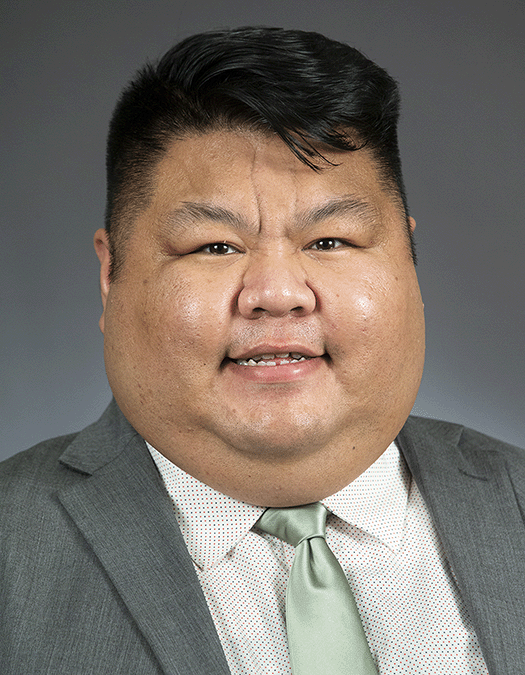
Rep. Jay Xiong
Sponsored bills
Maddy summaryHF 1559 appropriates $1.25 million for each of fiscal years 2026 and 2027 from Minnesota’s arts and cultural heritage fund to support community festivals. The Minnesota Humanities Center will distribute these grants to community organizations, cities, and counties for event programming, staffing, outreach, transportation, facilities, and signage. Up to $200,000 of the total can reimburse county sheriff departments for public safety costs at these events. The bill specifically prioritizes funding for named festivals including the Somali Museum Annual Celebration, Twin Cities Jazz Fest, Hmong Festival, and Rondo Days in St. Paul.
Maddy summaryHF 1586 appropriates $800,000 from Minnesota's arts and cultural heritage fund for a commemorative project honoring Gordon Parks. The bill directs the Minnesota Humanities Center, working with Soul Touch Productions, to create an art installation and related programming celebrating Parks' life and legacy. This funding specifically supports cultural programming focused on Parks' contributions as a photographer, filmmaker, and civil rights advocate. The bill does not create new policy but allocates existing state funds for a specific cultural initiative.
Maddy summaryHF 132 prohibits the open or concealed carry of firearms within 100 feet of polling places, ballot drop boxes, or counting centers during election hours (two hours before polls open to two hours after they close). It directly affects individuals carrying firearms near these locations during voting periods, with exceptions for law enforcement officers on duty, lawful possession on private property or in vehicles, and travel to/from private property. Violations are punishable as misdemeanors, with repeat offenses classified as gross misdemeanors. The bill creates a specific safety buffer zone around election sites to prevent firearm presence during voting, without altering broader gun laws.
Maddy summaryThis bill extends the deadline for businesses to apply for relocation grants under Minnesota's 2024 economic development program. It requires the commissioner of employment and economic development to reopen the application process and provide outreach and technical assistance to eligible businesses. The grant funding, originally available until a prior date, will now remain accessible until June 30, 2026. This directly affects businesses seeking financial support for relocating operations within Minnesota. The key change is simply extending the application window and mandating support services for applicants.
Maddy summaryHF 718 appropriates $700,000 from Minnesota's workforce development fund for fiscal year 2026 and another $700,000 for fiscal year 2027 to provide a grant to the organization Hired. The funds will support Hired's existing workforce development programs, specifically expanding career pathway job training that connects lower-skilled job seekers to entry-level positions in high-growth sectors. The grant also enables Hired to create new services for low-income Minnesotans, including employment coaching and support to improve job retention and workforce stability. This is a one-time funding appropriation for these specific program expansions.
Maddy summaryHF 1307 appropriates $5.7 million from state bonds to fund a new recreation facility at the Jimmy Lee Recreation Center in St. Paul's Rondo community. The bill authorizes the state to issue bonds and provides the funds for predesign, design, and construction of the new facility, directly serving residents of the Rondo neighborhood. The money comes from the bond proceeds fund, following Minnesota's bonding procedures under statutes 16A.631-16A.675. This is a capital investment bill focused on physical infrastructure for a specific community facility.
Maddy summaryHF 383 appropriates $5.7 million from state bond proceeds to fund planning, design, engineering, environmental work, and construction of a new water distribution facility in Minneapolis, located in Hennepin or Anoka County. The bill authorizes the state to issue bonds up to $5.7 million to cover these costs, with funds administered through the Public Facilities Authority to the city of Minneapolis. This directly affects Minneapolis by providing capital for critical water infrastructure upgrades. The legislation enables the city to advance a specific water system project without immediate state budget expenditure.
Maddy summaryHF 1107 appropriates $1,000,000 from the workforce development fund for a one-time grant to the Black Women's Wealth Alliance. The grant will fund job skills training, career counseling, and career placement assistance specifically for Black women. This is a single-year allocation for fiscal year 2026 with no ongoing funding provided. The bill directly affects the Black Women's Wealth Alliance as the recipient organization and Black women seeking workforce development services.
Maddy summaryHF 1315 appropriates $1 million for fiscal year 2026 to fund a community center project for Hnub Tshiab: Hmong Women Achieving Together in Ramsey County. The grant will cover acquiring property, building, and equipping the center to host educational and leadership programs focused on strengthening cultural identity and improving opportunities for Hmong women and girls. This one-time funding is specifically earmarked for constructing a facility dedicated to these programs. The bill does not create new policies but provides targeted financial support for an existing community organization's physical space needs.