

Maddy summaryHF 2148 establishes a locally controlled housing fund within Minnesota's housing development fund to finance affordable housing projects. The fund provides loans to eligible recipients - including cities, counties, tribes, community land trusts, and housing authorities - to acquire, rehabilitate, or build housing where local entities maintain at least 75% ownership control. Projects must include 30% of units for households earning ≤50% of area median income (AMI) and 30% for households earning 50-100% of AMI, with all housing meeting accessibility standards and avoiding income-based segregation. Repayments to the fund are reinvested to support additional affordable housing production in the recipient’s jurisdiction.
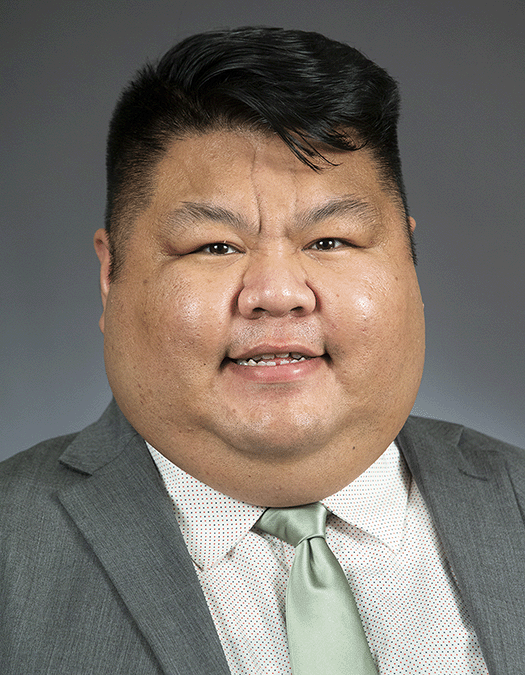
Rep. Jay Xiong
Sponsored bills
Maddy summaryHF 2835 provides $2 million in one-time funding from the state general fund to the Indigenous Roots nonprofit organization. The grant will allow them to expand their St. Paul cultural center by acquiring and renovating adjacent property. This expansion aims to increase programming capacity specifically to incubate and support small businesses along the Intertribal Cultural Corridor in St. Paul and surrounding communities. The funding is available until the project is completed or abandoned, per state statute.
Maddy summaryHF 2712 allocates $8.5 million from the state general fund for one-time improvements to the Capitol tunnel under Rev. Dr. Martin Luther King Jr. Boulevard and east of the State Capitol. The funds will cover designing, constructing, and equipping the tunnel to meet Americans with Disabilities Act (ADA) requirements, directly benefiting people with disabilities who use Capitol facilities. The bill specifies that the funding is available until the project is completed or abandoned, with no ongoing annual appropriations. This is a straightforward infrastructure funding measure focused on accessibility compliance, not a policy change affecting broader legislation.
Maddy summaryHF 2775 appropriates $200,000 from Minnesota's arts and cultural heritage fund for a grant to Siengkane Lao MN. The funding is specifically designated to support a Southeast Asian music festival on St. Paul's East Side during fiscal year 2026. This bill directly provides financial resources to Siengkane Lao MN, a cultural organization serving the Southeast Asian community. The key mechanism is the allocation of state funds through the arts and cultural heritage fund to enable this community event. The bill does not create new regulations or alter existing laws, solely providing targeted grant funding for a cultural festival.
Maddy summaryHF 2774 appropriates $500,000 from Minnesota's arts and cultural heritage fund to Hmong Town Connections for renovating the Maplewood Sears complex building to create dedicated arts space. The bill directly affects Hmong Town Connections, a community organization serving the Hmong community, and the Maplewood neighborhood in Maplewood, Minnesota. The key provision is a one-time grant for physical renovations to establish a permanent arts venue. This is a straightforward funding allocation with no additional policy provisions or requirements beyond the renovation project.
Maddy summaryHF 1223 appropriates $500,000 for fiscal year 2026 and $500,000 for fiscal year 2027 from the workforce development fund to Big Brothers Big Sisters of the Greater Twin Cities. The funds will support job-seeking skills, connections to job training/education, and career-focused mentorship for disadvantaged youth aged 12-21 in Twin Cities, central, and southern Minnesota chapters. This one-time appropriation directly affects youth in these regions through targeted youth development programming. The bill creates a specific grant mechanism to deliver these services via an existing nonprofit organization.
Maddy summaryHF 1216 appropriates $400,000 for fiscal year 2026 and $400,000 for fiscal year 2027 from the workforce development fund to fund a statewide apprenticeship readiness program. The grant supports Building Strong Communities, Inc. to prepare women, Black, Indigenous, and People of Color, and veterans for careers in the building and construction industries. This one-time funding creates a targeted initiative to increase workforce diversity in skilled trades through program access and training. The bill directly affects the specified demographic groups and the organization administering the program.
Maddy summaryHF 2452 prohibits businesses from using artificial intelligence to automatically adjust product prices in real time based on factors like market demand, competitor pricing, inventory levels, or customer behavior. This directly affects retailers and online sellers that currently use AI-driven dynamic pricing systems. The bill defines "artificial intelligence" broadly and makes it illegal for any person to use such systems to set or change prices dynamically. Enforcement would be handled by the Minnesota Attorney General under existing consumer protection laws.
Maddy summaryHF 1096 allocates $2 million for fiscal year 2026 and $2 million for fiscal year 2027 from Minnesota's workforce development fund to Summit Academy OIC. The funding directly supports Summit Academy OIC in expanding student enrollment, employment placement, GED preparation, STEM programming, and launching a dental assistant training program in the Twin Cities and across Minnesota. It requires the organization to collaborate with employers to place students after they complete the dental assistant program. This bill provides concrete financial support for specific workforce development initiatives at Summit Academy OIC.
Maddy summaryHF 982 creates a new education benefit in Minnesota for dependents of disabled veterans. It provides full tuition, mandatory fees, and book coverage (after subtracting other aid) for dependents of veterans with a 100% permanent disability, and 50% coverage for dependents of veterans with a 70%+ disability rating. The benefit applies to undergraduate programs at Minnesota state colleges, universities, or the University of Minnesota Board of Regents institutions. Eligible students must be enrolled at these institutions, and institutions apply for the benefit on their behalf through the Office of Higher Education.