

Maddy summaryHF 1197 requires mining companies seeking permits for nonferrous sulfide ore projects in Minnesota to disclose all environmental violations, fines, or legal actions against them or their key personnel within the past 15 years. The bill prohibits state agencies from conducting environmental reviews or issuing permits to applicants who have been charged, convicted, or fined for environmental violations, bribery, or corruption in that timeframe. This directly affects companies applying for mining permits by blocking approval if they or their leadership have recent environmental compliance issues. The law aims to prevent entities with poor environmental records from obtaining permits for new mining projects.
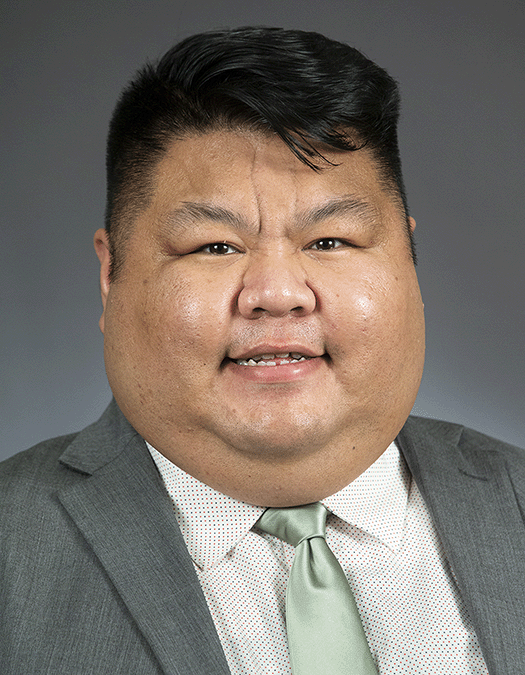
Rep. Jay Xiong
Sponsored bills
Maddy summaryHF 3641 appropriates $250,000 from Minnesota's arts and cultural heritage fund for a grant to ComMUSICation, a nonprofit organization. The funding will support ComMUSICation's programs aimed at amplifying young voices and building skills through equitable access to music, collaboration, and opportunity. This bill directly affects ComMUSICation and the youth it serves by providing dedicated financial resources for its music-based initiatives.
Maddy summaryHF 3349 requires Minnesota public and charter high schools to permit students in grades 9-12 to possess and administer opiate antagonists (like naloxone) to other students experiencing an opioid overdose. The bill directly affects high school students and school districts by mandating this policy change. Key provisions include requiring schools to allow student possession/administration of these life-saving drugs and extending legal protections under section 604A.04 to cover this activity. The law aims to make overdose reversal more accessible in school settings without adding new administrative burdens to schools.
Maddy summaryHF 3662 amends Minnesota's individual income tax code to require taxpayers to include certain employer-reimbursed travel expenses as taxable income. Specifically, it adds an "addition" for travel costs (like fares, meals, and lodging) paid by or reimbursed by an employer while traveling within Minnesota for immigration enforcement activities or supporting such activities. This provision applies only to expenses incurred in Minnesota and takes effect for tax years starting after December 31, 2025. The bill directly affects Minnesota taxpayers whose employers cover travel related to immigration enforcement within the state.
Maddy summaryHF 3659 requires individuals who earned income in Minnesota while participating in immigration enforcement activities or providing material support to such activities to file a Minnesota income tax return. This requirement applies even if the individual's income would normally be too low to trigger a filing obligation under standard tax rules. The bill amends Minnesota Statutes to add this specific filing requirement, which takes effect for tax years beginning after December 31, 2025.
Maddy summaryHF 3619 requires Minnesota's Environmental Quality Board to conduct a generic environmental impact statement on sustainable aviation fuel production and use. It places a temporary moratorium on both tax credits for sustainable aviation fuel producers/blenders (under Minn. Stat. § 41A.30) and grants from the Department of Agriculture until this review is completed. The bill amends tax credit rules to state that credits can only be claimed after the Environmental Quality Board finishes the impact statement and the commissioner certifies the credit. This directly affects sustainable aviation fuel producers, blenders, and the state agencies responsible for administering tax credits and grants.
Maddy summaryHF 3357 would prohibit the possession of dangerous weapons (including guns, ammunition, or explosives) in Minnesota's Capitol complex buildings, making it a felony punishable by up to five years in prison or a $10,000 fine. The bill specifically applies to state buildings within the Capitol Area described in chapter 15B, excluding the National Guard Armory. Key exemptions include licensed peace officers on duty, permit holders who notify law enforcement, individuals displaying weapons as evidence with sheriff approval, and retired officers working in security roles under specific federal rules. The law would take effect on August 1, 2026, and directly affects anyone entering Capitol complex buildings, with limited exceptions for authorized personnel and specific lawful activities.
Maddy summaryHF 3369 appropriates $50,000 from the arts and cultural heritage fund for fiscal year 2027 to establish the Centennial Barns Registry. The Minnesota Historical Society will operate the registry, allowing landowners to voluntarily register barns built before 1959 and share their history and location. This funding directly supports documenting historic barn structures across Minnesota without imposing requirements on property owners.
Maddy summaryThis bill provides $4 million in state funding for Minnesota food shelf programs during fiscal years 2026 and 2027. It directs the state agency overseeing food shelves to use these funds to support community food banks that serve people facing food insecurity. The money comes from the state general fund and is added to existing base funding for these programs. This directly affects food shelves across Minnesota and the families and individuals they serve.
Maddy summaryHF 1114 appropriates $50 million from the general fund for the GroundBreak Capital Access and Innovation Fund, managed by the Minneapolis Foundation. It establishes three programs: forgivable startup business loans (up to $50,000) for new Minnesota businesses lacking traditional financing, commercial real estate equity enhancements (up to $250,000) for developments under $10 million, and forgivable down payment assistance loans (up to $25,000) for first-time homebuyers in the seven-county metro area meeting income limits. Loans become fully forgiven after 3 years for businesses (with preference for those hiring employees) and 5 years for homeowners, subject to specific conditions like using funds for approved purposes. The bill directly affects Minnesota-based startups, small commercial developers, and low-income homebuyers, particularly targeting underserved communities through eligibility criteria. Funds are allocated over fiscal years 2026-2029 with annual amounts specified.