

Maddy summaryHF 3483 modifies Minnesota's trespass law to require law enforcement to obtain a warrant signed by a judicial officer before entering property for civil immigration enforcement. It also prohibits local law enforcement from detaining individuals solely based on federal civil immigration detainers. The bill amends Minnesota Statutes § 609.605 to add a specific provision (subdivision 1, clause (6)) requiring a warrant with probable cause for immigration-related trespass entries. This directly affects local police and sheriff's departments by restricting their ability to act on federal immigration requests without judicial oversight. The law applies to all trespass offenses involving immigration enforcement activities on private property.
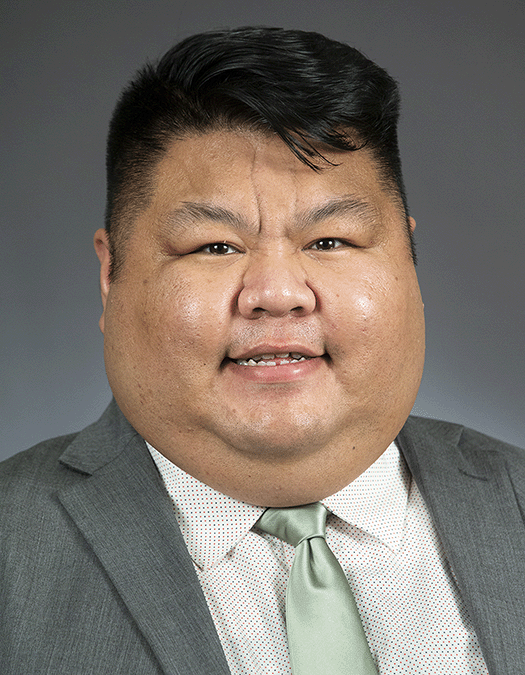
Rep. Jay Xiong
Sponsored bills
Maddy summaryHF 3279 proposes a constitutional amendment to increase Minnesota's sales tax rate by 0.375% (three-eighths of one percent) starting July 1, 2027, through June 30, 2052. The revenue would fund three dedicated housing programs: 25% to a homeownership opportunity fund for owner-occupied housing, 25% to a community and household stability fund for homelessness prevention services, and 50% to a rental opportunity fund for rental assistance and housing development. All Minnesotans purchasing taxable goods would pay the slightly higher tax, with funds specifically targeting housing stability for vulnerable households. The amendment requires voter approval at the 2026 general election before taking effect.
Maddy summaryHF 2986 requires Minnesota's public utilities to include specific details about virtual power plant programs in their resource plans and file formal tariffs with the Minnesota Public Utilities Commission by 2026. The bill directs utilities to create programs that aggregate customer-owned devices like solar panels, home batteries, electric vehicles, and smart thermostats to reduce peak electricity demand. These programs must demonstrate how they lower customer bills, cut emissions, avoid new infrastructure, and reduce reliance on fossil-fuel peaker plants during grid stress events. The legislation also allows utilities to recover costs associated with implementing these programs through customer rates. This directly affects all Minnesota public utilities and their ratepayers through new reporting requirements and program implementation.
Maddy summaryThis bill increases funding for Minnesota's Family Homeless Prevention and Assistance Program, raising the annual appropriation from $10.27 million to $45.27 million. The additional funds will be used to reduce homelessness risks and improve program effectiveness, with a portion designated for the housing development fund. The legislation also grants agencies flexibility in awarding grants to existing grantees and allows new grantees in certain areas to work with advisory committees or local care systems without meeting specific statutory requirements. These changes take effect immediately and establish a future funding base of $10.72 million starting in fiscal year 2028.
Maddy summaryThis bill allocates $130,000 from Minnesota's workforce development fund to provide a one-time grant to New Pathways, a program in Cambridge. The funding supports job readiness services for parents with children experiencing homelessness, including resume assistance, interview preparation, and connections to employers and training programs. The grant requires the program to use case management and community partnerships to help families achieve stable housing and self-sufficiency while overcoming employment barriers.
Maddy summaryThis bill creates a new grant program to provide social services and mental health support to victims of Operation Metro Surge, a federal immigration enforcement operation. The program will fund organizations that help affected individuals with basic needs like housing, food, and employment assistance, as well as mental health care. Eligible applicants include nonprofits, government agencies, tribal nations, and legal service providers, with priority given to areas most impacted by the operation. The bill appropriates unspecified funding from the state's general fund for one-time use through June 2029, requiring grantees to report on program participation and outcomes.
Maddy summaryThis bill expands eligibility for Minnesota state veterans homes to include former commissioned officers of the Public Health Service and the National Oceanic and Atmospheric Administration who served on active duty. To qualify, these individuals must have served at least 181 consecutive days or been separated due to a service-related disability, and must have been discharged under honorable conditions. The legislation amends existing state statutes to formally define these groups as veterans for the purpose of accessing nursing care and related health and social services at state veterans homes.
Maddy summaryThis bill appropriates $250,000 from the state's general fund for fiscal year 2027 to support victims of human trafficking in Minnesota. The money will be given to the International Institute of Minnesota to provide services such as housing, medical care, food, and employment assistance to up to 25 trafficking survivors. The organization must work with local law enforcement, shelters, healthcare providers, and other community partners to identify victims in the seven-county metropolitan area and help them become safe and economically self-sufficient. The bill also requires the institute to collect data on all clients to measure the impact of the funding and ensure accountability. This is a one-time appropriation that does not create ongoing funding.
Maddy summaryThis Minnesota bill restricts state and local government participation in federal civil immigration enforcement efforts, prohibiting agencies from using resources to investigate, detain, or arrest individuals for immigration violations. It defines civil immigration enforcement to exclude criminal law enforcement and clarifies that cooperation with federal authorities on criminal matters remains permitted. The legislation also establishes a cause of action for constitutional rights violations related to immigration, prohibits denying education based on immigration status, and requires hospitals to create policies for interactions with law enforcement. Additionally, the bill appropriates funding to support these provisions and amends existing state statutes regarding immigration-related activities.
Maddy summaryThis bill allocates $160,000 from the arts and cultural heritage fund in fiscal year 2027 to support Lao Culture Dance and Traditional Fashion Show LLC. The funding is intended to provide grants for traditional Lao dance and fashion arts education and public cultural programming aimed at Minnesota youth and families. The appropriation is directed through the commissioner of administration to the organization. This measure focuses on preserving and promoting cultural heritage through specific educational and public engagement activities.