

Maddy summaryHF 1686 expands training requirements for licensed security officers in Minnesota. It mandates 40 hours of pre-employment training (up from 12 hours) within 21 days of hire, plus 24 hours of annual continuing education for all officers, with an additional 6 hours yearly for those armed with firearms or weapons. The bill requires new training content including mental health crisis response, de-escalation techniques, CPR/AED use, legal use of force standards, and building safety disruptions. These requirements apply to all licensed security officers, managers, and employees in Minnesota, effective January 1, 2026. The bill also ensures employees can obtain copies of their training certificates from employers at no cost.
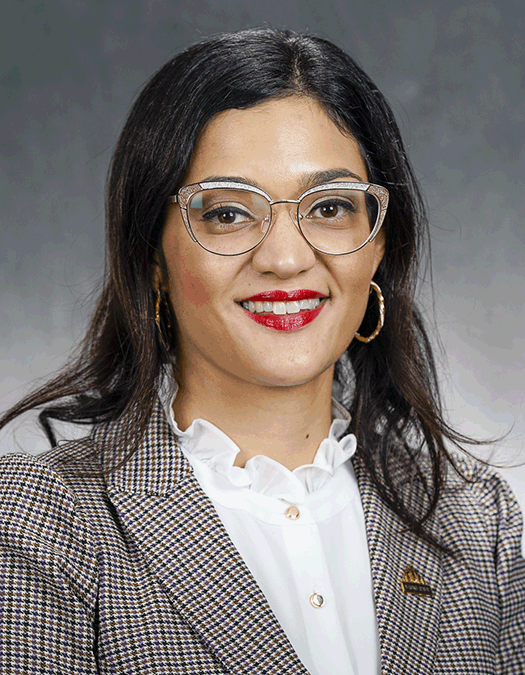
Rep. María Isa Pérez-Vega
Sponsored bills
Maddy summaryThis bill makes Minnesota's existing Nursing Home Workforce Standards Board rule (published October 2024) effective starting January 1, 2026, or after federal approval. The rule establishes minimum wage standards for nursing home workers and links these standards to medical assistance reimbursement rates paid to nursing homes. Nursing homes receiving state medical assistance funding will directly be affected, as their reimbursement rates will be adjusted based on compliance with these minimum wage requirements. The change focuses on aligning worker compensation with state payment systems for long-term care facilities.
Maddy summaryHF 1037 appropriates $4.75 million from the workforce development fund for a one-time project to renovate and expand the Metropolitan Center for Independent Living facility in St. Paul. The funds will cover acquiring land, predesign, construction, and equipment for the facility to provide expanded services. This directly affects the center’s ability to deliver independent living, vocational, and case management services to people with disabilities across the seven-county metropolitan area. The appropriation is available until the project is completed or abandoned, per state statute.
Maddy summaryHF 2342 appropriates $1.5 million for each of fiscal years 2026 and 2027 to fund academic assistance programs through the Minnesota Alliance of Boys and Girls Clubs. The grant directly supports youth, particularly those needing the most academic help, by funding homework help, tutoring, the Exact Path personalized learning program (for K-12 math, reading, and language arts), literacy/STEM activities, mentorship, and attendance strategies. The recipient must provide a 25% nonstate funding match, and any unused 2026 funds carry over to 2027. This is a funding bill focused on concrete program support, not procedural changes.
Maddy summaryHF 264, the "Larry R. Hill Medical Reform Act," requires all licensed Minnesota correctional facilities (both public and private) to meet specific medical care standards. The bill amends state law to mandate facilities implement policies covering mental health screening, suicide prevention, medication verification, discharge planning with prescribed medications, telehealth use, and death reviews. These requirements directly affect incarcerated individuals by improving access to consistent medical and mental health care while holding facilities accountable through commissioner inspections. The law aims to standardize care practices without creating new programs, focusing on operational changes to enhance safety and treatment.
Maddy summaryHF 1005 adjusts payment rates for healthcare providers under Minnesota's medical assistance program. It increases reimbursement rates for certain residential services, sets a new statewide rate for behavioral health home services, and adjusts physician professional service rates. These changes directly affect hospitals, clinics, and care providers receiving state medical assistance payments for these specific services. The bill amends existing statutes to implement these rate adjustments while requiring budget neutrality for hospital payments. It does not create new programs but modifies existing payment structures for covered services.
Maddy summaryHF 339 appropriates $1 million from the general fund for fiscal year 2026 to the Nursing Home Workforce Standards Board. This one-time funding is specifically for grants to certified worker organizations that support nursing home workers. The grants help these organizations carry out duties under Minnesota Statutes section 181.214, which relates to nursing home workforce standards. The funds are available until June 30, 2028.
Maddy summaryHF 2325 requires Minnesota employers to pay non-exempt employees at least 1.5 times their regular hourly rate for work performed on designated holidays. The bill directly affects hourly workers in Minnesota who are scheduled to work on holidays defined under Minnesota Statutes section 645.44, subdivision 5. It amends existing law (Minnesota Statutes 2024, section 177.25) to add a new provision mandating this overtime pay rate specifically for holiday work. This changes the current standard by explicitly requiring higher pay for holiday shifts, rather than allowing employers to use alternative compensation methods. The bill does not change the definition of "holiday" but specifies the required pay rate when work occurs on those days.
Maddy summaryThis bill modifies Minnesota law to clarify and limit optometrists' authority to prescribe or administer certain drugs. It specifically sets new time limits: oral antivirals may not be prescribed for more than 10 days, oral steroids for more than 14 days (requiring physician consultation), and oral carbonic anhydrase inhibitors for more than seven days. These changes apply directly to licensed optometrists in Minnesota who prescribe medications for eye conditions under the Board of Optometry's rules. The bill maintains existing restrictions on intravenous injections, invasive surgery, and Schedule II/III oral drugs.
Maddy summaryHF 2349 creates the Ramsey County Economic Development Authority (RCEA), a new entity with powers to support local economic growth. It also expands the existing Ramsey County Housing and Redevelopment Authority (RCHRA) to include all the RCEA's development powers, effectively merging their functions under a unified structure. The bill allows Ramsey County's board to appoint commissioners for both authorities, using existing county governance procedures. This directly affects Ramsey County residents and businesses by streamlining economic development efforts through a single coordinated authority. The key change is consolidating and expanding development powers previously held separately under county and housing authorities.