

Maddy summaryThis bill allocates $1.5 million from Minnesota's general fund to support the Somali Museum of Minnesota in building a new facility. The money will be used to design, construct, furnish, and equip the new building in Minneapolis to preserve Somali cultural heritage and display artifacts. This is a one-time appropriation available until the project is completed or abandoned, and the funds are managed by the commissioner of employment and economic development. The legislation directly affects the Somali Museum of Minnesota by providing financial resources for its expansion and preservation efforts.
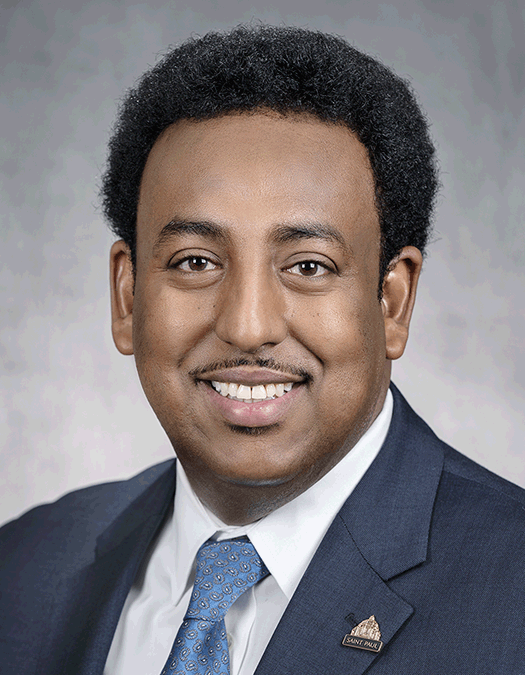
Rep. Samakab Hussein
Sponsored bills
Maddy summaryThis bill allocates $175,000 from the state's general fund to support a pilot youth mentoring program called Bolder Options. The program will serve young people aged 12 to 21 in Minneapolis, St. Paul, and Rochester by introducing them to public service career paths, including opportunities with the Minnesota Army National Guard. The funding is designated as a one-time appropriation for fiscal year 2027 and is managed by the commissioner of public safety.
Maddy summaryThis bill requires sellers of emotional support dogs to provide written notice to buyers stating that the dog is not a service animal and does not have the special training required for service dogs. The notice must be printed in bold 12-point type and included on the purchase receipt or a separate document, informing buyers that the dog is not entitled to the legal rights and privileges granted to service animals. Additionally, the bill increases criminal penalties for intentionally misrepresenting an emotional support dog as a service dog, raising the offense from a petty misdemeanor to a gross misdemeanor for repeat violations. These changes apply to all sales of emotional support dogs and take effect on August 1, 2026.
Maddy summaryThis bill extends the expiration date of the St. Paul local sales tax from December 31, 2042, to December 31, 2060, allowing the city to collect the tax for a longer period. The legislation amends existing state law to update this deadline while keeping the same rules that let the city end the tax earlier if projects are completed or if the city council decides the tax has generated enough revenue. The changes apply only to the City of St. Paul and do not affect other municipalities or change how the tax is collected or used.
Maddy summaryThis bill creates the Minnesota Civil Remedies Act to hold government employees personally liable for civil rights violations they commit while acting under color of law, regardless of whether the misconduct occurred on or off duty. It removes common legal defenses like qualified immunity, official immunity, and sovereign immunity from government employees, allowing injured individuals to seek compensatory damages, punitive damages, and attorney fees. However, the law preserves immunity for judges, prosecutors, and legislators when they act in their official judicial, prosecutorial, or legislative capacities. The bill applies to all government entities including state, county, and municipal agencies, and it does not limit existing federal civil rights claims.
Maddy summarySF 3596 creates a one-time state-funded emergency rental assistance program for Minnesota counties and Tribal governments to help eligible households facing housing instability. Eligible households must have income at or below 200% of the federal poverty level, experienced financial hardship after August 31, 2025, and be at risk of eviction or homelessness. The program covers up to two months of prospective rent, past-due rent, utility costs, or related fees for qualifying households. Counties and Tribal governments must distribute funds within four months of the bill's effective date and return any unspent money to the state.
Maddy summaryHF 3617 bans the possession of semiautomatic military-style assault weapons in Minnesota, including specific firearms like AR-15 rifles and AK-47s, as well as weapons with features such as folding stocks, pistol grips, or detachable magazines. The bill defines these weapons broadly to cover both listed models and similar firearms with minor modifications, such as redesigned versions or enhanced features. Possessing a banned weapon would be a criminal offense under amended statutes, with penalties established for violations. This law directly affects individuals who own or possess these firearms, making such possession illegal under state law.
Maddy summaryHF 3618 bans the possession of specific semiautomatic military-style assault weapons (like AR-15s, AK-47s, and Uzis) and ammunition magazines holding more than 10 rounds in Minnesota. It defines these weapons broadly to include models listed in the bill, as well as firearms with features like folding stocks, pistol grips, or threaded barrels. The bill creates criminal penalties for possessing these banned weapons or magazines, directly affecting individuals who own them. The law would amend Minnesota statutes to enforce this ban and penalties, applying to anyone in the state who possesses such firearms or magazines.
Maddy summaryHF 974, the Equal Access to Broadband Act, updates Minnesota's broadband laws by defining key terms like "broadband" (meeting FCC standards for high-speed internet), "underserved areas" (lacking 100/20 Mbps wired service), and "broadband infrastructure." The bill requires broadband providers to coordinate with local governments when placing infrastructure in public rights-of-way, including notifying them before installation to minimize future disruptions. It preserves local governments' authority to require franchises from broadband providers, while excluding electric cooperatives and satellite-only providers from these requirements.
Maddy summaryHF 3279 proposes a constitutional amendment to increase Minnesota's sales tax rate by 0.375% (three-eighths of one percent) starting July 1, 2027, through June 30, 2052. The revenue would fund three dedicated housing programs: 25% to a homeownership opportunity fund for owner-occupied housing, 25% to a community and household stability fund for homelessness prevention services, and 50% to a rental opportunity fund for rental assistance and housing development. All Minnesotans purchasing taxable goods would pay the slightly higher tax, with funds specifically targeting housing stability for vulnerable households. The amendment requires voter approval at the 2026 general election before taking effect.