

Maddy summaryHF 2063 designates July 2 each year as "1st Minnesota Day" to honor the 262 men of the 1st Minnesota Regiment who fought for the Union at the Battle of Gettysburg on July 2, 1863. The bill requires the governor to issue an annual proclamation, encourages schools to teach about the regiment's Civil War role, and mandates that the Minnesota Historical Society's replica regimental flag be flown at the State Capitol on July 2. It directly affects state government officials, public schools, and Capitol operations through these ceremonial requirements. The bill establishes a recurring observance without creating new taxes, regulations, or funding.
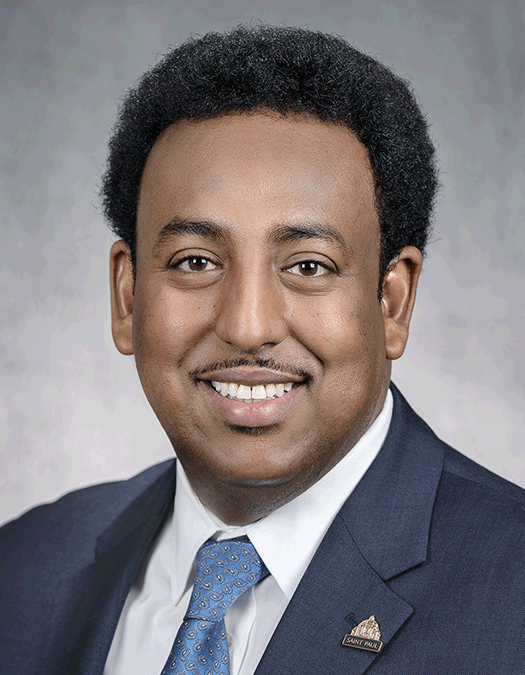
Rep. Samakab Hussein
Sponsored bills
Maddy summaryHF 107 modifies Minnesota's unemployment insurance rules for workers involved in labor disputes. It specifies that workers participating in or directly affected by a labor dispute can receive benefits until the end of the week the dispute was active, while those not involved are eligible until the dispute began. The bill clarifies that certain situations - like employer safety violations, lockouts, or being fired before a dispute starts - do not make applicants ineligible. This directly affects workers who stop working due to labor conflicts, ensuring they maintain eligibility under defined conditions. The changes amend Minnesota Statutes section 268.085, subdivision 13b.
Maddy summaryHF 2549 authorizes the issuance of $44.66 million in housing infrastructure bonds specifically for the St. Paul Port Authority’s The Heights housing development project. The funds must be used for affordable housing meeting income limits set in Minnesota law (section 462A.33, subdivision 5). The bill adds a new provision to Minnesota Statutes allowing this bond authorization and requires annual transfers from the general fund to support debt service on these bonds. This bill directly affects the St. Paul Port Authority and residents of The Heights development, which is intended to provide housing for low-to-moderate-income households.
Maddy summaryHF 2262 appropriates $250,000 for fiscal year 2026 and $250,000 for fiscal year 2027 from the workforce development fund to the city of St. Paul. The funds are designated to expand the Right Track youth internship program, which connects young people from cost-burdened households to internships that build work skills, provide mentorship, and explore career paths. This is a one-time appropriation, not an ongoing funding source. The bill directly affects St. Paul's program and the youth participants in that initiative.
Maddy summaryHF 1223 appropriates $500,000 for fiscal year 2026 and $500,000 for fiscal year 2027 from the workforce development fund to Big Brothers Big Sisters of the Greater Twin Cities. The funds will support job-seeking skills, connections to job training/education, and career-focused mentorship for disadvantaged youth aged 12-21 in Twin Cities, central, and southern Minnesota chapters. This one-time appropriation directly affects youth in these regions through targeted youth development programming. The bill creates a specific grant mechanism to deliver these services via an existing nonprofit organization.
Maddy summaryHF 2560 appropriates $6 million from the general fund for fiscal year 2026 to the Rondo Community Land Trust, a nonprofit organization, to acquire and develop land between Dale Street North and St. Albans Street North in St. Paul. The funding covers land acquisition, construction, infrastructure, and site improvements for a specific redevelopment project. This one-time appropriation is available until the project is completed or abandoned, as specified in Minnesota law. The bill directly affects the Rondo Community Land Trust and the community in that St. Paul neighborhood.
Maddy summaryHF 2600 modifies Minnesota's voter registration rules to allow individuals in county jails to register using the address listed on their jail intake form. This change directly affects eligible voters currently incarcerated in county facilities, enabling them to register on election day without needing additional proof of residence. The bill also requires the secretary of state to allocate funds to sheriffs to implement jail-based voter registration procedures, with grants distributed based on the number of jail beds under each sheriff's authority. These funds are intended to support the administrative work needed for this new registration process.
Maddy summaryHF 775 requires Minnesota school districts to create written policies ensuring parents of children with disabilities can fully participate in their child's education. Specifically, districts must establish processes for providing free language assistance (like interpreters or translated documents) for non-English-speaking parents and reasonable accommodations (such as sign language interpreters or modified meeting formats) for parents with disabilities, without requiring health information disclosure. These policies must be posted in multiple languages on district websites, shared annually with parents, and kept confidential. The bill directly affects school districts and parents interacting with special education programs, effective July 1, 2025.
Maddy summaryHF 2559 appropriates $11.5 million from the general fund for a one-time grant to the Rondo Community Land Trust through the Minnesota Housing Finance Agency. The funds must support a home buyer initiative pilot program targeting households with incomes at or below 115% of the area median income (as defined by HUD). This legislation directly affects low-to-moderate income households in Minneapolis, particularly in the historically Black Rondo neighborhood, by funding affordable homeownership opportunities. The grant requires the trust to use the money exclusively for this specific pilot program, with no ongoing annual funding.
Maddy summaryHF 1577 appropriates $200,000 for fiscal year 2026 and $200,000 for fiscal year 2027 from the workforce development fund to create a statewide education campaign. The campaign directly targets Minnesota employers, aiming to inform them about the benefits of hiring people with conviction records (second-chance hiring) and available state/federal incentives. Key mechanisms include developing an informational website and staffing a hotline service. This is a one-time funding allocation, not a permanent program, to support employer education on inclusive hiring practices.