

Maddy summaryHF 262 prohibits employers from paying people with disabilities less than the state minimum wage, effective August 1, 2025 for new hires and August 1, 2027 for all current employees, ending the use of federal or state special certificates that allow subminimum wages. It requires providers of home and community-based services to report data on individuals currently paid subminimum wages by August 1, 2027, including personal details and employment metrics. The bill appropriates $38,000 in fiscal year 2026 and $75,000 in fiscal year 2027 to enhance the MnCHOICES system with employment-related resources. These changes directly affect employers, service providers, and people with disabilities working in supported employment programs across Minnesota.
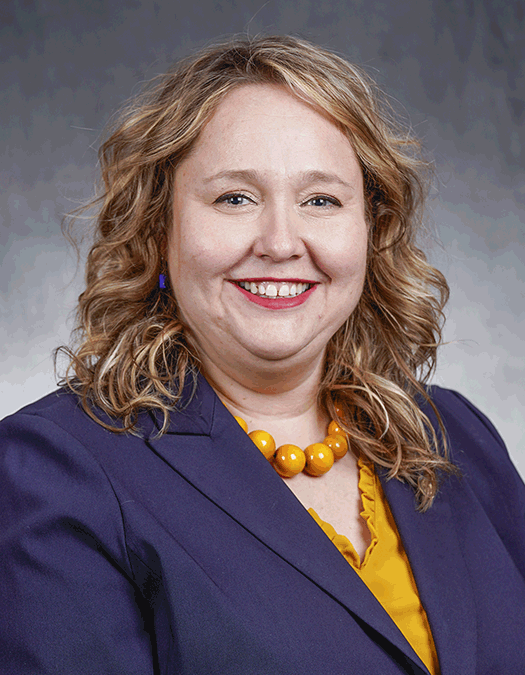
Rep. Emma Greenman
Sponsored bills
Maddy summaryHF 37 proposes adding a new constitutional guarantee to Minnesota's state constitution, stating that "Elections shall be free, fair, and equal. No civil or military power shall, at any time, interfere with the free exercise of the right to vote." If approved by voters in the 2026 general election, this amendment would take effect January 1, 2027, directly affecting all Minnesotans participating in elections by establishing this fundamental principle. The bill specifies the exact wording for the constitutional amendment and the ballot question voters would see. It does not create new election procedures but enshrines this standard into the state constitution.
Maddy summaryHF 108 appropriates $2.5 million from the general fund for fiscal year 2026 and another $2.5 million for fiscal year 2027 to provide grants to Ujamaa Place. The funds are designated to support workforce development services specifically targeting African American men, including job training, employment preparation, internships, education, and vocational housing. The bill also allocates resources for Ujamaa Place's organizational capacity building. This legislation directly affects Ujamaa Place as the recipient organization and the African American men in Minnesota who will receive these targeted workforce services.
Maddy summaryThis bill establishes new rules for ticket sales in Minnesota to increase transparency and prevent deceptive practices. It requires ticket sellers and online marketplaces to clearly display the total price, including all fees, and to provide buyers with proof of purchase and refund policies within 24 hours. The legislation also prohibits specific behaviors such as selling duplicate tickets, using unauthorized domain names, or bypassing online security measures to buy multiple tickets. The commissioner of commerce is given the authority to request data on how violations occur and to enforce these rules, with the law taking effect on January 1, 2025.
Maddy summaryHF 5237 is a supplemental budget bill that provides additional funding to the state's education system and related human services programs. The legislation directly affects public schools, charter schools, early childhood education providers, and families receiving child welfare or economic support services. Key provisions include allocating money for school operations, teacher salaries, special education, and facilities, while also adjusting funding forecasts for various state agencies. The bill amends existing laws to ensure these resources are distributed and managed according to updated needs, particularly regarding instructional hours and student support services.
Maddy summaryThis bill is a resolution from the Minnesota Legislature that formally asks Congress to overturn the Supreme Court ruling in Citizens United v. FEC. It requests that Congress propose a constitutional amendment to clarify that only natural persons, not corporations or other artificial entities, possess rights under the Constitution. The proposed amendment would also state that spending money to influence elections is not protected speech and would allow governments to regulate or limit campaign contributions to ensure equal political access. Additionally, the bill mandates that all permissible campaign spending must be publicly disclosed. Ultimately, the resolution directs state officials to send copies of the text to federal leaders and Minnesota's congressional representatives.
Maddy summaryThis bill makes it illegal to advertise a price for goods or services while hiding mandatory fees that consumers must pay. It defines these hidden fees as charges that are unavoidable or that a reasonable person would expect to be included in the total cost, though it excludes government taxes. Businesses must clearly show any additional flat fees or percentages before a customer selects items and again on a subtotal page before checkout. The law includes specific exemptions for motor vehicle dealers, utilities regulated by the state, and certain real estate settlement costs.
Maddy summaryThis bill appropriates funds from the arts and cultural heritage fund to the Minnesota Historical Society for fiscal year 2025. The money is designated to commission and install a bust of former Supreme Court Justice Harry A. Blackmun. The sculpture will be placed on the second floor of the State Capitol, outside the chambers of the Minnesota State Supreme Court.
Maddy summaryThis bill, known as the Elections policy and finance bill, provides funding and updates policies related to elections, campaign finance, lobbying, and redistricting in Minnesota. It establishes a new Minnesota Voting Rights Act and modifies laws regarding the use of deep fakes to influence elections, while also adjusting certain notary rules. The legislation appropriates money to the Secretary of State for specific purposes, including grants to improve polling place access for individuals with disabilities and to educate formerly incarcerated individuals about their right to vote. Additionally, it adjusts funding transfers between state accounts to support voting operations and technology resources.
Maddy summaryThis bill modifies Minnesota's unemployment insurance rules to clarify eligibility for workers who stop working due to a labor dispute at their workplace. It states that applicants involved in such disputes are not considered to have quit or been fired, nor are they on leave, which preserves their potential claim for benefits. The law specifies that eligibility depends on whether the worker is directly participating in the dispute or if the dispute involves a conflict between different labor organizations. Additionally, the bill clarifies that quitting or being fired while a dispute is active does not end the worker's participation in the dispute for benefit purposes.