

Maddy summaryHF 96 requires Minnesota's medical assistance program (like Medicaid) to cover home birth services for low-risk patients when specific conditions are met. It directly affects pregnant people choosing home births and eligible providers (certified midwives, doctors, or nurse practitioners) who must meet scope-of-practice standards. Key provisions include requiring providers to document low-risk status through prenatal care, obtain patient consent about home birth risks, and have a hospital transfer plan. The bill also sets payment rates: 100% for provider services and 70% for facility services compared to hospital rates for similar care.
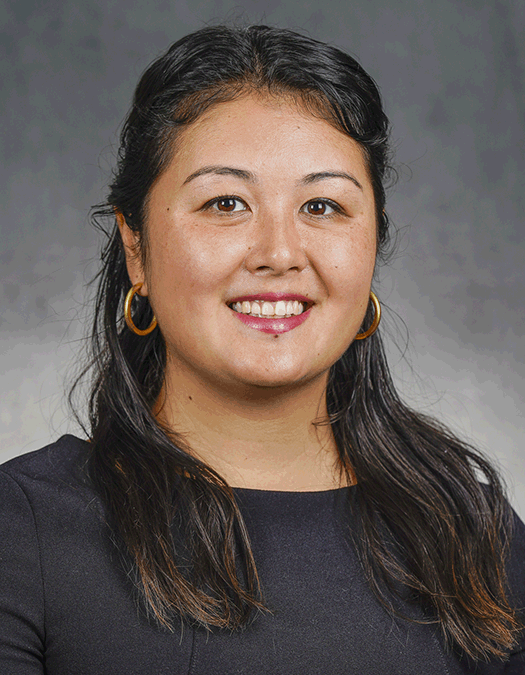
Rep. Samantha Sencer-Mura
Sponsored bills
Maddy summaryHF 2266 appropriates $350,000 for fiscal year 2026 and $350,000 for fiscal year 2027 from the workforce development fund to provide a grant to YWCA Minneapolis. The funds will directly support YWCA Minneapolis in offering job skills training, career counseling, and job placement assistance. This training specifically helps eligible individuals obtain a child development associate credential and build careers in early education. The bill provides concrete funding for workforce development services targeting early childhood education pathways.
Maddy summaryHF 1469 allocates $850,000 for fiscal year 2026 and another $850,000 for fiscal year 2027 from the workforce development fund to provide job skills training for individuals recently released from prison after a felony conviction (within 12 months of release). The funds are directed to Better Futures Minnesota, which must deliver the training and report annually on program outcomes. Required reports must include data on participant numbers, employment status, homelessness, recidivism, child support compliance, and specific job skills training provided. The bill directly affects formerly incarcerated Minnesotans with felony convictions and the state agency managing workforce development funds.
Maddy summaryHF 2254 adds a $400 "baby bonus" to Minnesota's existing child credit for each qualifying child born during the tax year. This directly affects Minnesota taxpayers with newborn children, increasing their state income tax credit. The bill modifies the child credit calculation by adding the $400 per newborn (without reducing the minimum credit amount) and allows for potential advance payments. It takes effect for tax years beginning after December 31, 2024.
Maddy summaryMinnesota's HF 2088 requires school districts to annually report specific details about school resource officer (SRO) contracts to the state education commissioner. The reports must include the law enforcement agency providing SROs, contract start/end dates, number of officers contracted, and assigned school sites. This applies to all school districts using SROs and takes effect July 1, 2025. The bill mandates transparency about existing SRO contracts without changing SRO program requirements or standards.
Maddy summaryHF 1947 appropriates state funds from the arts and cultural heritage fund to develop cultural studies materials for underrepresented groups in Minnesota, specifically targeting communities like Hmong, Karen, Somali, and Oromo cultures, as well as oral-based cultures without formal writing systems. The commissioner of administration will distribute these funds through competitive grants to create high-quality educational materials for schools. Recipients must collaborate with school districts planning to use the materials, and funding is allocated for fiscal years 2026 and 2027. This bill directly affects schools, cultural organizations, and the commissioner's office by providing resources to address gaps in existing curricula.
Maddy summaryHF 2003 proposes a constitutional amendment allowing Minnesota counties, cities, and school districts to set the voting age at 16 for local elections, while keeping the state/federal voting age at 18. It requires local governments to pass a resolution to implement this change and specifies that 16-year-olds can only vote in local elections (not state or federal races) and must meet all other voter eligibility requirements. The amendment must be submitted to voters at the 2026 general election with a specific "Yes/No" question. If approved, it would amend Minnesota Statutes to update voting age rules in sections 201.014, 201.071, and add new provisions in section 201.017. This change directly affects local election administrators and 16-year-olds in jurisdictions that adopt the lower voting age.
Maddy summaryHF 1126 creates a property tax exemption for specific land owned by federally recognized Indian Tribes in Minnesota. It exempts one parcel (max 40,000 sq ft) that was classified as class 3a in 2025, located in a city over 400,000 population (like Minneapolis), owned by a tribe as of January 1, 2024, and used exclusively for tribal purposes or public charities. Properties used for housing, apartments, farming, or forestry do not qualify. The exemption applies starting with tax assessments in 2026. This directly affects eligible tribal entities owning qualifying property in designated urban areas.
Maddy summaryHF 1926 allocates $1,000,000 from the state general fund for a one-time grant to the Greater Minneapolis Council of Churches to support food shelves. The funds must be distributed to food shelves enrolled in the Minnesota FoodShare program according to that program's existing distribution formula. The Council may use up to 5% of the grant for administrative costs and must report details on fund distribution to the state commissioner by August 1, 2026. This bill directly affects participating food shelves in the Minneapolis area through the Council of Churches' grant program.
Maddy summaryHF 1941 provides $500,000 in fiscal year 2026 and $500,000 in fiscal year 2027 from the workforce development fund to the American Indian Opportunities and Industrialization Center. The bill directly funds the Center for its workforce development programming, including job training and economic opportunities for American Indian communities in Minnesota. This is a one-time appropriation, meaning the funds are provided only for those two fiscal years. The bill does not create new requirements or change existing laws - it simply allocates specific funds for a designated purpose.