

Maddy summaryHF 1010 establishes a new licensure process for certified midwives in Minnesota through the Board of Nursing, creating a specific "Minnesota Certified Midwife Practice Act" (Chapter 148G). It amends health occupation definitions to include "licensed certified midwife," expands Medicaid coverage to include services provided by these licensed midwives, and sets civil/criminal penalties for violations. The bill directly affects certified midwives (requiring national certification plus state licensure) and Medicaid recipients who can now access midwifery care under their coverage. Key provisions define midwifery scope (including pregnancy, birth, and women's primary care) and set licensure terms, moving midwifery from an unregulated status to a licensed profession with expanded coverage.
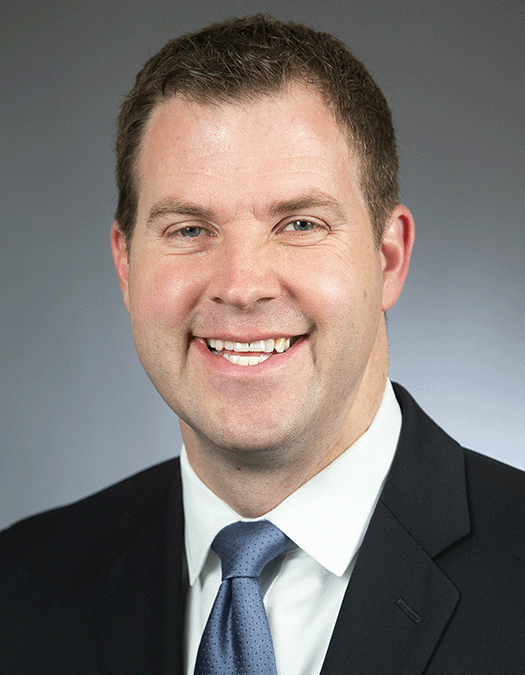
Rep. Jamie Long
Sponsored bills
Maddy summaryHF 2847 establishes a statewide clean transportation standard requiring fuel providers in Minnesota to meet annual carbon intensity targets for transportation fuels. It creates a credit system where providers exceeding the standard earn credits (for lower emissions), while those falling short face deficits (requiring fees or credit purchases). The Department of Transportation will implement the program, requiring fuel providers to report emissions data using standardized calculations and enforce penalties for noncompliance. This directly affects companies supplying gasoline, diesel, and alternative fuels in Minnesota, mandating annual reductions in carbon intensity across all transportation fuel pathways.
Maddy summaryHF 474 appropriates $200,000 from Minnesota's general fund to replace the existing statue of Henry Mower Rice in the U.S. Capitol's Statuary Hall with a statue of Hubert H. Humphrey. The funds cover removing Rice's statue, transporting it to the Minnesota Historical Society, recasting Humphrey's statue (currently at the state capitol), and erecting the new statue. This one-time appropriation is specifically for the physical replacement project in the Capitol. The bill directly affects Minnesota's representation in the Statuary Hall collection.
Maddy summaryThis Minnesota House resolution (H.R. No. 1) condemns President Trump's January 20, 2025, pardon of individuals convicted of violent crimes related to the January 6, 2021, Capitol insurrection. It specifically targets the pardon of 400 people, including members of extremist groups like the Oath Keepers and Proud Boys, who had been found guilty of assaulting law enforcement with weapons. The resolution expresses the Minnesota House's disapproval of erasing these convictions, arguing the pardon undermines justice and devalues law enforcement sacrifices. As a non-binding resolution, it has no legal effect but formally rejects politicizing public safety.
Maddy summaryHF 2765 modifies Minnesota's optometry scope of practice by adding specific restrictions to the existing law. The bill directly affects licensed optometrists by prohibiting them from administering prescription medications via injection (except for anaphylaxis treatment), performing invasive surgeries (including laser procedures), prescribing certain strong oral medications (like Schedule II/III drugs or steroids), and extending the duration of some prescriptions (limiting oral antivirals to 10 days and oral carbonic anhydrase inhibitors to 7 days). These changes clarify the boundaries of optometric practice under Minnesota Statutes 148.56. The bill does not alter optometrists' core duties like vision testing, lens prescribing, or diagnosing eye conditions.
Maddy summaryHF 2591 establishes a new fifth tax bracket for Minnesota individual income tax, targeting high earners to replace revenue lost from federal Medicaid funding changes. The bill amends tax law to create a top income bracket (applying to income over $1.667 million for married couples filing jointly) with a rate set by the commissioner of revenue. This rate must be calculated to generate revenue equal to the amount of federal Medicaid funds Minnesota lost, as certified by the commissioner of management and budget. The new tax rate applies to taxable years 2026 and 2027, affecting only taxpayers in the highest income bracket.
Maddy summaryHF 2195 proposes adding a new constitutional section to Minnesota's state constitution, specifically stating "Marriage is a fundamental right and shall not be restricted based on gender or race" (Sec. 18). If approved by voters, this amendment would prohibit legal restrictions on marriage based on gender or race. The amendment must be submitted to voters in the 2026 general election, with potential implementation starting January 1, 2027, if ratified. This bill directly affects marriage rights and legal protections for all Minnesotans, requiring voter approval rather than legislative passage alone.
Maddy summaryHF 1762 proposes adding a new constitutional amendment to Minnesota's state constitution. If approved by voters, it would guarantee all persons equal rights under state law and prohibit discrimination based on race, color, national origin, ancestry, disability, or sex - including protections for pregnancy decisions, gender identity, gender expression, and sexual orientation. The amendment would apply to all state actions and agencies, requiring any discriminatory state action to be the "least restrictive means" of achieving a "compelling governmental interest." The proposed amendment must be submitted to voters in the 2026 general election, with implementation starting January 1, 2027, if ratified.
Maddy summaryHF 1386 appropriates $150,000 from the arts and cultural heritage fund for fiscal year 2026 and another $150,000 for fiscal year 2027. The funds are directed to the Bakken Museum through the Minnesota Humanities Center Board to support its interactive exhibits and community outreach programs focused on arts and cultural heritage. This bill directly provides financial support to the Bakken Museum for its educational programming. The appropriation is a straightforward funding allocation with no additional policy changes or requirements beyond the specified grant.
Maddy summaryHF 132 prohibits the open or concealed carry of firearms within 100 feet of polling places, ballot drop boxes, or counting centers during election hours (two hours before polls open to two hours after they close). It directly affects individuals carrying firearms near these locations during voting periods, with exceptions for law enforcement officers on duty, lawful possession on private property or in vehicles, and travel to/from private property. Violations are punishable as misdemeanors, with repeat offenses classified as gross misdemeanors. The bill creates a specific safety buffer zone around election sites to prevent firearm presence during voting, without altering broader gun laws.