

Maddy summaryHF 1380 requires Minnesota's Commissioner of Human Services to set a minimum $1,800 per day rate for Clay County's psychiatric residential treatment facility. It appropriates $1 million in fiscal year 2026 for Clay County to cover equipment and remodeling costs to convert a juvenile center into an 18-bed facility for youth under 21. The bill also allocates $1 million for fiscal year 2026 and $1 million for 2027 to fund start-up and capacity-building grants for psychiatric residential treatment facilities statewide, with $200,000 specifically designated for Clay County's new facility. These are one-time appropriations, available until June 2029.
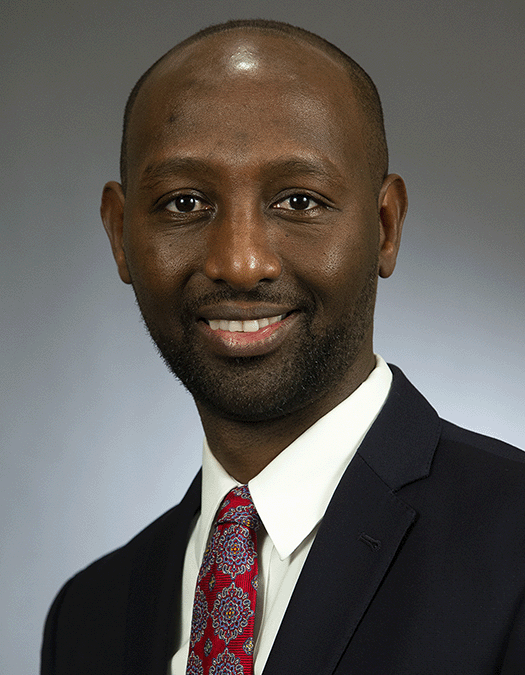
Rep. Mohamud Noor
Sponsored bills
Maddy summaryHF 1579 establishes a new supplementary payment rate for specific housing providers serving vulnerable populations. It requires agencies to negotiate an additional $975 per month (capped at this amount, including inflation adjustments) for facilities providing 24/7 supervised housing to unsheltered individuals with complex health needs (including substance use, mental illness, or physical conditions). These facilities must offer private dwellings in the Twin Cities metro area (100 beds, operating since 2020) or central Minnesota (48 beds, opening after 2025), with all beds dedicated to this population. The rate applies starting July 1, 2025, and is supplemental to existing payment rates.
Maddy summaryHF 2331 exempts assisted living facilities licensed under Minnesota's Chapter 144G from existing rules requiring providers to allocate specific percentages (45-66%) of revenue toward direct care staff compensation. This change specifically applies to assisted living service providers, not other human services providers. The bill amends Minnesota Statutes 256B.4914 by adding a new subsection (10d) that explicitly excludes these facilities from the compensation allocation requirements. The policy change removes a financial obligation for assisted living facilities regarding staff pay, without altering other funding or licensing standards.
Maddy summaryHF 1105 amends Minnesota law to require the state health commissioner to *conduct* maternal death studies annually, changing the previous language from "may" to "must." This directly affects the Minnesota Department of Health, which must now systematically analyze preventable maternal deaths to improve healthcare systems. The bill mandates these studies to identify preventable causes and inform medical, health, and welfare service planning. Its key provision is making the maternal death study process mandatory, aiming to reduce preventable deaths through data-driven system improvements. The law applies statewide to all maternal health outcomes covered under Minnesota's health system.
Maddy summaryHF 2141 allocates $400,000 from Minnesota's general fund for a one-time grant to the Organization of Liberians in Minnesota (OLM), a nonprofit community organization. The funds will cover the renovation, construction, and equipping of OLM's Brooklyn Park community center. This grant enables OLM to provide culturally relevant programs and services to Liberian community members in the northwest suburbs. The appropriation is available until the project is completed or abandoned, per state funding rules.
Maddy summaryHF 2144 appropriates unspecified funds from the general fund for the Family Homeless Prevention and Assistance Program under Minnesota Statutes § 462A.204, for fiscal years 2026 and 2027. The bill directly affects families in Minnesota at risk of homelessness by providing funding for prevention and assistance services. Key provisions include directing the Housing Finance Agency to administer the program using these allocated funds. This is a funding bill with no new policy requirements, solely authorizing budget resources for an existing state program.
Maddy summaryHF 1762 proposes adding a new constitutional amendment to Minnesota's state constitution. If approved by voters, it would guarantee all persons equal rights under state law and prohibit discrimination based on race, color, national origin, ancestry, disability, or sex - including protections for pregnancy decisions, gender identity, gender expression, and sexual orientation. The amendment would apply to all state actions and agencies, requiring any discriminatory state action to be the "least restrictive means" of achieving a "compelling governmental interest." The proposed amendment must be submitted to voters in the 2026 general election, with implementation starting January 1, 2027, if ratified.
Maddy summaryThis bill requires Minnesota's Commissioner of Human Services to create a formal proposal to incorporate existing federal standards for integrated community supports into state law. It specifically directs the development of draft legislation based on federal waiver plans for brain injury, disability inclusion, community care, and developmental disabilities services. The commissioner must consult with provider organizations, county social service administrators, and people with disabilities before submitting the proposal to legislative committees by January 1, 2026. This affects state human services planning and directly involves providers and recipients of community-based disability supports.
Maddy summaryHF 1685 requires Minnesota's IT Services agency to combine the state's transit assistance program (currently managed by Metro Transit) into the existing Minnesota Benefits Web Portal by December 31, 2025. The bill mandates coordination with transportation, human services, and children's agencies to ensure seamless integration while allowing Metro Transit to continue processing applications. It also appropriates $1.2 million from the general fund in fiscal year 2026 specifically for this integration work. This change directly affects state agencies managing benefits and Metro Transit, aiming to streamline access for Minnesotans using transit assistance programs.
Maddy summaryHF 1739 appropriates $1 million from the general fund for fiscal year 2026 to fund workforce programs for individuals in recovery through the nonprofit Generation Hope. The bill requires the funds to support four specific mechanisms: workforce training in high-demand industries, record expungement assistance to reduce employment barriers, personalized career coaching and job placement services, and partnerships with employers to connect participants to sustainable jobs. This one-time appropriation directly affects individuals in recovery seeking employment, aiming to address systemic barriers through concrete support services. The bill does not create new laws but allocates specific funding for targeted job placement initiatives.