

Maddy summaryHF 1374 amends Minnesota's eligibility rules for the Challenge Incarceration Program, which allows certain incarcerated individuals to serve part of their sentence in a community-based setting. The bill adds specific categories of people who can no longer participate, including those convicted of violent crimes involving death or injury (like murder or assault), recent sex offenses, or crimes requiring sex offender registration. It also bars individuals with active warrants, less than 180 days left on their sentence, recent disciplinary issues in prison, or suspended disciplinary sanctions. The changes directly affect incarcerated Minnesotans seeking to transition to community supervision through this program.
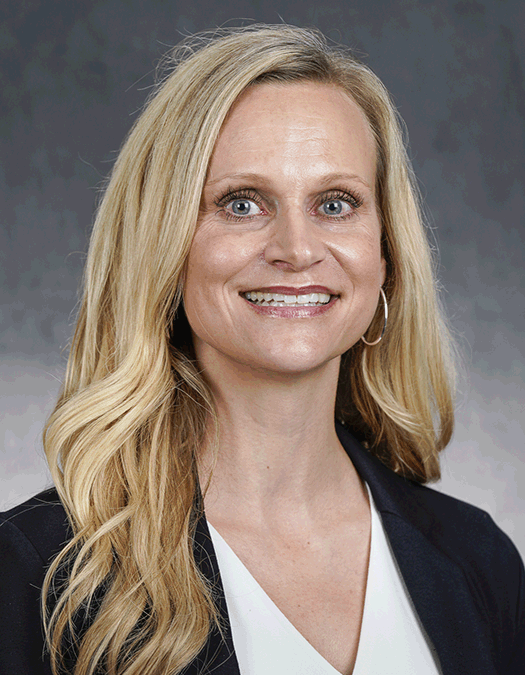
Rep. Krista Knudsen
Sponsored bills
Maddy summaryHF 514 amends Minnesota Statutes section 121A.425 to modify dismissal limitations for kindergarten through grade 3 students. The current law prohibits disciplinary dismissals for these students, with exceptions for short-term dismissals (less than one school day) for students receiving special education services and for expulsions only after exhausting other resources in cases of serious safety threats. This bill adjusts those limitations, but the specific policy changes are not detailed in the provided bill text. The amendment directly affects public school students in grades K-3 and their schools, altering how disciplinary actions may be applied.
Maddy summaryThis bill expands Minnesota's sales tax exemption to include additional baby products, directly affecting parents and caregivers who purchase these items. It adds baby wipes, cribs and bassinets (including mattresses and sheets), changing tables and pads, strollers, car seats and bases, baby swings, bottle sterilizers, and infant eating utensils to the list of tax-exempt items. The exemption applies to sales and purchases made after June 30, 2025. This change removes sales tax from these specific baby products, aligning with the existing exemption for items like breast pumps and baby bottles.
Maddy summaryHF 1026 proposes a constitutional amendment to Minnesota's Constitution that would prohibit state legislators from receiving pay on days when their chamber (Senate or House) fails to organize on the legally required convening date. The amendment specifies that legislators must not be compensated for any day the house is not "duly organized" as required by law. If approved by voters in the 2026 general election, this change would directly affect Minnesota legislators' compensation during unorganized sessions. The bill requires voter approval at the 2026 election and does not change current pay schedules for properly convened sessions.
Maddy summaryHF 1018 proposes adding a new section to the Minnesota Constitution that would establish parents' right to direct their child's education as a fundamental liberty. It specifically guarantees parents the right to choose private, religious, or home schooling as alternatives to public school, and the right to make reasonable educational choices within public schools. The proposed amendment would require voter approval at the 2026 general election, with the ballot question asking whether the state constitution should protect these parental rights. If passed, this would change Minnesota's constitutional framework, not current education laws.
Maddy summaryHF 814 criminalizes performing castration, sterilization, or any procedure causing permanent infertility on minors under 18 in Minnesota. It makes these acts a felony, imposing criminal penalties on anyone who carries them out. The law directly affects minors under 18 and healthcare providers or others who perform such procedures on them. The bill takes effect August 1, 2025, and is codified under Minnesota Statutes § 609.2248.
Maddy summaryHF 540 requires Minnesota's Commissioner of Administration to submit a report by February 15, 2026, detailing all state-owned or leased office space and identifying substantially vacant properties. The report must assess the feasibility of converting vacant space into housing, estimate conversion costs, and analyze potential revenue from renting or selling repurposed properties. This report will be provided to specific legislative committees overseeing the Department of Administration's budget. The bill does not change existing laws but mandates a study to evaluate underutilized state assets. (HF 540, Section 1)
Maddy summaryHF 706 modifies Minnesota's K-12 education tax benefits by increasing the maximum allowable subtraction (reducing taxable income) and credit for families with children in grades K-12. It raises the annual limits to $2,750 per child for grades K-6 and $4,125 for grades 7-12, extends the credit to cover tuition payments, and adds automatic annual inflation adjustments starting in 2025. The bill directly affects Minnesota taxpayers with qualifying K-12 children who claim these education-related tax benefits. These changes take effect for taxable years beginning after December 31, 2024.
Maddy summaryHF 465 requires all peace officers in Minnesota, including those with the Minnesota State Patrol, to be U.S. citizens. The bill amends state law (Minnesota Statutes 626.843, 626.845, and 626.87) to add citizenship as a mandatory qualification for licensing and employment. This change applies to both full-time and part-time peace officers seeking or renewing certification. The bill establishes a new requirement that would be enforced through the existing licensing and certification processes managed by the Board of Peace Officer Standards and Training. It does not address existing officers' current citizenship status but would affect future hiring and license renewals.
Maddy summaryHF 396 requires Minnesota school districts to obtain written parental consent before providing sexual education to minor students. It updates existing rules by mandating that schools establish clear procedures for parents, guardians, or adult students (18+) to review all instructional materials - including sexual education content - and request alternative instruction if they object. Schools must provide this review process without penalizing students who arrange alternatives, though they are not required to cover costs for parent-provided alternatives. This bill directly affects public school students, parents/guardians, and school districts in Minnesota.