

Maddy summaryHF 3552 amends Minnesota law to gradually adjust the age requirement for being defined as an "adult operator" of a motorboat. The bill changes the definition so that operators must be born on or after specific dates: July 1, 2004 (effective 2025), July 1, 2000 (2026), July 1, 1996 (2027), and July 1, 1987 (2028). This means the minimum age to operate a motorboat without additional supervision increases incrementally over time. The change directly affects motorboat operators in Minnesota who must meet these birth date requirements based on the effective year.
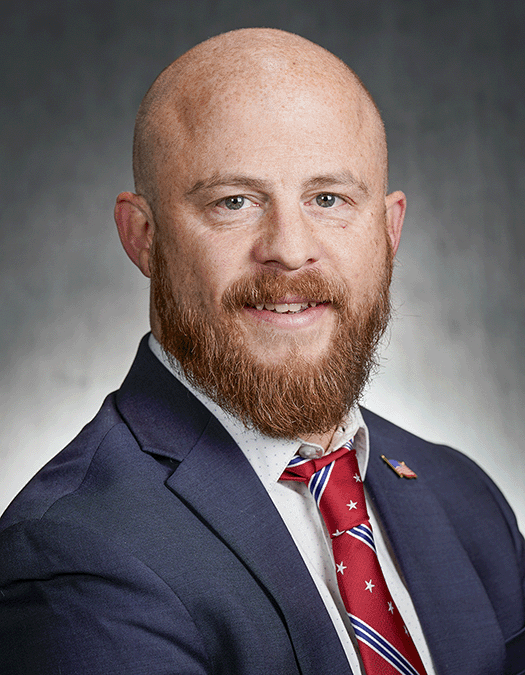
Rep. Drew Roach
Sponsored bills
Maddy summaryHF 3533 prohibits public school teachers from discussing gender identity in classrooms for students in kindergarten through grade 8, effective for the 2026-2027 school year. The bill requires schools to notify parents about changes in a student's health, well-being, or school environment, and mandates written parental permission before administering well-being questionnaires to K-8 students. It also requires schools to obtain parental consent for health services and ensures parents can access their child's health records. These provisions directly affect K-8 public school students, teachers, and school administrators in Minnesota.
Maddy summaryHF 3377 requires voter approval (a referendum) before certain capital improvement projects can proceed. It applies to cities and economic development authorities when projects qualify as "capital improvements" under state law and are financed through revenue bonds issued by economic development authorities. Specifically, cities must hold a vote before entering lease-purchase agreements for these projects, and authorities must follow voting rules when issuing bonds for projects leased to cities. The bill does not change existing debt limits but adds a voter approval step for these specific transactions. This directly affects local governments and economic development authorities planning such projects.
Maddy summaryHF 2517 restricts MinnesotaCare (the state's Medicaid program) from using public funds to cover abortions, except in three specific cases: when the pregnancy endangers the patient's life, causes substantial and irreversible impairment of a major bodily function, or results from rape or incest. This directly affects MinnesotaCare enrollees who might seek abortion coverage, limiting public funding to those narrow exceptions. The bill amends Minnesota Statutes § 256L.03 to clarify that public funds cannot cover abortions outside these circumstances. The change applies to all MinnesotaCare-covered health services, excluding the listed exceptions.
Maddy summaryHF 1784 requires government entities (such as state agencies or local municipalities) to pay the legal costs - including attorney fees - of individuals or organizations they sue and lose in court. If a government entity initiates a civil lawsuit against a person and does not win, the bill mandates that the government cover all defense-related expenses incurred by the losing party. This applies to actions filed on or after August 1, 2025, and does not limit other legal remedies available to defendants. The bill aims to discourage government entities from filing meritless lawsuits by making them financially responsible for opposing legal costs.
Maddy summaryHF 3251 eliminates the requirement for a license to sell copper scrap metal in Minnesota. The bill repeals Minnesota Statutes 2024, section 325E.21, subdivision 2c, which previously mandated the license. This change means sellers of copper scrap metal no longer need to obtain or maintain a separate license. The bill directly affects copper scrap metal sellers and scrap metal dealers, who no longer need to verify a copper-specific license for transactions. The repeal removes the existing licensing requirement without introducing new rules for copper sales.
Maddy summaryHF 15, the "Safe Haven In Every Local District (SHIELD) Act," requires all Minnesota public school districts and charter schools to include specific student and staff safety measures in their long-term facility plans by August 2025. The bill creates new grants to fund comprehensive security systems, including features like bullet-resistant doors, emergency alert systems, and staff training, with priority given to schools serving the most students. School districts must apply for these grants through the Minnesota School Safety Center, which will rank applicants and provide lists of approved vendors. The law appropriates funds from the general fund for fiscal year 2026 to support these security upgrades and plan updates.
Maddy summaryThis bill requires underground telecommunications installers working near existing utilities to be "safety-qualified" starting in 2025. It mandates that certified installers must perform utility location checks (via hand/hydro-excavation) and monitor directional drilling operations, with at least two certified installers present during drilling. Installers must complete a 40-hour training course covering utility safety, incident response, and equipment use, pass an exam, and take 4-hour refresher courses every three years to maintain certification. The rule applies to all installations within 10 feet of existing utilities or crossing them, beginning July 1, 2025, in the seven-county metro area and January 1, 2026, statewide - excluding private property installations under 36 inches deep.
Maddy summaryHF 3319 requires employers with 15 or more employees in Minnesota to provide a standardized job accommodation request form to employees who disclose a disability needing accommodation. The form must allow employees to identify their disability-related limitations and suggest potential accommodations. Employers must then initiate an interactive process to determine reasonable accommodations, considering factors like cost and feasibility. The commissioner of labor must create and distribute this required form. This bill directly affects Minnesota employers meeting the size threshold and employees with disabilities seeking workplace adjustments.
Maddy summaryThis bill restricts the deployment of Minnesota National Guard members into active duty combat without specific federal authorization. It prohibits sending the Guard into active duty combat unless the U.S. Congress has passed an official declaration of war or taken action under the Constitution (Article I, Section 8, Clause 15) to call the Guard to "execute the laws of the union, repel an invasion, or suppress an insurrection." The law directly affects the Minnesota National Guard and its members by requiring the governor to prevent such deployments without these specific federal actions. The bill does not restrict deployments under Title 32 of the U.S. Code for domestic civil support missions within the U.S. or its territories.