

Maddy summaryThis bill appropriates $2,950,000 for fiscal year 2026 and another $2,950,000 for fiscal year 2027 from the general fund to support Minnesota's county feedlot program. The funds are provided to delegated counties (those authorized to administer the program) through grants managed by the Pollution Control Agency. These grants will help counties oversee feedlot operations under Minnesota Statutes section 116.0711, focusing on environmental compliance and oversight. Any unspent funds from 2026 may be carried over to 2027.
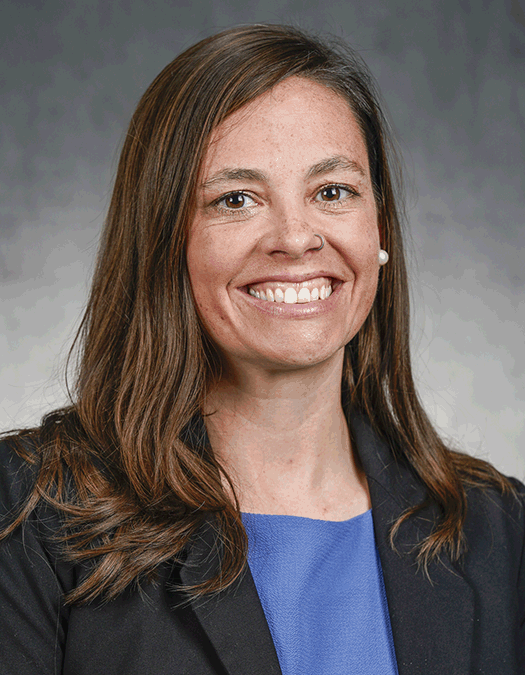
Rep. Kristi Pursell
Sponsored bills
Maddy summaryHF 1812 establishes a state-run Minnesota Health Plan to guarantee comprehensive, affordable health care for every Minnesota resident. The plan covers all necessary medical, dental, vision, mental health, and long-term care services without co-pays, with premiums based on income. It creates new state entities including the Minnesota Health Board, Health Fund, Office of Health Quality and Planning, a patient advocacy ombudsman, and an auditor for the plan. The bill also requests a federal waiver under the Affordable Care Act to modify certain health insurance requirements and appropriates funding for implementation.
Maddy summaryHF 1796 modifies Minnesota's Livestock Investment Grant Program to change how grants are calculated. Instead of awarding 10% of the first $500,000 in qualifying expenditures, the bill establishes a tiered system: 50% of the first $20,000 plus 20% of the next $220,000. The bill expands eligible expenses to include specific items like pasture development (fencing, watering systems), livestock housing equipment (freestall barns, milking parlors), and waste management facilities (digesters, manure storage). This directly affects Minnesota livestock producers raising eligible animals (beef cattle, dairy, swine, poultry, goats, etc.) who make qualifying capital investments in their operations.
Maddy summaryHF 981 appropriates $500,000 for fiscal year 2026 and $500,000 for fiscal year 2027 from the general fund to the Minnesota Commissioner of Health. This funding is directed to the nonprofit organization "Change the Outcome" to implement opioid prevention and education programs. The bill requires these programs to provide data-driven school and community education on opioid dangers, prevention strategies, overdose recognition, emerging drug trends (like fentanyl and xylazine), and access to substance use disorder support resources. The primary beneficiaries are Minnesota middle and high school students, communities, and individuals struggling with substance use disorders.
Maddy summaryThis bill amends Minnesota Statutes section 513.075 to update language in cohabitation agreements from gendered terms ("a man and a woman") to gender-neutral language. It directly affects unmarried couples living together in Minnesota who enter into written property and financial agreements. The key change replaces outdated terminology while keeping the same requirements: agreements must be in writing, signed by both parties, and enforced only after the relationship ends. This is a straightforward terminology update with no change to the legal requirements or protections for cohabiting couples.
Maddy summaryHF 132 prohibits the open or concealed carry of firearms within 100 feet of polling places, ballot drop boxes, or counting centers during election hours (two hours before polls open to two hours after they close). It directly affects individuals carrying firearms near these locations during voting periods, with exceptions for law enforcement officers on duty, lawful possession on private property or in vehicles, and travel to/from private property. Violations are punishable as misdemeanors, with repeat offenses classified as gross misdemeanors. The bill creates a specific safety buffer zone around election sites to prevent firearm presence during voting, without altering broader gun laws.
Maddy summaryHF 1415 increases funding for Minnesota's school unemployment aid program, which provides financial support to hourly school employees who face unemployment between academic terms. The bill appropriates specific additional funds from the general fund to the Department of Education for fiscal years 2026 and 2027. This directly affects hourly school workers, such as those in maintenance or summer programs, who qualify for unemployment aid under existing rules. The change simply adds more money to an existing account without altering eligibility or program structure.
Maddy summaryHF 1212 requires Minnesota's Secretary of State to update election rules by January 1, 2026, to accept a medical bill as valid proof of residence on election day. This change directly affects voters who may not have traditional address documents like utility bills but can show a medical bill with their current address. The bill amends specific election rules to allow this alternative proof method, streamlining voter registration for those with address-related challenges. It authorizes the Secretary of State to make this rule change using existing rulemaking procedures. The policy change takes effect immediately after the bill is signed into law.
Maddy summaryHF 1041 imposes an additional tax on Minnesota corporations with high executive-to-median-worker pay ratios, ranging from 0.2% to 1.5% based on the ratio tier (e.g., 0.2% for 50:1 to 100:1 ratios). It directly affects corporations meeting specific pay ratio thresholds, using the federal disclosure standard (17 CFR § 229.402(u)(1)(iii)) to calculate the ratio. The bill also disqualifies these corporations from receiving state grants or subsidies, as specified in amended Minnesota Statutes sections 16B.981 and 290.06. The tax applies to taxable years beginning after December 31, 2025, with disqualification effective January 1, 2026.
Maddy summaryHF 773 prohibits health insurance companies in Minnesota from requiring cost-sharing (like copays or deductibles) for specific short office visits for infants, children, and adolescents. The bill applies when visits are under 15 minutes and focus on evidence-based preventive care aligned with federal Health Resources and Services Administration guidelines. It also requires insurers to allow providers to bill separately for preventive services delivered during these visits. This directly affects health insurers, pediatric providers, and families seeking routine preventive care for young patients. The law amends Minnesota Statutes section 62Q.46 to add these protections.