

Maddy summaryHF 1388 appropriates $10 million annually for fiscal years 2026 and 2027 to fund the Building Assets, Reducing Risks (BARR) Center. The center will deliver evidence-based programs to at least 40 schools serving high concentrations of students in poverty or from underrepresented groups (including Black, Indigenous, and People of Color communities), with geographic balance across urban, suburban, and rural areas. Key provisions focus on improving student social-emotional skills, increasing academic achievement for marginalized students, supporting teacher effectiveness, and boosting high school graduation rates. The funding requires the BARR Center to provide school coaching, professional development, and curriculum resources over a three-year period.
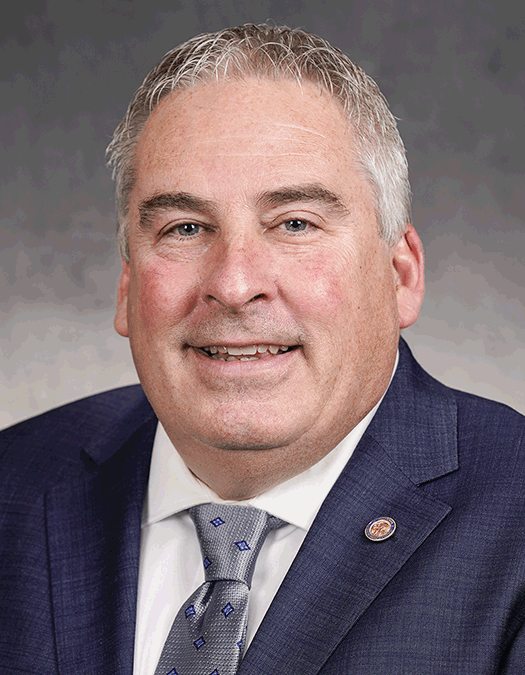
Rep. Jeff Witte
Sponsored bills
Maddy summaryHF 1227 provides a refundable sales and use tax exemption for construction materials used in a new public safety training facility in Lakeville. The exemption applies to materials purchased between February 28, 2025, and September 1, 2026, with taxes paid upfront but refunded later through the state's general fund. Businesses selling these materials to the Lakeville project will collect the tax initially but receive a refund under the same process used for similar projects. The law takes effect retroactively for eligible purchases made after February 28, 2025.
Maddy summaryHF 260 extends an exemption for small employers from Minnesota's Paid Leave Law until January 1, 2028. The bill amends Minnesota Statutes to exempt employers with 20 or fewer employees (as calculated under section 268B.14, subdivision 5b) from the law's requirements. This means small businesses in Minnesota will not need to provide paid leave to employees until 2028, while larger employers must comply earlier. The exemption expires on January 1, 2028, after which all employers must adhere to the full Paid Leave Law.
Maddy summaryHF 790 allocates $7.2 million for fiscal year 2025, and $2.9 million each for fiscal years 2026 and 2027 from the general fund to cover staff and equipment costs for additional Minnesota State Patrol troopers. The funds specifically support new trooper staffing and necessary equipment, but cannot be used for permanent capitol security troopers or nonsworn officers. This bill directly affects the State Patrol by providing dedicated funding to expand operational capacity. The appropriation is effective upon final enactment, with no additional policy changes beyond the specified funding.
Maddy summaryHF 50 appropriates $40.8 million from state highway bonds to fund the design and construction of a bridge interchange project on Interstate Highway 35 at Dakota County State-Aid Highway 50 (CSAH 50) in Lakeville. The funds will cover environmental analysis, engineering, right-of-way acquisition, and building two bridges over CSAH 50 along with associated ramps. The state will issue bonds up to $40.8 million to cover this project, with bond proceeds deposited into the trunk highway fund. This bill directly affects Lakeville residents and commuters by improving traffic flow at this specific highway intersection.
Maddy summaryThis bill clarifies and expands Minnesota's self-defense laws by removing the requirement to retreat before using force to protect oneself or one's home. It specifically eliminates the "duty to retreat" outside the home, broadens the definition of "dwelling" to include vehicles and adjacent areas like porches or decks, and creates a legal presumption that force was justified when someone enters a dwelling or occupied vehicle by stealth or force. The law applies directly to Minnesotans defending their homes, vehicles, or occupants against unlawful entry or threats, and extends protections to individuals defending others in these spaces. These changes codify existing common law principles into statute while removing restrictions on defensive force in specified scenarios.
Maddy summaryHF 975 appropriates $318,000 from the arts and cultural heritage fund for the Dakota County Historical Society to design and build the Heroes and Heritage Interpretive Trail Loop. The project will create a new trail loop along existing paved paths in South St. Paul, West St. Paul, and Inver Grove Heights. This funding directly supports local historical preservation and public access to heritage sites in Dakota County. The bill provides concrete financial resources for a specific infrastructure project without altering broader policy.
Maddy summaryHF 166 updates Minnesota's estate tax rules to match current federal estate tax exclusion amounts. It sets the Minnesota estate tax threshold at $3 million for estates of decedents dying in 2020 and later, aligning with the federal exclusion amount. This means estates valued below $3 million will no longer owe Minnesota estate tax, directly affecting decedents' estates that would have previously been subject to tax under older thresholds. The change takes effect for estates of decedents dying after December 31, 2024.
Maddy summaryHF 49 repeals a tax on all lawful gambling receipts in Minnesota, removing an existing tax burden for gambling businesses. This bill directly affects casinos, racetracks, and other legal gambling operators that previously paid this tax. The primary mechanism is the repeal of specific tax provisions (including sections 297E.01 and 297E.02), with related technical adjustments to other statutes to align with the repeal. The change eliminates a financial obligation for these businesses but does not alter gambling regulations or operations.
Maddy summaryHF 516 modifies Minnesota's teacher shortage reporting requirements and mandates a new annual report on teacher supply and demand. It updates the definition of "shortage area" to include regions where teacher diversity doesn't match student diversity, and requires the Professional Educator Licensing Board to submit detailed reports starting November 2025. These reports must include data on teacher retirement, licensure, diversity, specific shortage areas (like special education and STEM fields), and school districts' hiring progress. The bill directly affects school districts, the licensing board, and state education committees by requiring standardized, field-specific data collection. The first report must include field-specific teacher openings and hiring data by February 2026.