

Maddy summaryHF 2179 appropriates $14.5 million for a State Patrol helicopter, $2.3 million for a Cirrus airplane, and $1.7 million annually for pilot staff and equipment costs, all from the trunk highway fund. These funds, available until June 2027, directly support the Minnesota State Patrol’s aircraft procurement and operational expenses. The bill provides specific, one-time funding for aircraft purchases and ongoing costs for pilot operations. It does not change laws or policies but allocates existing transportation funds for aviation needs. (Bill: HF 2179, Title: State Patrol aircraft purchases and operations funding provided, and money appropriated.)
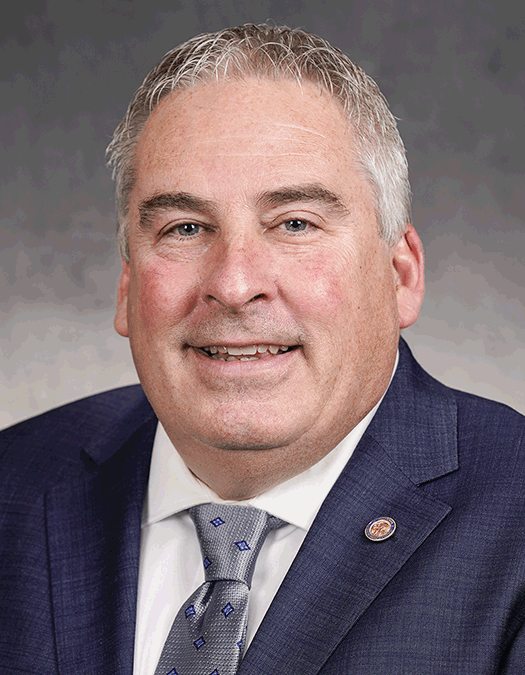
Rep. Jeff Witte
Sponsored bills
Maddy summaryHF 2220 prohibits Minnesota state agencies from charging parking fees to state employees at facilities owned or operated by the state. It directly affects all state employees who park on state property, whether working or with manager approval for personal use. The bill amends Minnesota Statutes (sections 16B.04 and 16B.58) to require free parking, removing all fees, fines, or penalties for eligible employees. This change applies to all state parking lots managed under the Department of Administration, ensuring employees receive a free parking permit.
Maddy summaryHF 2186 prohibits the Metropolitan Council from using transportation sales and use tax revenue for light rail or passenger rail projects, specifically naming the Green Line Extension (Southwest Corridor) as an example. The bill amends Minnesota Statutes to add this restriction in section 473.4465, subdivision 5, ensuring tax funds are reserved for other transit priorities like bus services, safety, and accessibility improvements. This prohibition expires on the date specified in Laws 2023, chapter 68, article 4, section 123, subdivision 11.
Maddy summaryHF 261 appropriates $250,000 for fiscal year 2026 and $250,000 for fiscal year 2027 to fund horse-assisted mental health therapy for eligible first responders in Minnesota. It directly affects active or retired peace officers, firefighters (full-time and volunteer), ambulance personnel, 911 telecommunicators, and correctional officers suffering from job-related trauma or PTSD. The funds will go to Abijah's on the Backside for therapy services, requiring two reports detailing program costs, participants, and outcomes by 2026 and 2028. This is a one-time appropriation to support existing mental health services for first responders, not a new statewide program.
Maddy summaryHF 1814 provides $2 million in fiscal year 2026 and $2 million in fiscal year 2027 to fund grants for local governments, tribal entities, and state agencies using Minnesota's statewide public safety radio system (ARMER). The grants cover purchasing or upgrading portable/mobile radios and compatible equipment that work with the ARMER system. Local governments can receive only one grant, must provide a 5% non-state match, and funds expire June 30, 2028. This one-time appropriation aims to improve emergency communication interoperability across participating public safety agencies.
Maddy summaryHF 1277 modifies Minnesota's sales and use tax exemption for data centers, providing a tax break on purchases of qualifying equipment and software. It creates three categories of qualifying data centers (standard, refurbished, and large-scale) with specific size, investment, and operational requirements - such as a minimum 25,000 square feet, $30 million in investments within 48 months, and features like backup power and security systems. The bill requires tax to be collected at standard rates but refunded later, applying to equipment like servers, cooling systems, and power infrastructure used in these facilities. This directly benefits data center operators investing in Minnesota facilities that meet the defined thresholds.
Maddy summaryHF 1162 appropriates $21.475 million from state bond proceeds to fund capital improvements at the Minnesota Zoo. Specifically, $17.675 million will build a new animal hospital, and $3.8 million will preserve assets by replacing outdated buildings and upgrading trails/roads at the zoo. The funding comes from bonds sold under Minnesota law, administered by the commissioner of management and budget. This bill directly affects the Minnesota Zoological Board and the zoo's physical infrastructure.
Maddy summaryHF 1860 appropriates $8 million from state bonds to fund a new regional household hazardous waste and recycling facility serving Dakota and Scott Counties. The money will be provided to a joint powers entity formed by both counties to construct and equip the facility, which will be located in Dakota County to serve residents and businesses from both areas. The bill authorizes the state to issue bonds up to $8 million to cover this appropriation, following standard bond procedures under Minnesota law. This funding directly supports waste management services for households in these two counties.
Maddy summaryHF 1399 requires Minnesota's Commissioner of Corrections to maintain a supply of opiate antagonists (like naloxone) at all state correctional facilities for immediate use during opioid overdoses. It mandates storing sufficient nasal doses throughout facilities for rapid response and provides training to correctional staff on recognizing overdose symptoms and administering the medication. This bill directly affects people in Minnesota's prisons and jails who may experience overdoses, as well as correctional facility staff responsible for safety. The law creates a specific protocol for overdose response within correctional settings, referencing existing statutes for definitions and administration procedures.
Maddy summaryHF 924 amends Minnesota law to allow retired peace officers to possess firearms in the Capitol complex, directly affecting retired law enforcement personnel who previously may have faced restrictions. The bill updates Section 609.66 of Minnesota Statutes by adding retired peace officers to an existing exception (under federal law § 926C) for firearm possession in Capitol Area buildings, alongside active officers and others with specific permissions. This change applies to all state buildings within the Capitol Area described in Chapter 15B, excluding the National Guard Armory, and takes effect August 1, 2025. The policy modifies existing felony prohibitions without altering general firearm laws or creating new permit requirements.