

Maddy summaryHF 749 establishes performance targets for Minnesota's Northstar Commuter Rail line, operated by the Metropolitan Council. It requires annual ridership of at least 900,000 passengers (measured June 1-May 31) or a farebox recovery ratio of 40% or higher starting in 2026. If these targets are not met, the bill mandates automatic termination: ending all service, closing stations, dissolving related agreements, and selling assets. The Metropolitan Council must seek federal waivers for termination obligations and deposit any resulting revenue into the state general fund. This law directly affects the rail line's operations and the entities managing it (Metropolitan Council and state transportation authorities).
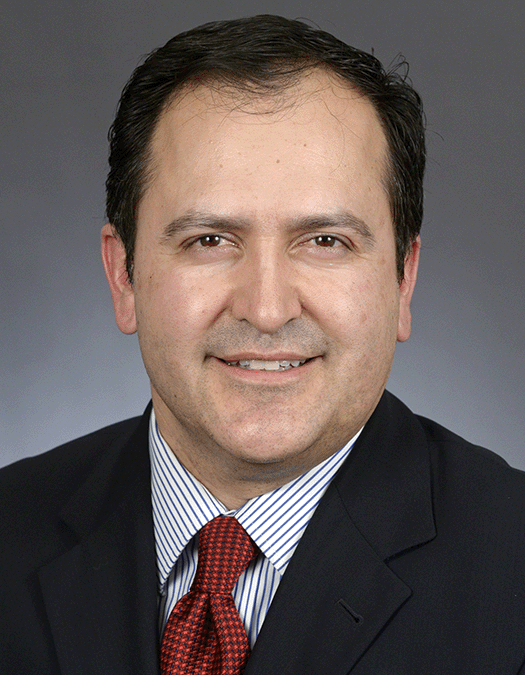
Rep. Jon Koznick
Sponsored bills
Maddy summaryHF 1690 makes technical updates to how funds are collected for Minnesota's motorcycle safety account. It requires motorcycle plate applicants to contribute $10 annually and directs specific portions of motorcycle endorsement fees ($19 of the $26.50 initial fee and $11 of the $17 renewal fee) to the account. The bill formally establishes the "motorcycle safety account" in the state's special revenue fund, specifying that funds must support safety training, instructor coordination, and reimbursements to approved organizations. This directly affects motorcycle owners who obtain special license plates or motorcycle endorsements. The changes take effect July 1, 2025.
Maddy summaryHF 1694 appropriates $4.5 million from state bond proceeds to fund planning, design, environmental review, engineering, and land acquisition for reconstructing the interchange between Interstate Highway 35 and Scott County State-Aid Highway 2. The bill authorizes the state to issue up to $4.5 million in bonds, with proceeds deposited into the trunk highway fund to cover these specific project costs. This funding directly supports the Minnesota Department of Transportation (commissioner of transportation) in advancing the interchange project. The bill affects Scott County residents and commuters who use this highway corridor by enabling improvements to this specific transportation junction.
Maddy summaryHF 1347 appropriates $20 million from state bonds to fund grants for metropolitan cities in Minnesota to reduce wastewater inflow and infiltration in municipal sewer systems. Eligible cities must be identified by the Metropolitan Council as contributors of excessive inflow/infiltration or within 20% of allowable limits, with grants covering up to 50% of eligible capital improvement costs. The funding supports infrastructure projects to mitigate strain on the regional sewer system, administered through the Metropolitan Council's guidelines. The bonds will be issued under Minnesota's bond authority statutes to provide the necessary capital.
Maddy summaryHF 1349 appropriates $10.8 million from state bond proceeds to fund the reconstruction of County State-Aid Highway 50 from Kenrick Avenue to Klamath Trail in Dakota County. This project is part of the Interstate 35 interchange improvements and will address mobility and safety needs. The funds cover design, construction, right-of-way acquisition, pedestrian/bike facilities, utility relocation, and stormwater management for Highway 50 and connected roads like 175th Street and Kenrick Avenue. The money is allocated to Dakota County, the city of Lakeville, or both, to complete this specific infrastructure project. The state will issue bonds up to $10.8 million to cover this appropriation.
Maddy summaryThis bill expands Minnesota's sales tax exemption to include additional baby products, directly affecting parents and caregivers who purchase these items. It adds baby wipes, cribs and bassinets (including mattresses and sheets), changing tables and pads, strollers, car seats and bases, baby swings, bottle sterilizers, and infant eating utensils to the list of tax-exempt items. The exemption applies to sales and purchases made after June 30, 2025. This change removes sales tax from these specific baby products, aligning with the existing exemption for items like breast pumps and baby bottles.
Maddy summaryHF 1351 clarifies definitions in Minnesota's transportation law to reduce ambiguity. It amends three specific definitions in Minnesota Statutes section 169.011: (1) defining "bicycle route" as a signed roadway encouraging bike use, (2) clarifying "roadway" to exclude shoulders unless dynamic shoulder lanes are active, and (3) specifying that "roadway" refers to individual roadways in multi-roadway highways. These changes update technical language without creating new requirements or directly affecting any group. The bill serves to make existing transportation statutes clearer for legal and administrative consistency.
Maddy summaryHF 795 modifies Minnesota's driver's license road skills examination scheduling and cancellation fees. It requires the driver's license department to provide real-time website updates showing next available exam dates and times at each location, with 50% of appointments bookable 3 months in advance, 75% for 2 months, and 100% for 1 month. The bill also increases the cancellation fee for failing to appear or canceling less than 24 hours before a scheduled test from $20 to $50, while keeping a $20 fee for cancellations between 24-72 hours. These changes apply to road skills examinations scheduled on or after August 1, 2025, directly affecting drivers needing to take these tests.
Maddy summaryHF 2 requires state agency employees to immediately report suspected fraud to law enforcement and legislative committee leaders when they have reason to believe fraud exists in agency programs. It mandates that all state agencies post current organizational charts online with contact details for leadership and division heads. The bill strengthens grant management by requiring agencies to conduct unannounced monitoring visits before final payments for grants over $50,000 (and annually for grants over $250,000), perform financial reconciliations prior to disbursement, and withhold funds from grantees failing to submit required progress reports. Violating these grant management requirements constitutes a misdemeanor under the bill.
Maddy summaryHF 14 proposed a temporary moratorium on most light rail transit project development spending by the Metropolitan Council in seven Minnesota counties (Anoka, Carver, Dakota, Hennepin, Ramsey, Scott, and Washington). The bill prohibited funds for planning, design, environmental analysis, land acquisition, and construction of new light rail projects, but exempted the Southwest Light Rail (Green Line Extension) and prior contractor payments. The moratorium would have expired once the Green Line Extension began revenue operations. The bill was introduced, amended, and ultimately not passed by the legislature.