

Maddy summaryThis bill updates policies and training requirements for assisted living facilities in Minnesota, directly affecting facility operators and unlicensed staff members who work there. It mandates that facilities maintain updated policies covering staff training, emergency procedures, infection control, and supervision of unlicensed personnel performing delegated tasks. The legislation also strengthens penalties for violations by allowing commissioners to assess investigation-related costs and increase fines for serious injuries or deaths caused by egregious conduct. Additionally, the bill requires facilities to ensure emergency-trained personnel are available 24 hours a day and to provide residents with clear information about their rights and facility procedures.
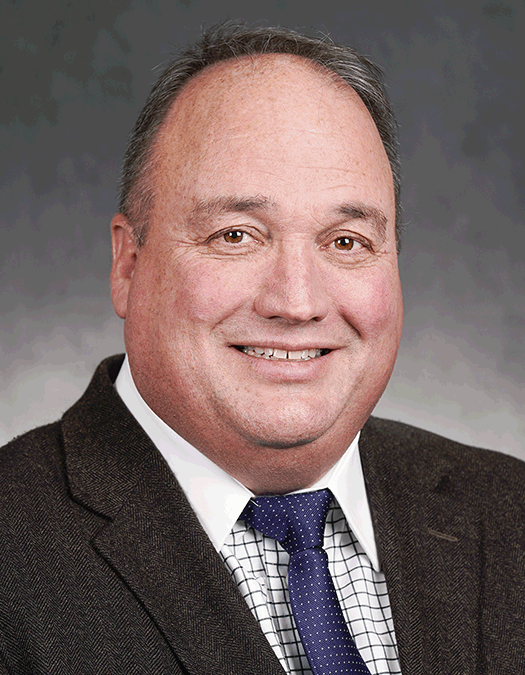
Rep. John Huot
Sponsored bills
Maddy summaryThis bill provides funding for Minnesota's Board of Public Defense, which supports public defenders representing low-income individuals who cannot afford legal representation. The legislation appropriates $6.9 million for fiscal year 2026 and $13.7 million for fiscal year 2027 from the state's general fund, with an additional base funding of $183.529 million starting in fiscal year 2028. These funds are intended to supplement existing appropriations and ensure continued financial support for the public defense system. The bill takes effect immediately upon final enactment.
Maddy summaryThis bill regulates the possession and transfer of semiautomatic military-style assault weapons in Minnesota by defining specific firearms that fall under the category and requiring owners to certify their ownership. It directly affects individuals who currently own or wish to acquire these weapons, which include various rifle, pistol, and shotgun models with specific features like detachable magazines or pistol grips. The law mandates that possession of these weapons requires certification and establishes criminal penalties for violations, while also requiring reporting mechanisms to track ownership. The bill applies to both existing firearms and conversion kits that could be assembled into assault weapons, with exemptions for weapons permanently rendered inoperable.
Maddy summaryThis bill requires hospitals in Minnesota to receive separate reimbursement for biological products used in cell or gene therapy treatments for rare diseases, effective July 1, 2025. Under the new rules, hospitals must be paid the actual cost of acquiring these biological products when they are administered to patients in an inpatient setting. The requirement applies only if drug manufacturers enter into value-based arrangements with the state commissioner, and the reimbursement rate will be set using the same methodology used for outpatient drug administration. The law amends existing Minnesota statutes to clarify how hospitals should be compensated for these specific medical treatments.
Maddy summaryThis bill reduces the time limit for filing medical malpractice lawsuits in Minnesota from four years to two years, directly affecting patients seeking to sue healthcare providers for negligence. It also restricts how much money plaintiffs can collect from a provider's personal income or assets, allowing such collection only if the provider acted willfully or maliciously or failed to carry at least $1 million in insurance. Additionally, the bill caps noneconomic damages for pain and suffering at $500,000 and limits economic damages to the actual medical expenses paid or owed by the patient. These changes would take effect on August 1, 2025, and apply to cases filed on or after that date.
Maddy summaryThis bill allocates $20 million in state funding to the Minnesota Hockey Hall of Fame nonprofit to build a facility in Inver Grove Heights that will include a museum, ice rink, and event spaces. It also authorizes the state to issue up to $5 million in bonds to provide infrastructure improvements like roads, utilities, and sidewalks to support the project. The funding is designated for construction and development costs, with the money available until the project is finished or abandoned. Both sections of the bill take effect immediately upon final passage by the legislature.
Maddy summaryThis bill updates Minnesota's health insurance laws to modernize how prescription drug prior authorizations are handled between healthcare providers and insurance companies. It requires that by January 1, 2027, all drug prior authorization requests be exchanged electronically using a specific national standard, replacing older methods like fax or paper. The legislation also clarifies rules for certain insurance groups that are not covered by federal privacy laws, adjusting their electronic data exchange requirements. Additionally, the bill adds a definition for biosimilar drugs and removes outdated language from several existing health statutes. These changes aim to streamline administrative processes and improve efficiency in prescription drug coverage management.
Maddy summaryThis bill expands Minnesota's property tax refund program for taxes payable in 2026. It requires the refund calculation to use an eight percent threshold instead of the current twelve percent threshold, which would increase refund amounts for eligible property owners. The change applies only to property taxes due in 2026 and does not affect refunds for other tax years. The legislation is limited to a one-time expansion and does not create permanent changes to the refund system.
Maddy summaryThis bill requires businesses in Minnesota to offer arbitration agreements to consumers only after completing a sale or lease, rather than including them as part of the initial transaction terms. The law mandates that any arbitration agreement must be presented separately from other contract terms and written in clear, conspicuous language that is easy for consumers to understand. If a business violates these requirements, the arbitration clause becomes unenforceable, but the rest of the contract remains valid. The changes take effect on August 1, 2026, and apply to all agreements signed on or after that date.
Maddy summaryThis bill allows employees of gambling facility owners to play pull-tab games at their workplace when they are not working. It amends existing Minnesota gambling laws to create an exception for off-duty lessor employees, permitting them to participate as players in pull-tab games at the premises where they work. The law maintains restrictions that prevent employees from playing while on duty or during working hours, and it keeps existing rules that bar employees from participating in other types of gambling games like bingo or electronic linked games. This change specifically affects employees of organizations that operate pull-tab games, giving them the option to play these games after their shifts end.