

Maddy summaryHF 1783 authorizes Minnesota to issue free special license plates for residents who have received the Legion of Merit military award. The bill allows eligible veterans to obtain these plates for personal-use vehicles (cars, trucks, motorcycles, or RVs) without paying registration fees or replacement costs. Plates can be transferred between vehicles owned by the same person, but must be used only for non-commercial purposes. This is a procedural change to Minnesota's license plate program, effective January 1, 2026.
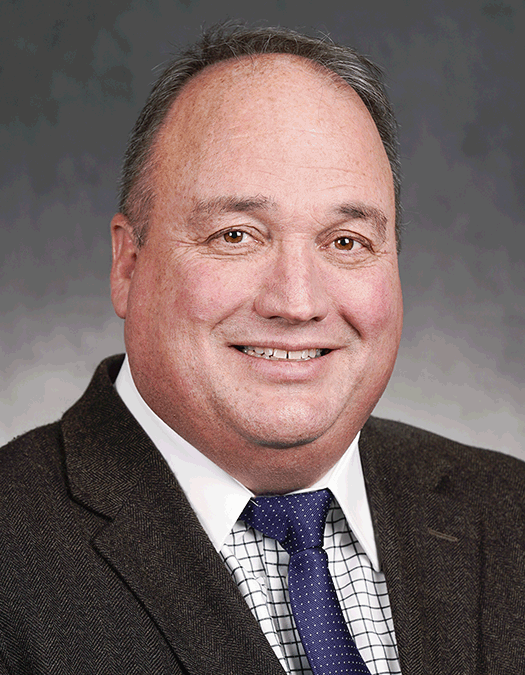
Rep. John Huot
Sponsored bills
Maddy summaryHF 1126 creates a property tax exemption for specific land owned by federally recognized Indian Tribes in Minnesota. It exempts one parcel (max 40,000 sq ft) that was classified as class 3a in 2025, located in a city over 400,000 population (like Minneapolis), owned by a tribe as of January 1, 2024, and used exclusively for tribal purposes or public charities. Properties used for housing, apartments, farming, or forestry do not qualify. The exemption applies starting with tax assessments in 2026. This directly affects eligible tribal entities owning qualifying property in designated urban areas.
Maddy summaryHF 967 creates a property tax exemption for specific land owned by federally recognized Indian Tribes in Minnesota. It directly affects tribal properties meeting four conditions: classified as "class 2b" for 2025 taxes, located in a county with 5,580-5,620 residents (2020 census), within an unorganized territory of under 800 residents (2020 census), and owned by a tribe as of January 2, 2023. The exemption applies to these properties for all future tax assessments starting in 2026. This change modifies Minnesota’s property tax law to exclude qualifying tribal land from local taxation.
Maddy summaryHF 1277 modifies Minnesota's sales and use tax exemption for data centers, providing a tax break on purchases of qualifying equipment and software. It creates three categories of qualifying data centers (standard, refurbished, and large-scale) with specific size, investment, and operational requirements - such as a minimum 25,000 square feet, $30 million in investments within 48 months, and features like backup power and security systems. The bill requires tax to be collected at standard rates but refunded later, applying to equipment like servers, cooling systems, and power infrastructure used in these facilities. This directly benefits data center operators investing in Minnesota facilities that meet the defined thresholds.
Maddy summaryHF 810 increases criminal penalties for assaulting firefighters, EMS personnel, and healthcare workers in hospital emergency departments. It amends Minnesota law to upgrade assaults causing demonstrable bodily harm from a gross misdemeanor (max 2 years jail/$4,000 fine) to a felony (max 3 years jail/$6,000 fine). The bill directly affects individuals who assault these emergency responders during their duties or hospital emergency staff providing care. The changes take effect August 1, 2025, applying to crimes committed on or after that date.
Maddy summaryHF 1762 proposes adding a new constitutional amendment to Minnesota's state constitution. If approved by voters, it would guarantee all persons equal rights under state law and prohibit discrimination based on race, color, national origin, ancestry, disability, or sex - including protections for pregnancy decisions, gender identity, gender expression, and sexual orientation. The amendment would apply to all state actions and agencies, requiring any discriminatory state action to be the "least restrictive means" of achieving a "compelling governmental interest." The proposed amendment must be submitted to voters in the 2026 general election, with implementation starting January 1, 2027, if ratified.
Maddy summaryHF 1877 amends Minnesota's medical cannabis laws by updating key definitions and adding new requirements for patient enrollment and manufacturer registration. The bill prohibits patients enrolled in federally approved clinical trials for a qualifying medical condition from joining the medical cannabis registry and requires the commissioner to inform patients about such trials as an alternative. It revises the process for registering medical cannabis manufacturers, mandating two in-state manufacturers to be registered by December 1 every two years, with the commissioner considering factors like technical expertise and financial stability. These changes directly affect patients seeking medical cannabis, healthcare providers who certify conditions, and the businesses that produce and distribute medical cannabis in Minnesota.
Maddy summaryHF 1810 requires Minnesota's Commissioner of Health to establish a statewide "Provider Orders for Life-Sustaining Treatment" (POLST) program, allowing patients nearing the end of life to document their medical treatment preferences. The bill creates a secure registry where authorized users - including emergency responders, hospitals, clinics, assisted living facilities, and hospices - can access POLST forms to honor patient wishes regarding life-sustaining treatments like resuscitation or mechanical ventilation. It classifies POLST data as confidential, provides immunity for providers acting in good faith under the program, and appropriates funds for implementation. The law clarifies that patients or their legal representatives may revoke or remove their POLST from the registry at any time, and it does not mandate POLST use for patients or providers.
Maddy summaryHF 1842 authorizes sports betting and fantasy contests in Minnesota while establishing licensing requirements for operators and prohibiting local governments from banning these activities. The bill creates a tax system for sports betting and fantasy contests, requires operators to obtain state licenses, and includes specific rules for mobile betting applications and in-game wagers. It clarifies that standard fantasy sports contests (based on real athlete performance) are permitted, but esports events must meet additional criteria. The legislation also updates tax rates for pari-mutuel horse racing and requires reports on gambling revenue, affecting operators, tribal casinos, and residents aged 21+ who place bets.
Maddy summaryHF 1626 eliminates maximum dollar limits on tax credits for Minnesota agricultural asset owners who sell or rent property to beginning farmers. Previously, credits were capped at $50,000 for sales and $7,000-$10,000 annually for rentals; this bill removes those caps, allowing credits to be calculated based on actual qualifying transaction values (8%, 10%, or 15% of sale price or rental income). The change applies to credits under Minnesota Statutes sections 41B.0391 and 290.06, effective for tax years beginning after December 31, 2024. It directly affects agricultural landowners and beginning farmers participating in Minnesota’s tax credit program.