

Maddy summaryHF 1355 requires permit holders harvesting or destroying aquatic plants in Minnesota public waters to use scuba diving equipment safely and establishes safety standards for commercial diving operations. It mandates that applicants provide documentation of a recent third-party safety survey by a qualified professional (like a DLI consultant or insurance underwriter) and ensures divers have valid certification from accredited programs. The bill also requires employers to provide buoyancy control devices for workers using scuba equipment during these activities. These requirements apply directly to commercial entities and contractors seeking permits under Minnesota Statutes §103G.615 for aquatic plant management. The law aims to improve workplace safety for divers working in Minnesota's waterways.
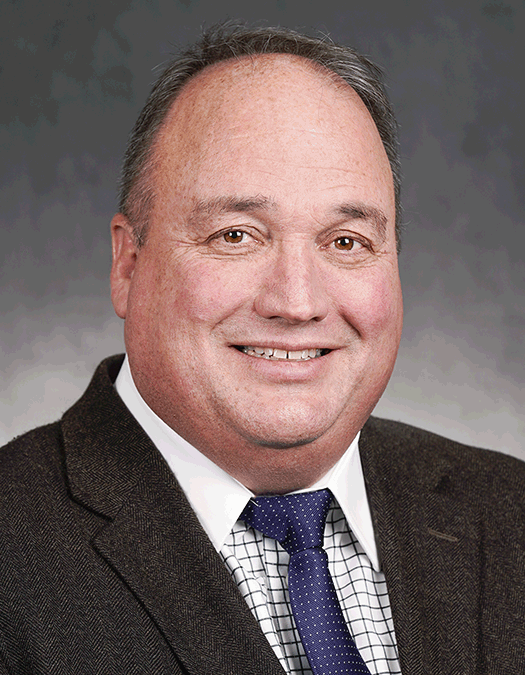
Rep. John Huot
Sponsored bills
Maddy summaryHF 124 allows living public safety officers (including police, firefighters, and emergency responders) to accept certain gifts, such as money, property, plaques, or services, when a fellow officer is killed in the line of duty. The bill requires that gifts be given within 24 months of the death, honor or commemorate the fallen officer, and support team morale. This applies to officers employed by the same agency or political subdivision as the deceased officer. The bill amends Minnesota Statutes to permit these gifts without violating existing gift acceptance rules.
Maddy summaryHF 1913 creates a new limited medical license for graduates of foreign medical schools who meet specific criteria, including 60 months of practice outside the U.S. in the past decade, working in a collaborative agreement within a rural or underserved area, and providing evidence of a job offer. It requires employers of these limited license holders to carry medical malpractice insurance and pay at least the equivalent of a medical resident's salary, while prohibiting retaliation for reporting violations. Limited license holders must submit periodic certification to the medical board confirming their employment and good standing every six months. The bill also establishes a pathway to full licensure after two years of practice (1,692 hours annually), passing all USMLE/COMLEX-USA steps, and obtaining a recommendation letter.
Maddy summaryHF 2228 establishes a 13-member task force to address insurance affordability issues affecting homeowners, renters in multifamily housing, common interest communities, cooperatives, and small businesses. The task force will review topics like risk mitigation, liability laws, reinsurance markets, and climate-related claim costs, then submit recommendations by February 2026. The bill appropriates $200,000 from the general fund to cover the task force’s operational costs through June 2026. It does not make immediate policy changes but requires a final report with findings and draft legislation to strengthen Minnesota’s property insurance system.
Maddy summaryHF 2554 designates a specific bridge on Burnsville Parkway over Interstate Highway 35W in Burnsville, Minnesota, as the "Elmstrand * Finseth * Ruge Heroes Memorial Bridge." The bill amends Minnesota Statutes section 161.14 to formally name the structure and requires the transportation commissioner to adopt appropriate signage for it. This is a commemorative measure naming a physical location, not a policy change affecting residents or creating new laws. The bridge itself is the direct subject of the designation, with no broader legislative impact beyond the memorial name and signage.
Maddy summaryHF 2171 is a symbolic resolution, not a law. It asks Congress to recognize Minnesota's historical ratification of the Child Labor Amendment (ratified by Minnesota in 1933), which would authorize federal regulation of child labor for those under 18. The resolution has no legal effect, as the amendment remains unratified nationally (requiring 38 states, but only 27 have ratified) and federal child labor laws are already in place following the 1941 Supreme Court case *United States v. Darby Lumber Co.*
Maddy summaryHF 978 exempts grain bins and tractor tires from Minnesota's sales and use tax, directly benefiting farmers and agricultural businesses that purchase these items. The bill adds "grain bins" (defined as fixed structures storing grain to prevent spoilage) and "tractor tires" to the list of tax-exempt farm equipment under Minnesota law. This change modifies existing tax statutes to remove these items from taxable purchases, effective after June 30, 2025. The policy provides a concrete tax relief for agricultural operations purchasing these specific storage and equipment items.
Maddy summaryHF 1645 appropriates $1 million from the general fund for fiscal year 2026 to the Minnesota Medical Association to run a "Treat Yourself First" campaign. The campaign aims to reduce stigma around mental health services, encourage healthcare workers experiencing burnout to seek help, and normalize seeking support for well-being. It specifically targets physicians, nurses, dentists, pharmacists, and other healthcare professionals. This is a one-time appropriation available until July 1, 2030.
Maddy summaryHF 1984 creates a new grant program to support Minnesotans affected by fetal alcohol spectrum disorders (FASD). It appropriates $1 million for fiscal year 2026 and $1 million for fiscal year 2027 from the general fund to the commissioner of health. The commissioner must award grants to a statewide organization focused solely on FASD prevention and intervention. The grantee must develop programming providing resource navigation, individualized support, education, and social connection opportunities for people with FASD and their families/caregivers. This bill directly affects Minnesotans living with FASD and their support networks through new state-funded services.
Maddy summaryHF 3158 proposes a constitutional amendment requiring a two-thirds vote in both the Minnesota House and Senate to authorize public funding for the design, construction, or renovation of a professional sports facility. Currently, a simple majority vote suffices for such funding. The amendment must be submitted to voters in the 2026 general election, where they will decide whether to adopt the two-thirds requirement. If approved by voters, this change would become part of the Minnesota Constitution, affecting future legislative decisions on sports facility funding.