

Maddy summaryHF 264, the "Larry R. Hill Medical Reform Act," requires all licensed Minnesota correctional facilities (both public and private) to meet specific medical care standards. The bill amends state law to mandate facilities implement policies covering mental health screening, suicide prevention, medication verification, discharge planning with prescribed medications, telehealth use, and death reviews. These requirements directly affect incarcerated individuals by improving access to consistent medical and mental health care while holding facilities accountable through commissioner inspections. The law aims to standardize care practices without creating new programs, focusing on operational changes to enhance safety and treatment.
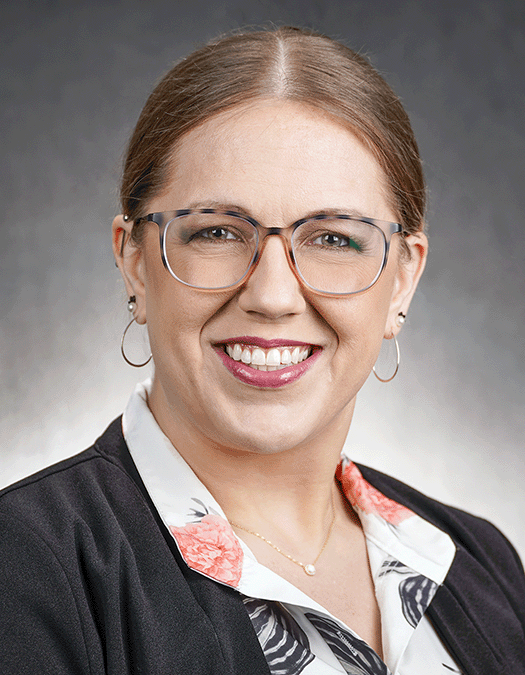
Rep. Jess Hanson
Sponsored bills
Maddy summaryHF 2406 allows people receiving certain disability waiver services in Minnesota to have remote reassessments (via video or phone) instead of in-person meetings under specific conditions. It directly affects individuals enrolled in developmental disabilities, community access, brain injury, or elderly waiver programs. The bill permits remote reassessments to replace up to two consecutive in-person meetings for some programs (followed by an in-person meeting), or one for others, but requires informed consent from the person or their legal representative and verifies ongoing needs, care level, and service plan details. All remote reassessments must follow the same requirements as in-person meetings, including updates to support plans. The changes take effect January 1, 2026, or after federal approval.
Maddy summaryHF 1392 establishes a dedicated "consumer protection restitution account" to handle unclaimed funds from consumer protection cases in Minnesota. It requires that 50% of money recovered by the Attorney General in consumer enforcement actions - where funds aren't specifically designated for victims - be deposited into this account instead of the general fund. The account is used to distribute restitution to eligible consumers (those directly harmed by unlawful practices) who cannot be located or to whom payments weren't redeemed within 120 days, prioritizing cases with the oldest final court orders. This ensures unclaimed restitution money directly benefits victims rather than flowing into general state funding.
Maddy summaryHF 862 requires all public Minnesota colleges and universities (including the University of Minnesota and Minnesota State Colleges) to maintain a supply of naloxone (an opiate antagonist used to reverse overdoses) on every campus building. Specifically, institutions must have at least two doses of nasal naloxone available onsite at each building and follow established protocols for storage and administration. The bill also directs the state health commissioner to provide training resources, including videos, to help campuses implement these emergency response measures. This requirement takes effect for the 2025-2026 academic year. The bill does not change who can administer naloxone but ensures campuses are prepared to respond to opioid overdoses.
Maddy summaryThis bill appropriates $6.4 million for fiscal years 2026 and 2027 to fund Minnesota's Small Business Assistance Partnerships Program under Minnesota Statutes §116J.682. It directly supports small businesses by providing two-year grants through local partnerships, with funding administered by the Department of Employment and Economic Development. The bill specifies that all grants must be awarded in the first year of funding, and up to 5% of the appropriation may cover administrative costs. This is a one-time funding measure, not an ongoing program.
Maddy summaryHF 2231 modifies Minnesota's requirements for publishing public notices. It allows local governments (political subdivisions) to post notices online via their website and the Minnesota Newspaper Association's statewide site when a qualified newspaper discontinues publication. The bill requires immediate online posting until a qualified newspaper can be identified, eliminating the need to wait for a new newspaper to become available. This change applies to all public notices mandated by law, rule, or ordinance, ensuring notices remain accessible to the public during newspaper disruptions.
Maddy summaryHF 1581 appropriates $553,000 for fiscal year 2026 and $553,000 for fiscal year 2027 from the general fund to the Diaper Bank of Minnesota. The funds are designated for its diaper distribution grant program, which provides diapers to low-income families in need. This bill directly supports families facing diaper insecurity by expanding access to essential supplies through the existing program. The funding is added to the program's base budget and requires no new policy changes or administrative processes.
Maddy summaryHF 683 allows Minnesota cities and counties to adopt ranked choice voting (RCV) for local elections, such as mayoral or city council races. It establishes rules for how RCV would work, including counting votes by voter preferences and reallocating votes when candidates are eliminated. The bill permits local jurisdictions to use electronic voting systems that automatically handle vote reallocation, and it appropriates funds for implementation. This bill directly affects local governments choosing to implement RCV and voters in those jurisdictions participating in local elections. It does not change state or federal election rules.
Maddy summaryHF 2707 appropriates $11.125 million for each of fiscal years 2026 and 2027 from the general fund to support sexually exploited youth or youth at risk of sexual exploitation under Minnesota Statutes §256K.47. At least $9 million annually must fund street outreach, emergency shelter, regional navigators, and housing services for these youth. The bill directly affects vulnerable youth in Minnesota by providing dedicated funding for critical safe harbor resources and housing support. It establishes concrete funding mechanisms without altering existing statutes or creating new requirements.
Maddy summaryHF 1412 appropriates $202,600 from the general fund to the Minnesota Department of Health for a one-time grant to the Division of Indian Work. The bill directs this funding to develop and pilot culturally specific suicide prevention curriculum for Native American youth in Minnesota. The curriculum must cover mental health, emotional intelligence, depression, and suicide, providing practical tools for students to support themselves and others. It specifically targets Native American youth and is not intended for general school use.