

Maddy summaryHF 1322 modifies Minnesota's auto insurance rules for total loss claims. It requires insurers to offer a replacement vehicle option (with all taxes, fees, and license costs paid by the insurer, except the insured's deductible) when settling a total loss under a policy using actual cash value or replacement with like kind and quality, and the insured is not an auto dealer. This directly affects individual vehicle owners and non-dealer businesses who experience a total loss. The bill ensures insureds have a clear choice for a replacement vehicle without additional out-of-pocket costs beyond their deductible.
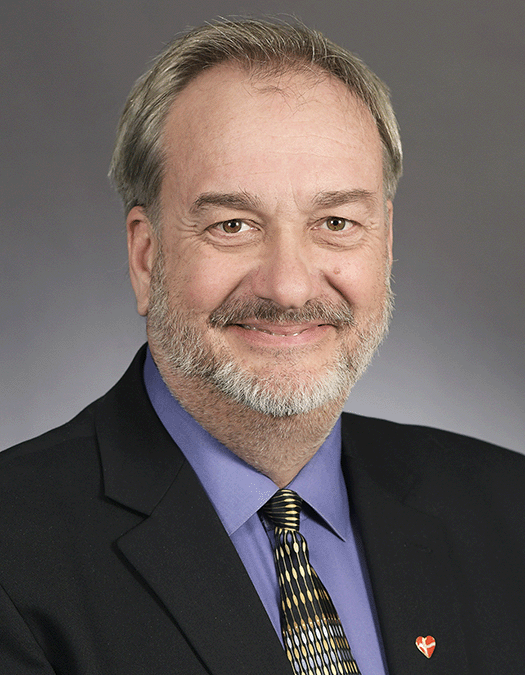
Rep. Rick Hansen
Sponsored bills
Maddy summaryHF 3240 establishes a two-year grant program administered by Minnesota's Department of Health to address outbreaks of vaccine-preventable diseases (like measles) in communities with low vaccination rates. It appropriates funds for fiscal years 2026 and 2027 to support community health boards and nonprofit organizations working in these high-risk areas. Grant funds must cover culturally appropriate vaccine education, combating misinformation, and helping individuals access vaccines, with materials provided in primary languages of affected populations. The program directly targets geographic areas or populations experiencing or at risk of outbreaks due to low vaccination coverage.
Maddy summaryHF 2381 establishes new rules for manufactured home parks in Minnesota. It requires park owners to charge uniform rent (with limited exceptions for lot size/location), caps late fees at 8% of rent, and prohibits fees based on family size, home size, or guests. The bill mandates itemized utility billing, requires safety inspections for hazardous trees within 14 days of notice, and requires 60 days' written notice for rent increases. These changes directly affect park residents and owners by standardizing fees, improving transparency, and enhancing safety protections.
Maddy summaryThis bill modifies a state appropriation for the city of Oak Park Heights to fund redevelopment of the Allen S. King power plant site. It authorizes a $2,190,000 grant for the city to acquire property and design public infrastructure including water systems, sewer systems, roads, trails, and sidewalks. The legislation extends the deadline for using bond sale proceeds and appropriations from the original timeframe to December 31, 2029. This change affects the city's ability to access state funding for infrastructure planning at the specified site.
Maddy summaryHF 3446 appropriates $6.5 million from state bond funds to build a new swimming pool and aquatics center in South St. Paul, Minnesota. The city of South St. Paul directly receives this grant for site preparation, construction, equipment, and furnishings. The bill requires the facility to include specific sustainability features like energy-efficient lighting, water-saving plumbing, native landscaping, accessibility for active transportation, and photovoltaic-ready infrastructure. The state will issue bonds to cover the cost, with the funding effective upon enactment.
Maddy summaryHF 3619 requires Minnesota's Environmental Quality Board to conduct a generic environmental impact statement on sustainable aviation fuel production and use. It places a temporary moratorium on both tax credits for sustainable aviation fuel producers/blenders (under Minn. Stat. § 41A.30) and grants from the Department of Agriculture until this review is completed. The bill amends tax credit rules to state that credits can only be claimed after the Environmental Quality Board finishes the impact statement and the commissioner certifies the credit. This directly affects sustainable aviation fuel producers, blenders, and the state agencies responsible for administering tax credits and grants.
Maddy summaryHF 3460 appropriates $4 million from state bonds to fund a regional facility in Washington County for processing wood waste and trees affected by disease into sustainable products. The bill authorizes the state to issue bonds to cover this cost and directs the funds toward acquiring land, designing, constructing, and equipping the facility. This directly affects Washington County residents and local businesses by creating a dedicated processing site for waste materials. The key mechanism is the bond-backed appropriation, with the facility intended to convert waste into reusable resources rather than sending it to landfills.
Maddy summaryHF 3369 appropriates $50,000 from the arts and cultural heritage fund for fiscal year 2027 to establish the Centennial Barns Registry. The Minnesota Historical Society will operate the registry, allowing landowners to voluntarily register barns built before 1959 and share their history and location. This funding directly supports documenting historic barn structures across Minnesota without imposing requirements on property owners.
Maddy summaryHF 3346 creates a commission to evaluate all campuses in the Minnesota State Colleges and Universities system for potential closure or consolidation, directly affecting those campuses and their students, faculty, and staff. The commission must base recommendations on factors like operating costs, enrollment trends, graduation rates, and program reputation, while seeking input from faculty and staff unions. It must submit a report with specific recommendations by December 1, 2026, and the governor must approve or reject the entire package by December 31, 2026, with approved changes becoming part of the state budget. The commission expires on October 1, 2026, ending the evaluation process.
Maddy summaryHF 3443 creates a property tax credit for homeowners in designated redevelopment areas. It provides a 70% credit on a property's tax amount for homes classified as 1a or 1b located in cities of the second class that were federally designated as redevelopment areas under the 1965 Public Works Act. The credit reduces property taxes paid by qualifying homeowners, with the state reimbursing local governments in two installments annually using funds appropriated from the general fund. The credit becomes effective for taxes payable starting in 2027.