

Maddy summaryHF 3911 is a supplemental budget bill that provides funding and updates laws for Minnesota's environment and natural resources agencies for the 2024 and 2025 fiscal years. The legislation appropriates money to various departments, including the Pollution Control Agency, and modifies existing statutes to establish new programs, adjust fees, and set rules for activities like gas exploration, forestry management, and water law enforcement. Specific provisions include creating a Packaging Waste and Cost Reduction Act, banning certain mercury-containing lights, and establishing a boat wrap product stewardship program. Additionally, the bill creates new accounts and task forces while repealing older sections of state law to align with current environmental and resource management needs.
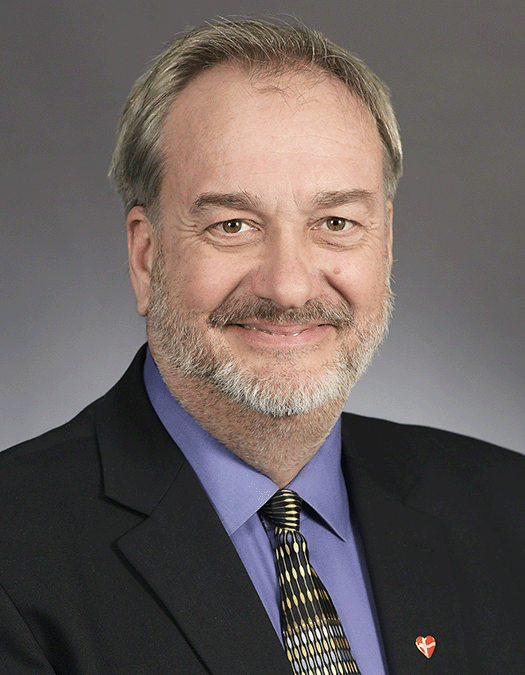
Rep. Rick Hansen
Sponsored bills
Maddy summaryThis bill is a resolution from the Minnesota Legislature that formally asks Congress to overturn the Supreme Court ruling in Citizens United v. FEC. It requests that Congress propose a constitutional amendment to clarify that only natural persons, not corporations or other artificial entities, possess rights under the Constitution. The proposed amendment would also state that spending money to influence elections is not protected speech and would allow governments to regulate or limit campaign contributions to ensure equal political access. Additionally, the bill mandates that all permissible campaign spending must be publicly disclosed. Ultimately, the resolution directs state officials to send copies of the text to federal leaders and Minnesota's congressional representatives.
Maddy summaryThis bill makes it illegal to advertise a price for goods or services while hiding mandatory fees that consumers must pay. It defines these hidden fees as charges that are unavoidable or that a reasonable person would expect to be included in the total cost, though it excludes government taxes. Businesses must clearly show any additional flat fees or percentages before a customer selects items and again on a subtotal page before checkout. The law includes specific exemptions for motor vehicle dealers, utilities regulated by the state, and certain real estate settlement costs.
Maddy summaryThis bill appropriates funds from the arts and cultural heritage fund to the Minnesota Historical Society for fiscal year 2025. The money is designated to commission and install a bust of former Supreme Court Justice Harry A. Blackmun. The sculpture will be placed on the second floor of the State Capitol, outside the chambers of the Minnesota State Supreme Court.
Maddy summaryThis bill restructures the Minnesota Clean Water Council to improve how the state prioritizes water quality improvements and manages funding. It expands the council's membership to include representatives from various sectors such as farming, business, local governments, and environmental groups, while adding requirements that members possess scientific expertise in water-related fields. The legislation also modifies the council's duties to include advising the legislature on how to allocate money from the clean water fund and establishes new criteria for deciding which waterways should be addressed first to protect human health and ecosystems.
Maddy summaryThis bill prevents the Minnesota Public Utilities Commission from issuing permits to build pipelines designed to transport carbon dioxide. It directly affects energy companies and regulators by legally barring the approval of any new carbon dioxide pipeline routes in the state. The law takes effect immediately upon final passage, ensuring that no such permits can be granted under the current statute.
Maddy summaryThis bill authorizes state funding to acquire, improve, and construct public buildings and facilities in Minnesota. It directs specific amounts of money to the commissioner of education for library construction and to the commissioner of administration for sustainable building guidelines and ADA accommodations. The legislation mandates that all workers on funded projects receive at least the prevailing wage rate and requires grant recipients to demonstrate they have a plan to sustain the facilities after state funding ends. Additionally, the bill cancels previous appropriations and modifies existing statutes related to capital investment programs.
Maddy summaryThis bill authorizes the state of Minnesota to spend money from bond proceeds and other funds to acquire, improve, and maintain public land and buildings. It establishes new programs and modifies existing ones to ensure capital projects are completed, including specific rules on how funds can be used for staff costs and grants to local governments. The legislation includes a $40 million appropriation for the University of Minnesota to address critical infrastructure needs, such as heating plant upgrades, HVAC repairs, and safety improvements at various campuses. Additionally, the bill allows for the issuance of state bonds to finance these long-term capital improvements while setting conditions to prevent the use of funds for projects that could be financed through other means.
Maddy summaryThis bill establishes the Equal Access to Broadband Act in Minnesota and updates existing laws to clarify definitions and rules for broadband services and infrastructure. It defines specific terms like "underserved areas" and "last-mile infrastructure" to help identify regions lacking high-speed internet and to distinguish between different parts of the network. The legislation also grants local governments the authority to require broadband providers to obtain a franchise or municipal authorization before placing infrastructure in public rights-of-way. Under this new framework, cities and counties can charge fees to broadband providers to cover costs associated with occupying public space or to generate revenue. Additionally, the bill ensures that various utility companies, including those providing broadband, can continue to use public roads for construction and maintenance without interfering with public safety.
Maddy summaryThis bill authorizes the issuance of up to $15 million in state bonds to fund the design and construction of new suicide prevention barriers on the Washington Avenue Pedestrian Bridge at the University of Minnesota. The appropriated funds will be used specifically to replace the existing pedestrian enclosure and install deterrent measures to address safety concerns at this location. The legislation requires that the project design process include consultation with individuals impacted by suicide, prevention organizations, and relevant experts. Once passed, the state will sell the bonds to generate the necessary capital for this infrastructure improvement.