

Maddy summaryHF 1074 modifies qualifications for members of professional licensing boards and adjusts fees for temporary military licenses. It reduces the required professional experience for board members from 10 years to 5 years in the relevant field and from 5 years to 2 years in responsible charge. The bill also eliminates a $132 fee for temporary military licenses in architecture, engineering, land surveying, landscape architecture, geoscience, and interior design, making them free. These changes directly affect the boards overseeing these professions and military personnel seeking temporary practice authorization.
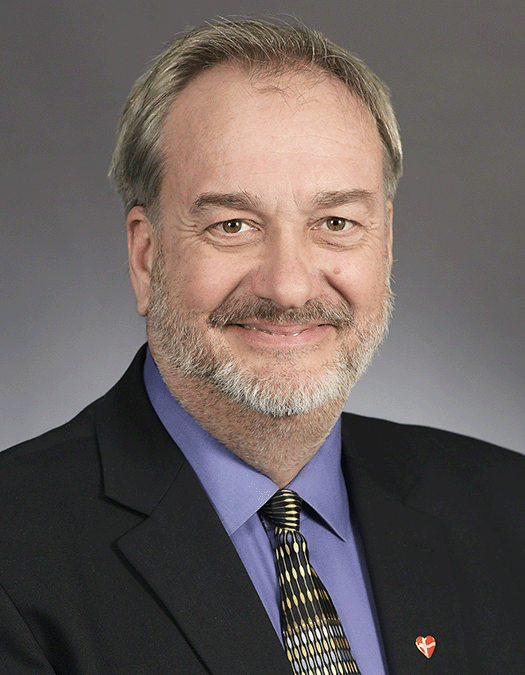
Rep. Rick Hansen
Sponsored bills
Maddy summaryHF 2138 appropriates $3 million from state bonds to fund capital improvements at Heritage Village Park in Inver Grove Heights. The bill directs the state to issue bonds and provide a grant to the city for designing, constructing, and equipping specific park upgrades, including an amphitheater, picnic shelters, restrooms, parking expansion, landscaping, and related amenities. This funding directly affects the city of Inver Grove Heights by enabling these physical park enhancements. The bill establishes the mechanism for financing through state bond sales under Minnesota law, with the appropriation effective upon enactment.
Maddy summaryHF 2144 appropriates unspecified funds from the general fund for the Family Homeless Prevention and Assistance Program under Minnesota Statutes § 462A.204, for fiscal years 2026 and 2027. The bill directly affects families in Minnesota at risk of homelessness by providing funding for prevention and assistance services. Key provisions include directing the Housing Finance Agency to administer the program using these allocated funds. This is a funding bill with no new policy requirements, solely authorizing budget resources for an existing state program.
Maddy summaryHF 2012 modifies Minnesota's Board of Animal Health by increasing its membership from 7 to 11 members. The bill specifies new composition requirements: 3 livestock producers, 1 tribal member with animal husbandry experience, 3 veterinarians (including one specializing in companion animals), 2 at-large members, 1 additional tribal member, and 8 regional members (with geographic balance). It also requires at least 2 public members not employed in agriculture or veterinary fields, and mandates gender/region balance in appointments. The changes take effect July 1, 2026, for all appointments after that date.
Maddy summaryHF 770 appropriates $30 million from state bond proceeds to fund specific agricultural loan programs administered by Minnesota's Rural Finance Authority. It directly affects Minnesota farmers by financing beginning farmer loans, seller-sponsored loans, agricultural improvement loans, and livestock expansion loans under Minnesota Statutes, chapter 41B. The bill authorizes the state to issue up to $50.05 million in bonds, with debt service repaid by the Authority, and prioritizes funding first for beginning farmers, then seller-sponsored loans, and finally agricultural improvement loans.
Maddy summaryHF 2011 modifies Minnesota's Green Acres tax deferment program to require a nutrient management plan for agricultural land in the southeast karst region (Dodge, Fillmore, Goodhue, Houston, Mower, Olmsted, Wabasha, and Winona counties) to qualify for tax deferment after January 1, 2027. Soil and water conservation districts in these counties must certify nutrient management plans to county assessors by May 1 annually. This change affects landowners in the specified counties who rely on the tax deferment for qualifying agricultural property. The requirement does not apply to land outside the southeast karst region or to other areas of the state.
Maddy summaryHF 1071 requires Minnesota local governments (counties and municipalities) to protect and plan for sand, gravel, and other aggregate resources in their land use decisions. It amends state laws to mandate that local comprehensive plans, zoning, and land use controls explicitly consider the protection and access to these resources, using data from the Minnesota Geological Survey. The bill appropriates $950,000 for mapping aggregate resources outside the metro area and updating reclamation guidance, plus $250,000 to update the metropolitan area's resource inventory, with technical assistance provided to local governments. These changes directly affect how communities plan for development and mining sites while ensuring resource availability.
Maddy summaryHF 1762 proposes adding a new constitutional amendment to Minnesota's state constitution. If approved by voters, it would guarantee all persons equal rights under state law and prohibit discrimination based on race, color, national origin, ancestry, disability, or sex - including protections for pregnancy decisions, gender identity, gender expression, and sexual orientation. The amendment would apply to all state actions and agencies, requiring any discriminatory state action to be the "least restrictive means" of achieving a "compelling governmental interest." The proposed amendment must be submitted to voters in the 2026 general election, with implementation starting January 1, 2027, if ratified.
Maddy summaryHF 726 imposes a 50% tax on the gross revenue from manufacturing or selling products containing PFAS (fluorinated chemicals) in Minnesota. It directly affects manufacturers and retailers with a presence in the state, requiring them to report monthly sales but not pay the tax immediately. Revenue collected funds a dedicated cleanup account for environmental remediation of PFAS contamination. The tax applies only to products where PFAS is deliberately added for a specific function, and funds are transferred annually to the cleanup account from the general fund. This bill creates a new tax mechanism to generate funding for PFAS cleanup efforts.
Maddy summaryHF 106 appropriates $750,000 from the general fund for fiscal year 2026 and another $750,000 for fiscal year 2027 to provide a grant to Neighbors, Inc. The bill directs these funds specifically for Neighbors, Inc. to deliver social services outreach, trainings, capacity building, support services, programming, and administrative support. This funding directly affects Neighbors, Inc. as the recipient organization and the communities they serve through these expanded services. The legislation creates a concrete, two-year financial commitment for these specific program activities.